
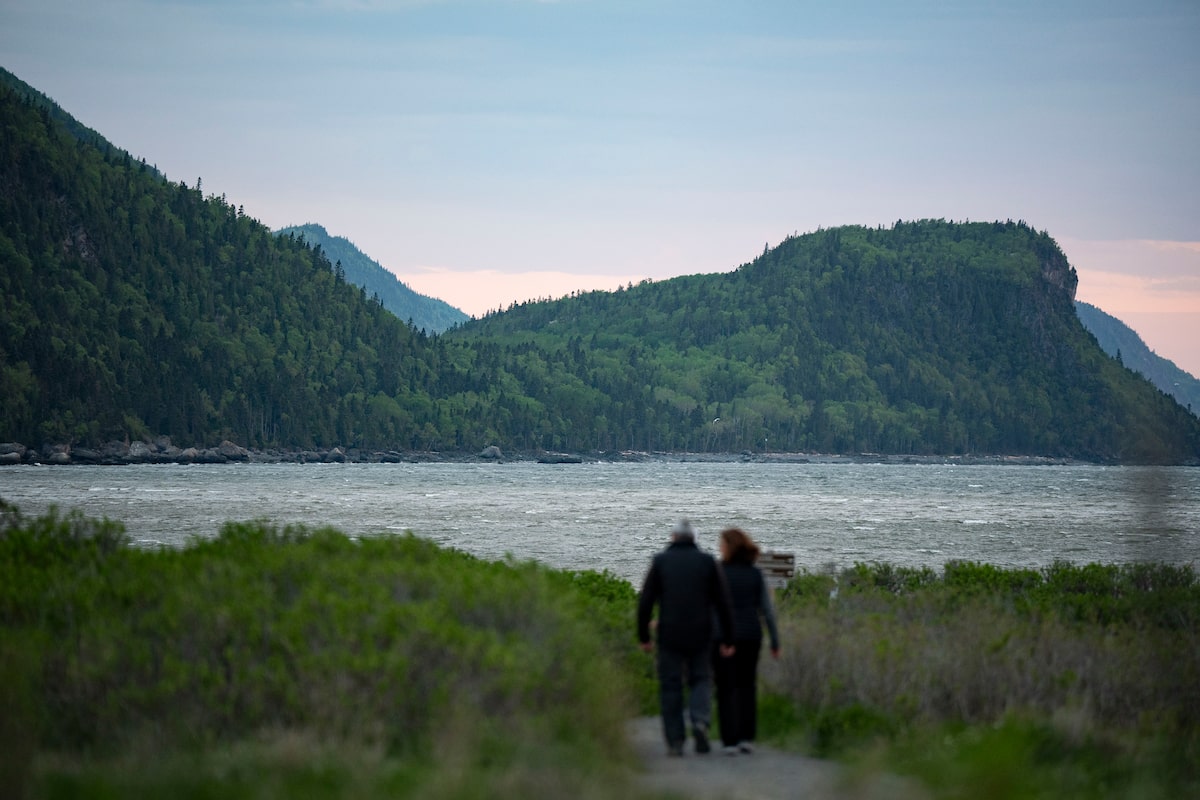
People walk in Bic National Park near Rimouski, Que., May, 2025.Christopher Katsarov/The Canadian Press
Canada released a $3.8-billion nature strategy on Tuesday, closing the gap left by a major conservation fund that expired the same day and laying out a path to nearly double the share of the country’s lands and waters under protection by the end of the decade.
“The beauty of Canada’s nature – from lakes and forests to mountains and coastlines – is central to our history, our identity and our way of life,” Prime Minister Mark Carney said at the announcement in Wakefield, Que.
Protecting 30 per cent of the country’s lands and waters by the end of the decade – a target known as 30×30 – is one of Canada’s most ambitious conservation commitments, stemming from a landmark international deal reached in Montreal in December, 2022: the Kunming-Montreal Global Biodiversity Framework.
Tuesday’s announcement came just as the Enhanced Nature Legacy fund – a $2.3-billion, five-year federal investment – was set to expire. As of December, 2024, Canada had conserved just 13.8 per cent of its land and fresh water and 15.5 per cent of its marine areas, well short of an interim 25-per-cent target for 2025. In November, the federal Auditor-General concluded Ottawa had not planned effectively to deliver 30×30.
Protected natural areas helped generate $11-billion in GDP, new research shows
The new plan, A Force of Nature: Canada’s Strategy to Protect Nature, maps a path to closing most of that gap, introducing measures across three pillars: “protecting nature” through new parks, marine protected areas and Indigenous-led conservation; “building Canada well” by integrating environmental data into infrastructure decision-making; and “valuing nature and mobilizing capital” through a new expert task force tasked with attracting private investment.
On land, the government said it will move terrestrial conservation from 14 per cent to 30 per cent by 2030, adding at least 1.6 million square kilometres – an area 1.7 times the size of British Columbia. It said it will achieve this through a combination of new federal protected areas such as national parks, finalizing existing projects, Project Finance for Permanence initiatives with Indigenous partners, and the use of expanded partnerships and innovative tools.
At sea, the strategy projects marine protection reaching 28 per cent by 2030 – with 1.8 percentage points still to close to reach the full 30×30 target.
Mr. Carney was direct about the limits of public funding. “We cannot do it with public money alone,” he said.
When pressed on whether encouraging private capital amounted to greenwashing, Secretary of State (Nature) Nathalie Provost acknowledged the tension. “Yes, this issue exists,” she said, adding the strategy must achieve three simultaneous goals: conservation, economic development and reconciliation.
Prime Minister Mark Carney and Environment and Climate Change Minister Julie Dabrusin, middle, and Nathalie Provost, Secretary of State (Nature), arrive to take part in an announcement in Wakefield, Que., Tuesday.Sean Kilpatrick/The Canadian Press
Andrew Van Iterson, manager of the Green Budget Coalition, a network of 21 leading Canadian environmental organizations, said the announcement provides a solid base for continued progress − but expressed concern about dependence on private-sector partners.
“We agree that private-sector funds provide an important opportunity, but we’re very wary and concerned that the government is counting on private-sector funds to play a bigger role than is likely,” he said in an interview. “Governments have the prime responsibility and the best ability to protect nature and biodiversity.”
Tuesday’s announcement also renewed the Indigenous Guardians program, whose funding was set to expire. It committed $231-million over five years, including a new Arctic Indigenous Guardians Program.
Indigenous program to protect Canadian wilderness aims to bolster First Nations’ economies
“Indigenous-led conservation and stewardship offer a great return on investment: They are proven to deliver concrete benefits for the land, for people and for Canada,” said Valérie Courtois, executive director of the Indigenous Leadership Initiative.
The strategy states: “There is no path to 30×30 without Indigenous leadership.”
Among the new protected areas is the Seal River Watershed National Park Reserve in Manitoba – habitat for what Mr. Carney called iconic Canadian species: polar bears and caribou. “It’s a good day to be a polar bear,” he said.
The strategy also advances the Wiinipaakw Indigenous Protected Area and National Marine Conservation Area in Eastern James Bay, co-developed with the Cree Nation.
The government also renewed the Canada Strong Pass for summer 2026, offering Canadians free access to national parks and marine conservation areas. In 2025, the pass helped drive a 13-per-cent increase in visits to Parks Canada sites.
Scrapping plans for Newfoundland conservation area is a blow to national goals, advocates say
New fisheries measures include $412.9-million over five years to restore vulnerable Pacific salmon populations, support sustainable fishing, combat illegal fishing and reduce pressures on at-risk stocks, and $81.7-million for Atlantic salmon habitat restoration across up to 10,000 square kilometres and monitoring in approximately 50 rivers.
“Balancing ecosystems is part of hunting and fishing,” Fisheries Minister Joanne Thompson said in an interview, adding that she is pleased to have “tangible resources” to encourage the growth of wild salmon populations.
The strategy also commits $15-million over three years to ghost gear removal, building on the 2,500 tonnes of lost, abandoned and discarded fishing gear retrieved from Canadian waters since 2020.
And it allocates $24.4-million to support ratification of the High Seas Treaty. Andrew McMaster, director of ocean policy for Fisheries and Oceans Canada, was in New York attending preparatory commission negotiations when the announcement came.
“It’s not just about what we are conserving domestically – that commitment to 30×30 also extends to the high seas, because the high seas is 70 per cent of the ocean’s surface,” he said in an interview.
Nature Canada called the investment “an impressive step” but said in a statement it looked forward to “seeing it translated into action on the ground.”