
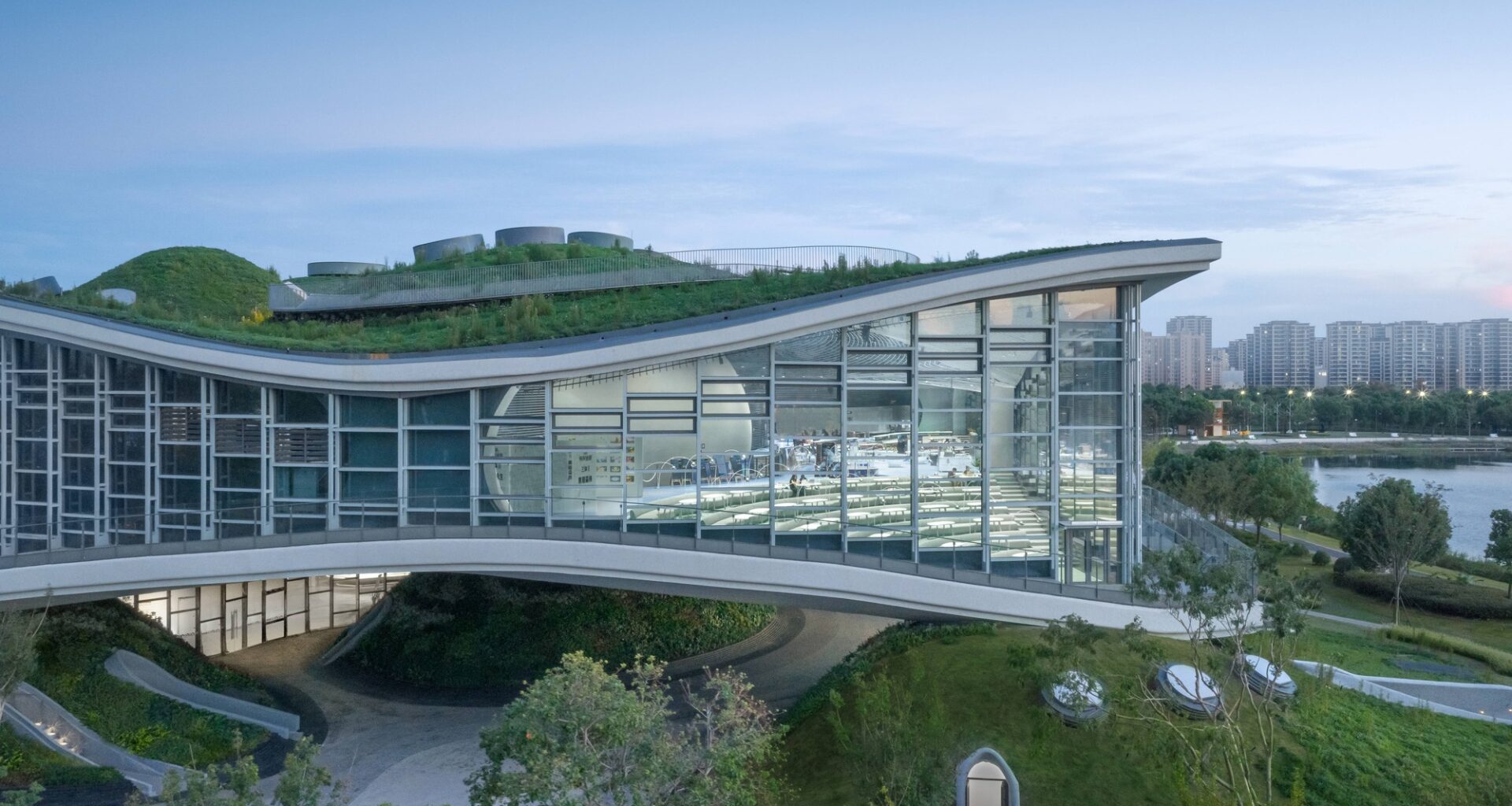
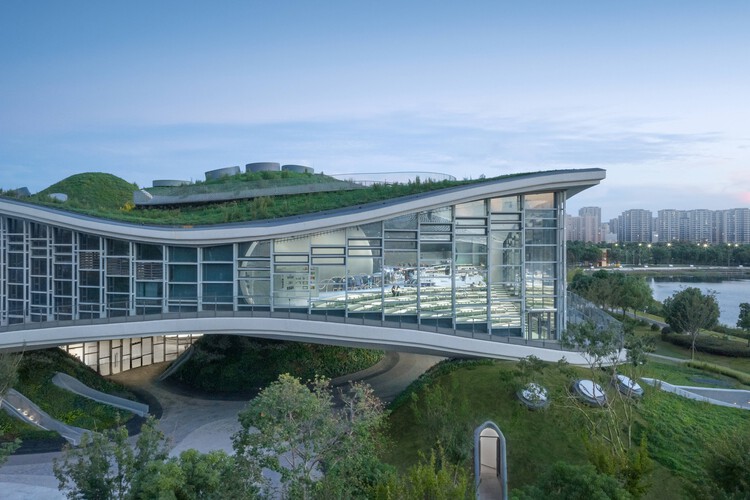
 Wave Cube’s supports and floatin structure. Image © Shengliang Su
Share
Or
https://www.archdaily.com/1040105/the-illusion-of-lightness-designing-civic-voids-for-public-life
In our current cities, urban density and rising land values often force a choice between large-scale civic buildings and open public space. Traditionally, plazas have been treated as areas surrounding a building’s footprint, but this strategy was modified when pilotis were introduced by the early 20th-century modernist movement. While the original intent was to create a sense of lightness that would allow circulation and light to flow beneath a structure, contemporary requirements for seismic loads, fire egress, and heavy occupancies render thin columns insufficient for the needs of current large-scale civic projects.
However, the pursuit of architectural lightness is not a strictly contemporary phenomenon. Following the modernist introduction of pilotis, several mid-century projects began experimenting with the illusion of suspension to achieve civic transparency. In 1953, the National Congress of Honduras in Tegucigalpa, designed by Mario Valenzuela, applied these principles to a legislative setting. The building consists of a solid assembly chamber elevated on a series of slender columns. Because the site sits on a terrace at the end of a sloping street, the resulting void does more than just provide circulation; it frames views of the city, creating the impression that the heavy legislative mass is lightly suspended above the urban fabric.
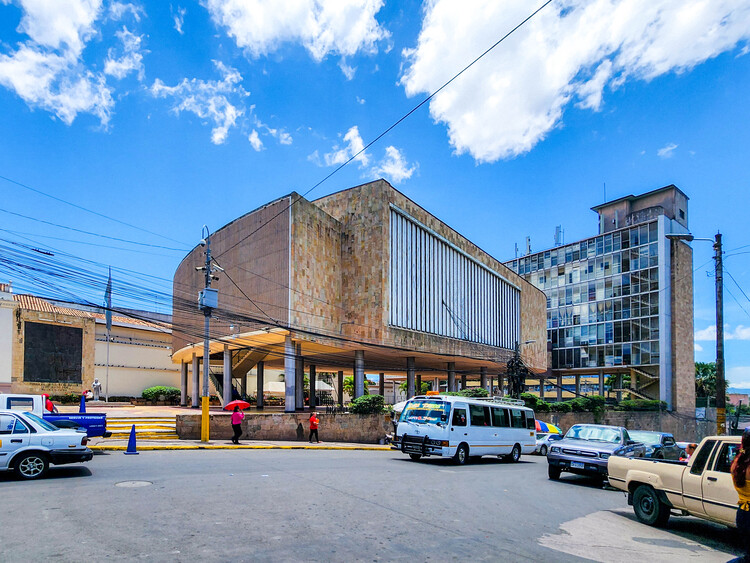 The National Congress of Honduras by Mario Valenzuela. Image © Moises Carrasco
In 1964, the National Museum of Anthropology and History in Mexico City, designed by Pedro Ramírez Vásquez, Jorge Campuzano, and Rafael Mijares, used a single structural element to define its central courtyard. A 52×82-meter canopy hangs from a single massive column. To intensify the feeling of lightness, the architects detached the perimeter of the canopy from the surrounding building volumes and integrated a circular waterfall around the central column. This water feature masks the structural connection, reinforcing the illusion that the ceiling is a weightless, hovering plane.
Related Article Why Are Some Houses Elevated off the Ground? 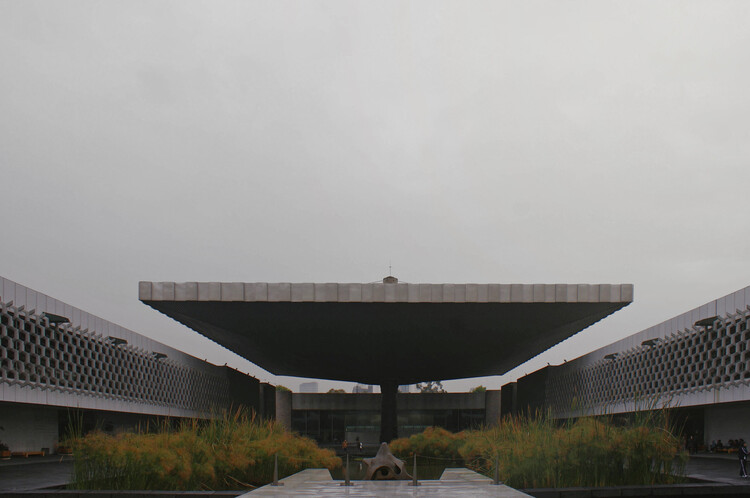 Museum of Anthropology in Mexico City. Image © Dan Gamboa Bohórquez
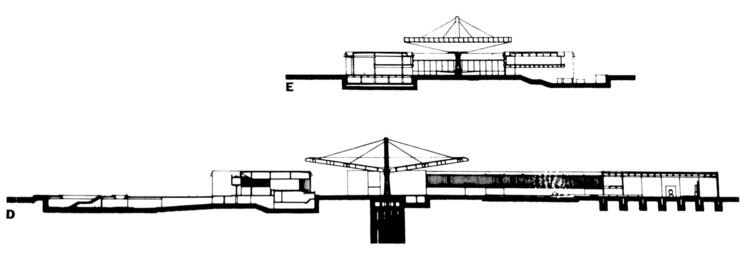 Museum of Anthropology in Mexico City sections. Image © ArchDaily
By 1970, this pursuit had evolved into more daring structural spans. The Brazil Pavilion in Osaka, designed by Paulo Mendes da Rocha, utilized a continuous concrete roof spanning 32.5 meters. Despite its massive weight, the structure was supported at only four points: a singular sculptural element and three columns concealed within earth mounds. The transition from these heavy mounds to the narrow “tips” of the supports created the perception that the expansive roof was floating.
 Model of the Brazil Pavillion in Osaka by Paulo Mendes da Rocha. Image © Arquivo Paulo Mendes da Rocha. Cortesia de Ruth Verde Zein
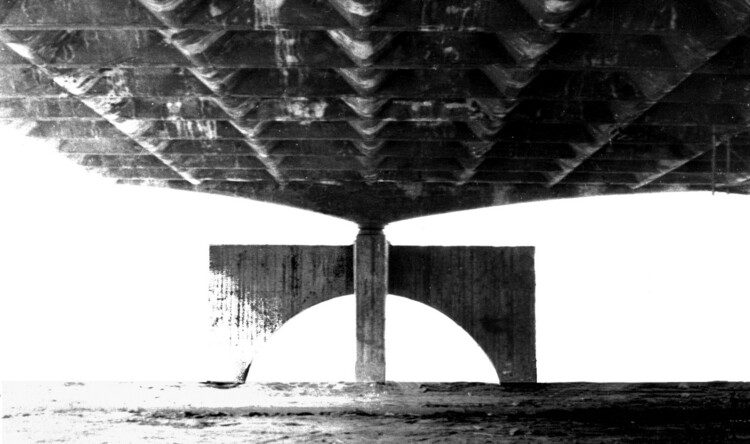 Sculptural support in the Brazil Pavillion in Osaka. Image © Arquivo Paulo Mendes da Rocha. Cortesia de Ruth Verde Zein
While these mid-century examples focused on the aesthetic and symbolic lightness of the canopy or the assembly hall, contemporary requirements for seismic loads and dense programming have transformed these “slender points” into the massive, functional supports seen in current projects. In architecture today, the strategy has shifted from the purely floating object to the inhabited support, where the structure itself must work harder to justify the void it creates. In that sense, a question arises: what remains beneath these elevated structures?
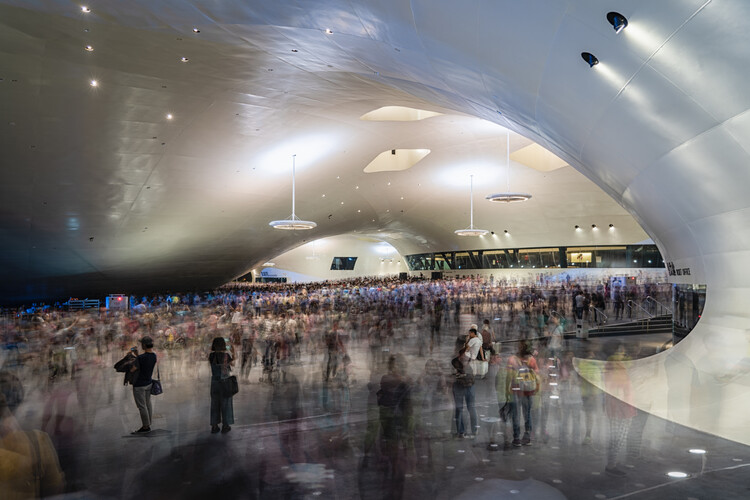 The canopy under the National Kaohsiung Center for the Arts. Image © Sytze Boonstra
The first thing to note is that, as a response to urban density, contemporary civic design seems to trend towards the idea that by lifting the building above ground, it is deliberately constructed as grounds for public life. To achieve this in large-scale projects, architects are increasingly using the illusion of levitating forms in their designs. While this implies a conceptual desire to echo modernist ideals, the vision of a floating building is grounded in the practical need for double-layer urbanism: the ability to provide interior square footage that adheres to construction norms and regulations, and to produce exterior sheltered space for the city on the same plot of land.
The first strategy that can be observed in current projects involves gathering the building’s load into a few large, discrete elements. The LAND Community Center by EID Architecture exemplifies this by resting the building on three hollow structural pillars rather than a continuous foundation. The building seems to hover over a plaza, with the bases formally giving the impression of a blended sweep, which, given the scale of the building above, makes the base perimeter barely touch the ground. However, these cores are big enough to hold emergency stairs and other service spaces. At the same time, the elevated structure also contributes to stimulating natural ventilation and creating thermal mass and shade during the extreme heat spikes throughout the summer in its location.
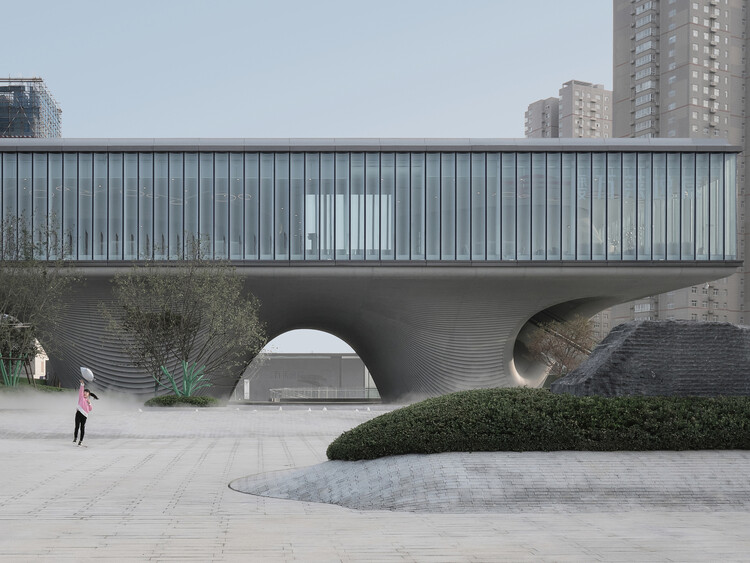 LAND Community Center by EID Architecture. Image © Lujing Architectural Photography
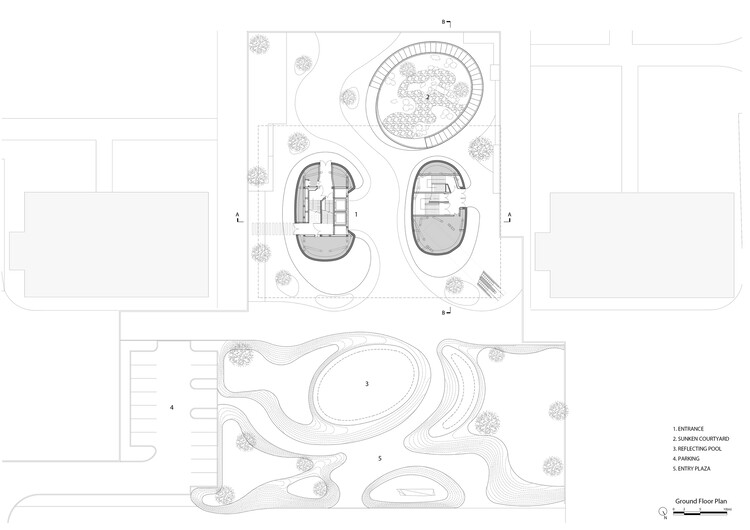 LAND Community Center Floorplan. Image Courtesy of EID Architecture
Similarly, the Wave Cube by Scenic Architecture uses sculptural, reinforced concrete supports thick enough to incorporate soil and vegetation. By limiting the contact points with the earth, the project maintains a continuous pedestrian path and allows the building to span over the land. The most interesting aspect here is that even though the building feels like it is floating, it is supported in eight concrete shells emerging from the ground, each one big enough to house spaces such as exhibition halls, cafes, bars, cultural and creative shops, and mechanical rooms These convergence points are divided into six that work as shear walls and two that work as structural cores that vertically penetrate the entire building, integrating the functions of structural support, vertical circulation, and MEP shafts.
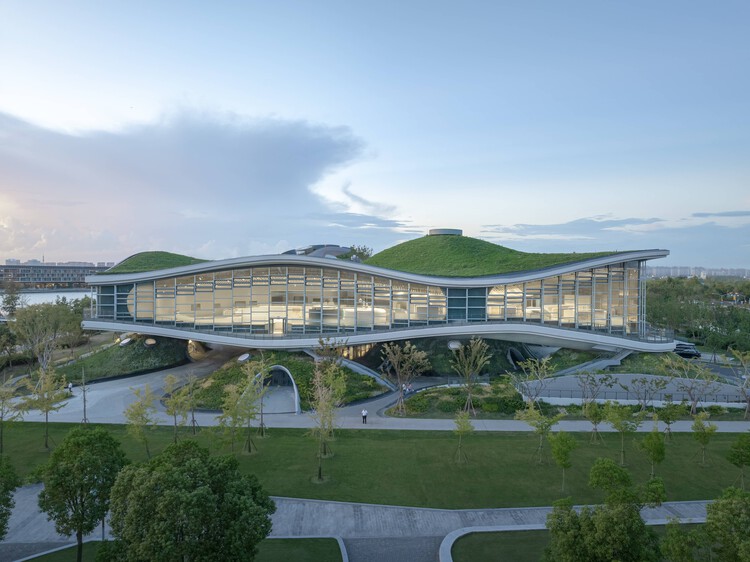 Wave Cube by Scenic Architecture Office. Image © Shengliang Su
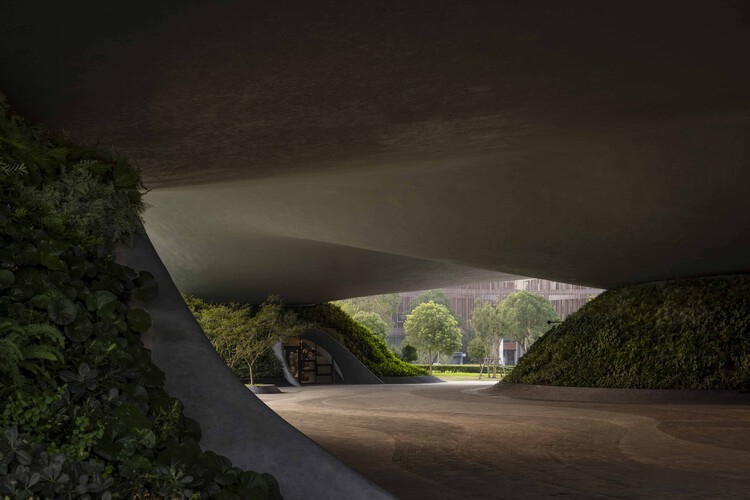 Underside of Wave Cube’s structure. Image © Guowei Liu
A second strategy makes use of large canopies. In the Qasr Al Hokm Metro Station by Snøhetta, the architects integrated a steel canopy with a shiny outer surface supported by one massive cone-shaped wall. The heavy infrastructure, including most of the coned-shaped concrete structure, platforms, and concourses, is buried, leaving only the reflective canopy above ground. This element acts as a point of orientation within the building, and also reflects indirect sunlight and city views downward from its mirror-like surface. In order to make this large structure seem like it was floating, the architects integrated long concentric ramps coming from the surface, gently sloping down into the center of the upper tip cone structure. This makes the canopy feel like it’s a thin floating sheet of stainless steel placed on three concrete supports. In reality, it is big enough to enclose mounted PV panels for the station’s energy production.
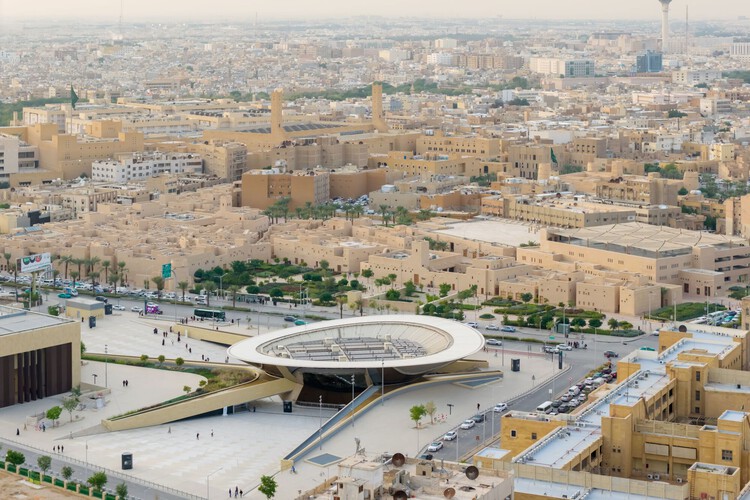 Qasr AlHokm Metro Station by Snøhetta. Image Courtesy of Snohetta
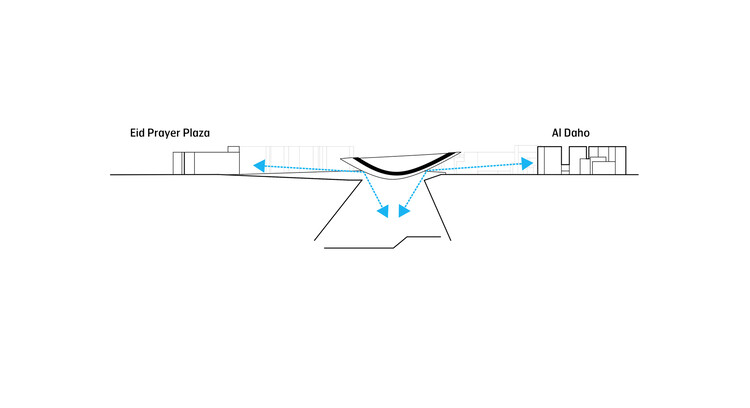 Qasr AlHokm Metro Station section. Image Courtesy of Snohetta
Another building with a similar concept is the National Kaohsiung Center for the Arts by Mecanoo in Taiwan. The design uses a vast, undulating canopy that spans between several supports to create a covered plaza. From far away, the building seems to be a light white sheet of metal, floating atop a few supports. In reality, each support is big enough to host parts of the building’s main program, like the playhouse, theater, recital hall, and concert hall. This is like having four different buildings covered by a single roof. The voids created between the program pods create a covered public space where more cultural activities can be held. The geometry of the underside is also designed to facilitate cross-ventilation to accelerate airflow and naturally cool the plaza without mechanical systems.
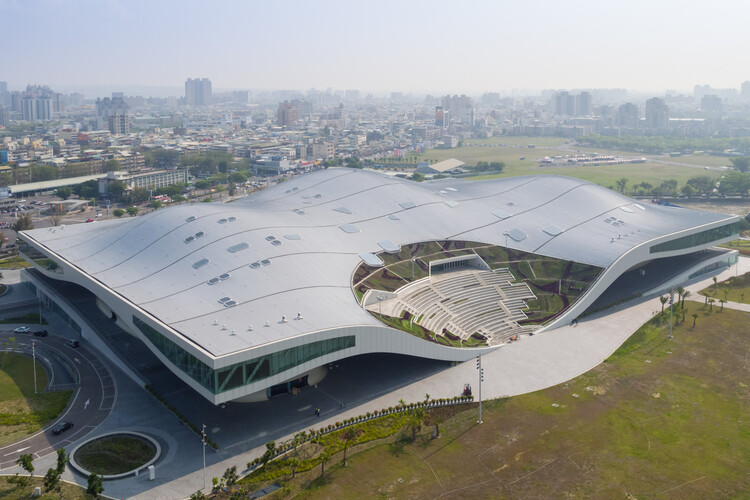 National Kaohsiung Center for the Arts by Mecanoo. Image Courtesy of Mecanoo
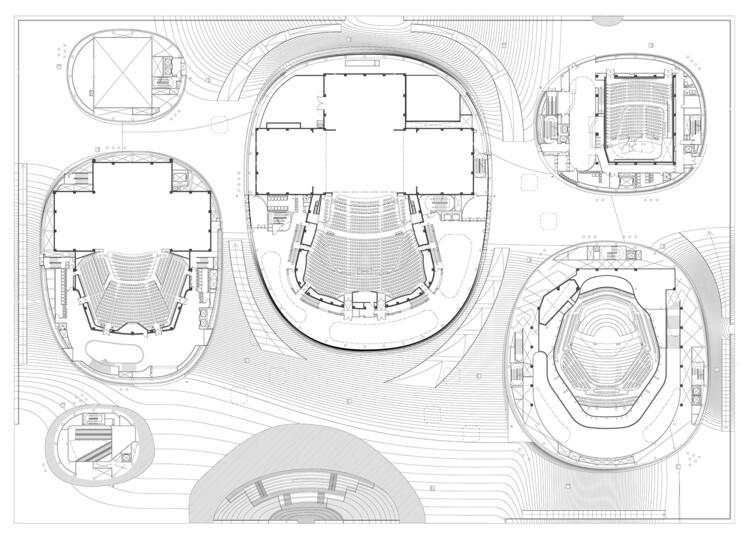 National Kaohsiung Center for the Arts floorplan. Image Courtesy of Mecanoo
Overall, these projects show how weight in architectural design is not always literal. Sometimes, depending on how the architects coordinate the building’s structural contact with the ground, buildings can give the illusion of lightness even though their scale is massive. At the same time, these strategies promote civic spaces to function on two levels simultaneously: the programmatic interior and the public landscape at grade. In this way, the public void is the central functional element, providing the shade, shelter, and permeability required for contemporary high-density urban life.
This article is part of the ArchDaily Topic: Light, Lighter, Lightest: Redefining How Architecture Touches the Earth, proudly presented by Vitrocsa, the original minimalist windows since 1992.
Vitrocsa designed the original minimalist window systems, a unique range of solutions, dedicated to the frameless window boasting the narrowest sightline barriers in the world. Manufactured in line with the renowned Swiss Made tradition for 30 years, Vitrocsa’s systems “are the product of unrivaled expertise and a constant quest for innovation, enabling us to meet the most ambitious architectural visions.”
Every month we explore a topic in-depth through articles, interviews, news, and architecture projects. We invite you to learn more about our ArchDaily Topics. And, as always, at ArchDaily we welcome the contributions of our readers; if you want to submit an article or project, contact us.