
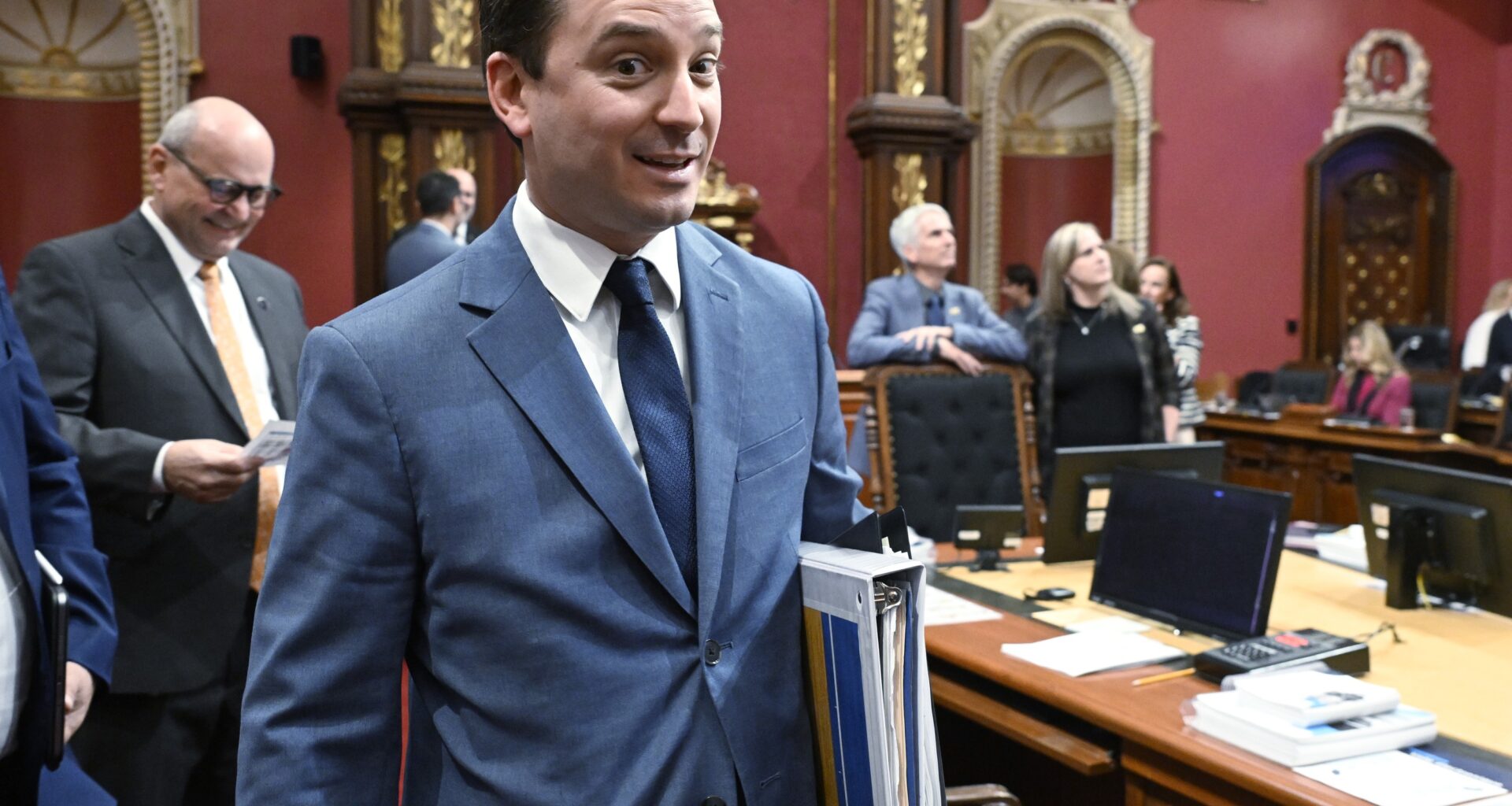
Quebec’s proposed constitution will explicitly recognize “the existence of the anglophone community and the fact that it enjoys enshrined rights,” Justice Minister Simon Jolin-Barrette announced Wednesday.
The change is in response to anglophone community groups who complained they were left out of his original plan, known as Bill 1.
“I heard them. They told us: ‘Let us be recognized in Bill 1.’ And that’s what I’m doing,” he said.
Jolin-Barrette described the change to the proposed constitution’s preamble as a gesture toward the English community “to ensure their rights are recognized.”
In the original draft, Bill 1 only mentioned anglophone Quebecers in passing. The preamble simply said Quebec would be “respectful of the institutions of the English-speaking community.”
A reporter asked if specific rights would be mentioned, such as the right to health and social services. Jolin-Barrette said that’s something that may be discussed by the National Assembly committee studying the plan.
During hearings into the bill in February, Sylvia Martin-Laforge, the director general of the anglophone rights group TALQ, complained the bill made “no mention of Quebec’s English-speaking community’s citizens (and) only a brief, tangential reference to its ‘institutions.’”
She said the Coalition Avenir Québec government has not shown that it recognizes “we are a minority — not the best protected, not the wealthiest, and not all living in Westmount. We are a credible, reasonable minority that is both vulnerable and contributes (to Quebec society) at the same time.”
Jolin-Barrette also announced that he will remove from the bill another key irritant for the anglophone community.
He said he will eliminate a provision, known as Article 5, that would have barred public institutions from using public funds to challenge some key Quebec laws.
Jolin-Barrette had previously criticized the English Montreal School Board for using taxpayer money to finance court challenges of language and secularism laws and the province’s plan to abolish English-language school boards.
In February, Jolin-Barrette and EMSB chair Joe Ortona had a testy exchange at public hearings of a National Assembly committee studying the bill.
Ortona urged the government to remove the provision banning publicly funded court challenges.
On Wednesday, Jolin-Barrette was asked why he is removing the clause.
“For sure, not because of Mr. Ortona,” he replied.
He said he made the change because he wants the constitution to move forward.
“If there are some irritants that I can take off the table, I’ll do it,” Jolin-Barrette said. “The constitution is more important than Article 5.”
The EMSB wasn’t the only anglophone institution to challenge laws with public funds. McGill and Concordia did so in their legal fight against a tuition overhaul that disproportionately affected them.
Several groups criticized the CAQ’s attempt to limit the judicial recourse of publicly funded organizations.
The Barreau du Québec, which regulates the province’s lawyers, had urged the CAQ to remove the provision, calling Bill 1 part of a “drift toward authoritarianism” and a sharp weakening of society’s checks and balances.
Jolin-Barrette also outlined several other changes to the bill.
They include:
A change that will make it clear that “there is no hierarchy between collective rights and human rights and freedoms.”
The addition of a collective right to the environment.
A new section on French-language protection.
The protection of university academic freedom.
Jolin-Barrette’s proposal has been heavily criticized.
In December, more than 300 organizations urged Premier François Legault to scrap the plan, warning that Bill 1 undermines fundamental rights, gives the government unchecked authority and threatens minority communities.
The Liberals, the Parti Québécois and Québec solidaire have previously said they would vote against the proposed constitution. Only the Conservative Party of Quebec is in favour.
This report will be updated.
Editor’s Picks