
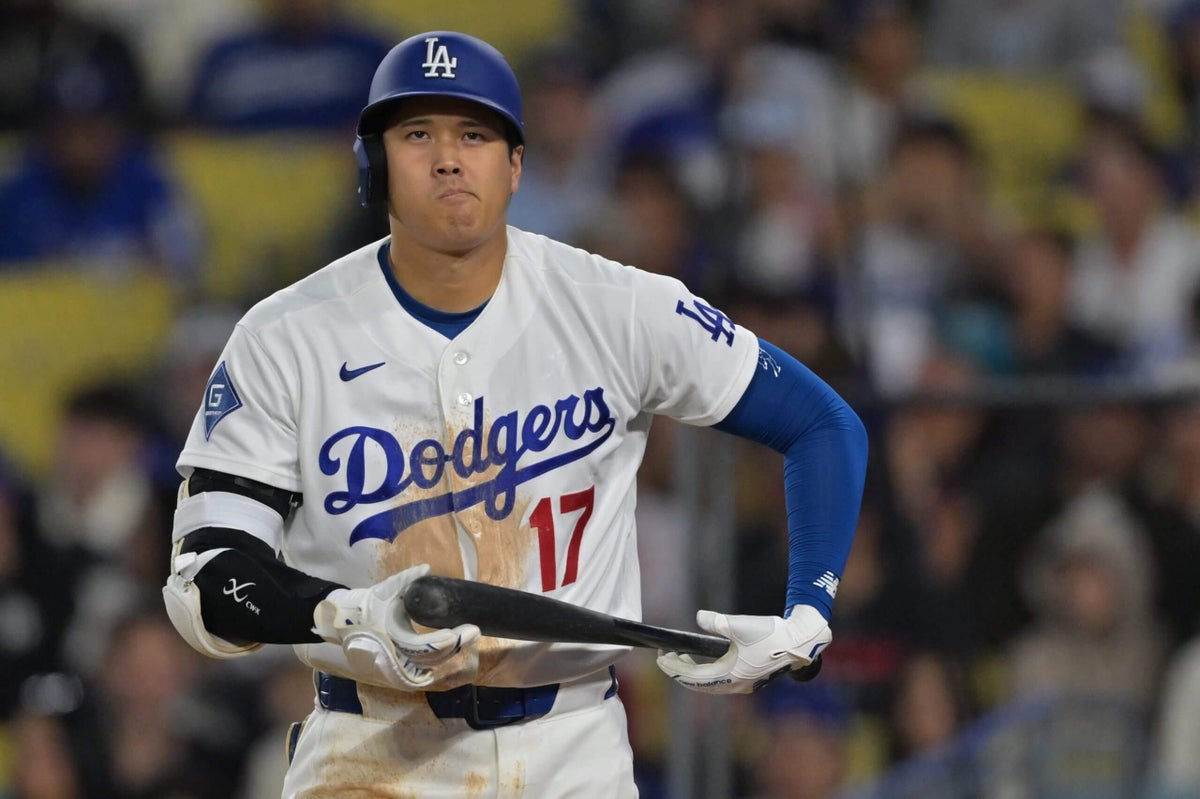
LOS ANGELES — Five games were hardly enough to fret over, but it certainly registered for Dave Roberts when the Los Angeles Dodgers manager checked his text messages Wednesday morning and saw a message from the club’s hitting coaches. The bats have not gotten going, starting at the top.
The coaches told Roberts that Shohei Ohtani, the leadoff hitter, was veering from his custom. The four-time MVP hardly hits on the field. It caused a stir last October when, amid a slump, he hit on the field at Dodger Stadium for the first time since signing in Los Angeles; it proved memorable when, two days later, he slugged three home runs and struck out 10 on the mound over six scoreless innings in the defining performance of his career.
So there Ohtani was Wednesday afternoon, bat in hand. Roberts had canceled batting practice for the rest of the Dodgers, but Ohtani wanted to hit. His first handful of games at the plate were not to his satisfaction. He had not recorded an extra-base hit while spearheading an offense that hadn’t scored more than five runs in a game since Opening Day. The Arizona Diamondbacks and Cleveland Guardians, to their credit, have pitched him carefully. Still, the start ate at him.
“I’ve been able to get on base, and that’s a good thing,” Ohtani said through interpreter Will Ireton on Tuesday night. “But on pitches that I should be making impact, I’m not quite able to do that to the extent that I should be able to. That’s the part that I’m not quite happy about.”
Whatever dissatisfaction Ohtani felt, he didn’t take it into the cage with him. He joked with Dodgers officials before stepping in against team hitting strategist J.T. Watkins, whom Ohtani in particular enjoys launching off. The ensuing five rounds of batting practice turned into a spectacle as he peppered baseballs into the stands, so much so that several Guardians stopped their pregame preparations to observe. Ohtani fiddled with his swing, mixing in a leg kick one round before switching to his typical toe-tap the next.
“I think he was looking for some feel,” Roberts said.
The toe-tap prevailed when he stepped in against Gavin Williams on Wednesday, drawing a walk the first time he came up to the plate. There have been plenty of those — his seven are tied for third in the majors. Ohtani still hasn’t done damage to the pitches he normally does. When Williams finally looked vulnerable, putting two on with no one out and Cleveland leading 2-0, he left Ohtani a first-pitch cutter over the heart of the plate.
Ohtani pounded it into the dirt, starting one of three double plays Williams earned on the night.
When Ohtani came up again in the eighth with two runners on, he struck out on three straight Erik Sabrowski curveballs.
The Dodgers lost 4-1. Ohtani went hitless. After the eighth-inning strikeout, Ohtani was shaking his right wrist. Roberts noticed that, too, though postgame he said he was unsure if the wrist was bothering Ohtani.
Ohtani is not alone in feeling off at the plate. It’s a six-game stretch that represents 3.7 percent of the season, but none of the Dodgers’ stars are hitting that well. Particularly, the top four hitters. Ohtani is hitting .167. Kyle Tucker is hitting .174. Mookie Betts is hitting 136. Freddie Freeman, a victim of plenty of fly balls that died at the warning track this week, finally cleared the fence with the Dodgers down to their final out Wednesday. He’s hitting .208. Add in Will Smith, and the top five hitters in the Dodgers lineup went 1-for-18 in the loss.
“It’s obviously a very talented lineup, and right now, it just seems like a lot of guys are in-between,” Roberts said.
Opposing starters have stifled them — the Dodgers have managed to score first just once through six games. After grinding down the Diamondbacks, their approach deviated against Cleveland, striking out 29 times while walking just six times over the three games. The amount of swing-and-miss, Roberts said, was “a little concerning.”
“I think you can talk to every single one of us and say we wish we had a better offensive first week,” Freeman said. “But I think our offense is inevitable.”
Maybe it is. The Dodgers dropped the series to Cleveland, but are 4-2 to start the season as they try to get their best hitters going.
When he issued his lineup Saturday, Roberts wanted to make clear: He is not creating a platoon at third base. Max Muncy remains the Dodgers’ primary option there. The organization is trying to be mindful of the 35-year-old’s recent injury history. And when he does get a day off, like Saturday when Santiago Espinal started at third, it’ll largely be against a left-handed starter.
This has become the norm in recent seasons. Muncy, for his part, is looking to keep those days to a minimum — and not just with his health. Hitting left-handed pitching didn’t used to be such an issue for him, as he hit .263 with a 140 wRC+ against lefties from 2018 through 2021, when he tore up his left (non-throwing) elbow on a freak play at first base on the final day of the regular season. From 2022 through 2025, he hit just .165 with an 84 wRC+ against southpaws.
Muncy knows this. He’s still trying to increase those numbers to make the conversation more difficult.
“After the elbow injury, I was atrocious against lefties,” Muncy told The Athletic. “I’m not blind to that, and ever since then, I just didn’t get consistent playing time off lefties. That’s something that we had many conversations about, and I was okay with it.
“I know (the numbers are) not good, but at the same time I know I can hit lefties.”
It helps that he’s been able to tap into a part of his swing that hasn’t been the same since his elbow injury. Muncy damaged the ulnar collateral ligament in that elbow but never underwent what essentially would have been a Tommy John surgery to repair it. That limited his range of motion and inhibited his ability to, in his words, “get inside the baseball.”
The resulting adjustments and compensations in his swing made it difficult to do much other than pull the baseball — he pulled 53.2 percent of batted balls after the injury, compared to 35.3 percent before it. After being a complete enough hitter early in his Dodgers tenure to log MVP votes, he’s had to remake himself as a slugger.
“I had some pretty successful years being able to do that,” Muncy said, “but I just felt like I lost the pure hitter that I used to be early in my career.”
Muncy thinks there’s more in there. So does Roberts, who several times in recent seasons has publicly yearned for Muncy to be a more complete hitter. Muncy thinks he can do that better. He doesn’t think his elbow is an issue anymore, finally. He believes he’s finally past the nagging oblique issues that have cost him time over each of the last two seasons.
If Muncy was looking to show something on both counts, he did Tuesday night. He was ready against Guardians left-hander Kolby Allard, and unloaded for a home run when he saw a center-cut sinker at 90.2 mph. That was validation after a spring when he felt confident in where his swing was. Anything would have been better than last year: He didn’t hit his first home run in 2025 until April 30.
At the end of a disastrous spring for Alex Freeland, hitting coach Robert Van Scoyoc had a ridiculous suggestion. Freeland had won the Dodgers’ second-base platoon gig despite his ugly spring numbers. He wound up hitting .125 in camp, and his swing never felt that good. His hands never did what he wanted them to. While he drew walks, he couldn’t hit the ball as hard as he should. With his hands feeling tight to his body in the cage last Monday, Freeland gave himself an exaggerated cue.
He held his hands far out in front of him, way further than he ever has.
Van Scoyoc stopped him and told him to try that before he swung. It felt better.
So Freeland took it into his first start of the year Friday. He took on a pair of two-strike pitches in his first at-bat before drilling a home run to right field. In the eighth inning, he scorched a double into the gap. Given his spring and the consternation around the Dodgers’ choice to have him open with the club, it was much-needed.
He’s adopted massive changes in the past in the organization, including dropping his leg kick to jump-start his time in the minor leagues.
Still, it was different.
“It’s super drastic,” Freeland told The Athletic. “The biggest change I’ve ever made.”
Freeland is willing to let this ride.
“We’re going to keep on working on it,” Freeland said. “Because if it worked that quick, it’s got to be good, right?”