
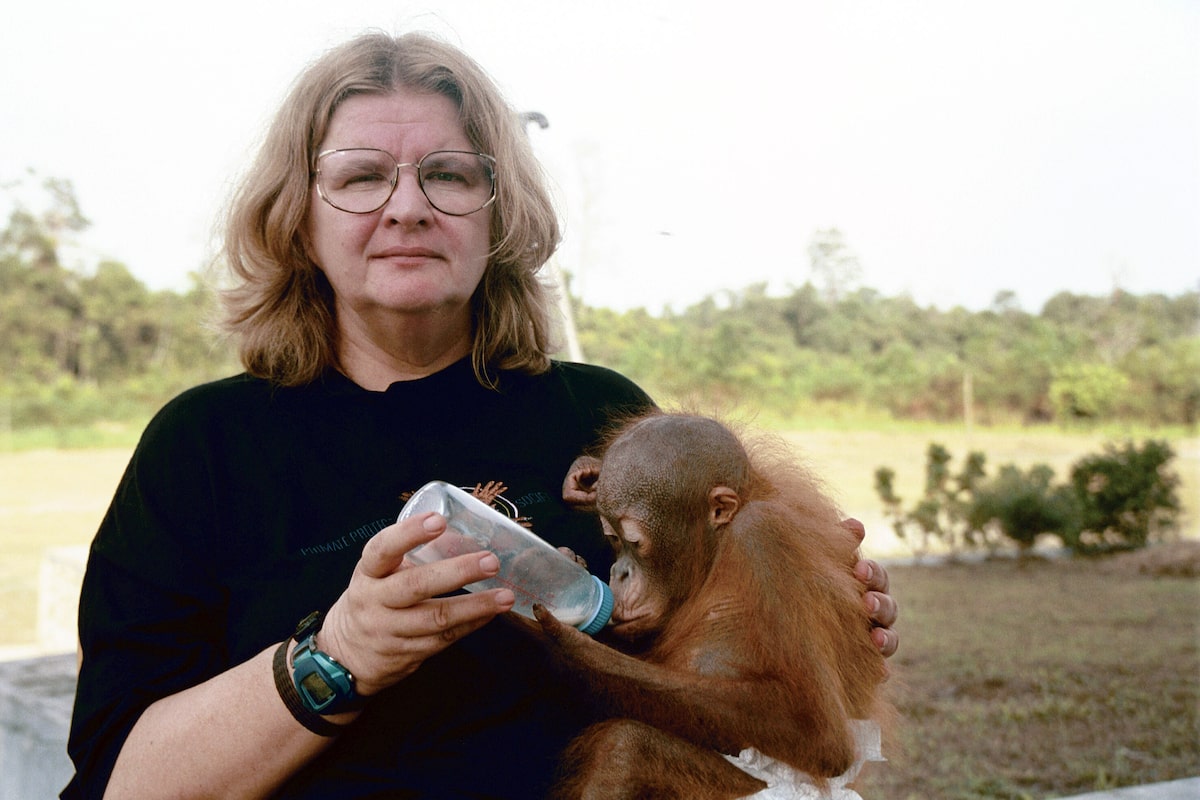
Dr. Biruté Galdikas holds an orphaned orangutan on the grounds of the Orangutan Foundation International Care Center in Borneo, Indonesia, in 2000.Alex Pitt/ZUMAPRESS.com/Reuters
In the early 1970s, it was not unusual to spot a twentysomething Biruté Galdikas trekking through the forests of Borneo with an orphaned infant orangutan strapped to her back. She was collecting scientific data on wild orangutans. Over the next five decades, Dr. Galdikas transformed our scientific understanding of Asia’s only great ape and became one of the world’s leading voices for the protection of this primate, now classified as Critically Endangered.
Dr. Galdikas died on March 24 in Los Angeles after a battle with lung cancer. She was 79.
When Dr. Galdikas dreamed of studying wild orangutans, she had pictured herself frolicking through a lush tropical paradise. Instead, when she arrived in Borneo in 1971, she found a swampy, leech-filled forest. In a post on Orangutan International Australia’s website, Dr. Galdikas remembered “the sweat pouring down through my clothes, the exhaustion of 16-hour days wading through deep, dark, acidic water in the omnipresent peat swamps, the illnesses, the hunger and the thirst.”
Dr. Galdikas died on March 24 in Los Angeles after a battle with lung cancer at the age of 79.Supplied
This was Camp Leakey, where Dr. Galdikas set out to follow the 200-pound, tree-dwelling orangutans in hopes of better understanding human evolution. Despite their size, the apes moved silently through the dense, dark canopy, often 30 metres above her head.
Primatologist Dr. Jane Goodall once spoke of the extraordinary challenges Dr. Galdikas faced. In Sy Montgomery’s 2009 book Walking with the Great Apes, Dr. Goodall observed: “The orangutan is the hardest of the three great apes to study. It takes Biruté a year to gather information and to see behaviours I might see in one lucky day.”
Yet, Dr. Galdikas persisted. She sensed something special about this place, where she would launch what Orangutan Foundation International heralds as “the longest individually led study on a single species.”
“She was an infinitely curious person,” says Ruth Linsky, a PhD candidate at Simon Fraser University. Now the secretary of the board for Canada’s branch of Orangutan Foundation International, Ms. Linsky was mentored by Dr. Galdikas, and has worked at Camp Leakey since 2010. “I’m certain that curiosity is what drove her to be able to do the research that she did. But the conservation work is just so immediate and so urgent.”
Globe readers remember Jane Goodall and the power of kindness
Dr. Galdikas recognized this urgency during her first weeks in Borneo when she discovered an infant male orangutan being kept in a wooden crate as a pet. Dr. Galdikas persuaded the infant’s captor to surrender the animal in exchange for reimbursement for the milk and bananas he had so far fed it. This marked the beginning of decades of hands-on rehabilitation efforts she undertook alongside her research.
Debra Erickson, co-founder and executive director of the conservation non-profit Wildlife Madagascar, was the executive director of Orangutan Foundation International from 2002 to 2005, where she worked in the field at Camp Leakey.
“I recall her holding an orphan and explaining that the infant had recently lost its mother,” Ms. Erickson says. “I was initially dismissive, but the expression on that baby orangutan’s face revealed unmistakable, gut-wrenching grief. It was a moment that reshaped how I view the emotional lives of animals.”
Dr. Galdikas with fellow primatologist Jane Goodall.Daniela&Catalin Mitrache/Supplied
In a talk at the University of British Columbia in 2014, Dr. Galdikas reminded the audience of our close genetic relationship to the orangutans: “When you look into the eyes of these creatures, you are looking into eyes that resemble human eyes; the eyes that gaze back at you reflect your own.”
Biruté Mary Galdikas was born in Wiesbaden, Germany, on May 10, 1946, to Lithuanian parents, Filomena and Antanas, who fled their homeland after it was occupied by Soviet forces in 1940. Her parents met in 1945 at a dance in a refugee camp near Standal, Norway. As the family travelled west, pushing carts filled with their belongings toward the American-occupied sector of Germany, they paused in Oebisfelde, where Filomena and Antanas married.
After Biruté was born, the family immigrated to Canada, where her father worked in the gold and copper mines in Quebec. Her brother, Vytas Anthony, was born in Quebec, and the family moved to Toronto, where her sister, Aldona, and another brother, Al, were born. Lithuanian was Biruté’s first language, and she later recalled starting kindergarten in Canada, unable to understand a word of English.
The Editorial Board: An evolution in how we think about how animals think
Her family found a strong Baltic community in diverse Toronto, and Biruté attended Lithuanian school every Saturday until Grade 9. She credited her Lithuanian upbringing and its emphasis on education with shaping her ambition to pursue a PhD.
As a child, she checked out a copy of Curious George from the library and became fascinated by the Man in the Yellow Hat, who travelled to the jungle and rescued the orphaned ape, George. At six years old, she decided she too would become an explorer.
The family moved to Vancouver and then Los Angeles, where she attended the University of California, Los Angeles. She earned three consecutive degrees there: her bachelor’s degree in psychology and zoology in 1966, her master’s degree in anthropology in 1969, and her PhD in biological anthropology in 1978.
She attended a lecture in 1969 by famous archeologist and anthropologist Dr. Louis Leakey that would change her life.
Inspired by his stories about Dr. Goodall’s work with chimpanzees and Dian Fossey’s studies of mountain gorillas, she boldly approached Dr. Leakey and proposed becoming the first to conduct a long-term study of the least-known of the great apes: the orangutans. Dr. Leakey recognized a spark in this young woman and agreed to sponsor her on this quest.
Dr. Galdikas was the last surviving member of Leakey’s “Trimates,” the nickname given to Dr. Galdikas, Dr. Goodall and Dr. Fossey, whose pioneering work transformed our understanding of the great apes and inspired generations of scientists, including many women.
Dr. Galdikas, right, was the last surviving member of the ‘Trimates,’ the nickname given to Dr. Galdikas, Dr. Goodall, centre, and Dr. Dian Fossey.Orangutan Foundation International/Supplied
Some of Dr. Galdikas’s key scientific discoveries included the diversity of the orangutans’ diet – they consume more than 400 types of food. Also, she found that they have the longest birth interval of any mammal, with mothers caring for infants for up to seven years.
“It was her passion for orangutan conservation and research that paved the way for me, my Indonesian colleagues, and so many others to study wild orangutans,” says Dr. Erin Vogel, a professor in the department of anthropology and director of the Center for Human Evolutionary Studies at Rutgers University. “Her groundbreaking discoveries revealed just how unique and vulnerable these apes are.”
Dr. Galdikas balanced field science with rehabilitation, setting up the first rehabilitation and release program in Kalimantan, the Indonesian portion of Borneo, in response to the pet trade. She founded Orangutan International in 1986 and spent as much time as possible in Borneo.
Dr. Galdikas’s drive seemed to have no limits.
“There was never downtime,” recalls Dr. Michael Reid, who was mentored by Dr. Galdikas, worked at Camp Leakey in 2002 and 2003, and has since earned his PhD in biological anthropology from the University of Toronto.
“There were days when we’d be going to do a release [of a rehabilitated orangutan], and things would start at eight in the morning, and we’d get back at midnight. She barely slept.”
Dr. Galdikas at her office at Simon Fraser University in Burnaby, B.C., in 2006.Lyle Stafford/The Globe and Mail
After witnessing habitat loss from logging, agriculture and fire, Dr. Galdikas recognized the importance of a protected habitat for the survival of orangutans, spearheading the creation of Tanjung Puting National Park in the south of Borneo. Orangutan International describes Tanjung Puting as “the largest and most diverse protected example of extensive coastal tropical heath and peat swamp forest” where the “largest wild orangutan population in the world” is found.
“Everything around Tanjung Puting is gone,” says Ms. Linsky. “If she weren’t there, and if people from all over the world didn’t come to see what she was doing, that whole forest would be gone for sure. And that population of orangutans would be gone, too.”
Georgianne Irvine, Dr. Galdikas’s long-time friend and colleague – director of historical affairs at the San Diego Zoo Wildlife Alliance – recalls one memorable visit to Camp Leakey. Dr. Galdikas had learned of illegal logging in the park. She mobilized, setting out on an impromptu two-day trek to find the loggers.
When they eventually found the loggers, Dr. Galdikas didn’t hesitate.
“In a very calm voice, she told them that they were in a national park, that logging was illegal, and that they had to leave,” remembers Ms. Irvine.
Much of Dr. Galdikas’s success can be attributed to her unique ability to garner the respect of the Indonesian government and communities. “Her Indonesian was flawless,” Dr. Reid says. He recalls a meeting with the forestry department where Dr. Galdikas recognized the person in charge from when she was a child. “They started reminiscing. … You mentioned her name to the government officials, and people knew who she was.”
“She was given an award directly from the hands of President Suharto,” said Ms. Linsky, referring to Indonesia’s Kalpataru Award for environmental leadership and stewardship, which Dr. Galdikas received in 1997.
She would go on to be recognized by the Tyler Prize for Environmental Achievement, the Explorer’s Medal and Indonesia’s Satya Lencana award for leadership in social development. She was also named an officer of the Order of Canada.
Dr. Galdikas carries an orangutan named Isabel before releasing her into the wild at Tanjung Puting National Park on Borneo Island, Indonesia, in 2008.Irwin Fedriansyah/The Associated Press
Since the 1970s, Dr. Galdikas served as a professor at Universitas Nasional in Jakarta, and in 1981 also joined Simon Fraser University in British Columbia, where she mentored hundreds of students. Both Dr. Reid and Ms. Linsky took Dr. Galdikas’s undergraduate course at Simon Fraser, and both remember her wealth of knowledge and the stories she would tell.
“I would have one side of my notes that were the notes that she wrote on the projector, and then the other side of my notebook was all the things that she just said and talked about in between,” Ms. Linsky says. “Like all the stories and all the side stories and all of the knowledge and bits of facts and everything that she was so full of.”
Dr. Galdikas leaves her children, Binti Brindamore, Frederick Bohap Galdikas and Jane Galdikas, and six grandchildren. Her son, Frederick, will continue her conservation efforts through Orangutan Foundation International in Los Angeles and Indonesia. As her final wish, Dr. Galdikas will be buried in Borneo beside her late husband, Pak Bohap bin Jalan, an Indigenous Dayak elder, near the rain forest that defined her life’s work.
“In remembering her, we honour not just a scientist, but a guardian of the forest,” says Dr. Vogel. “We are reminded that her work must continue, as orangutans remain Critically Endangered and their future depends on all of us.”
Dr. Keriann McGoogan is a primatologist and the author of Sisters of the Jungle: The Trailblazing Women Who Shaped the Study of Wild Primates.
You can find more obituaries from The Globe and Mail here.
To submit a memory about someone we have recently profiled on the Obituaries page, e-mail us at obit@globeandmail.com.