
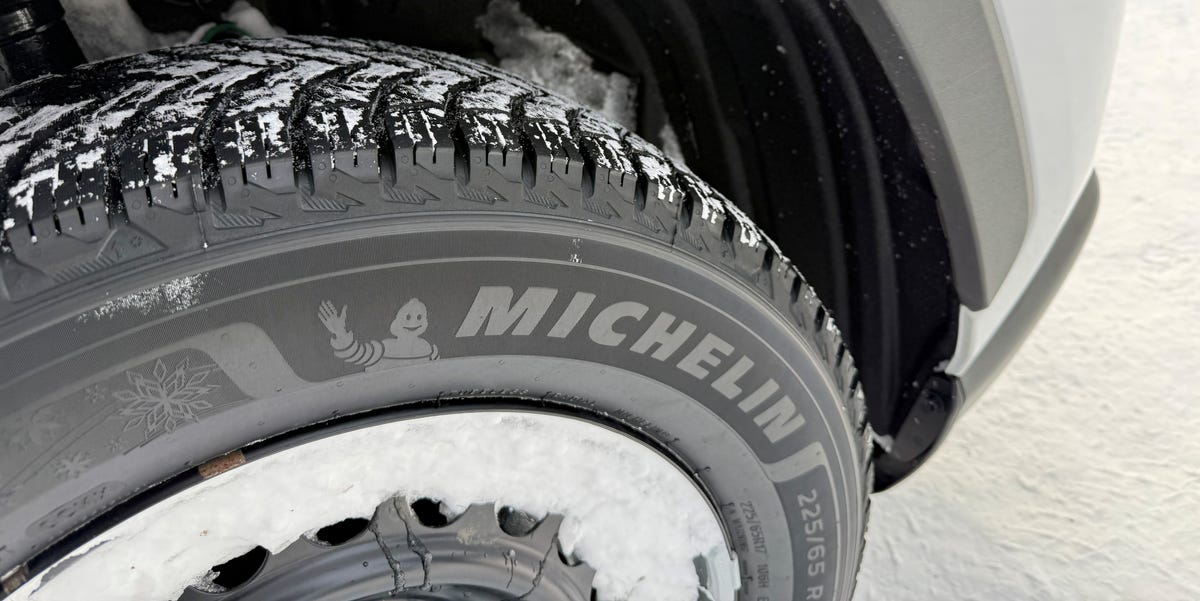
As temperatures start to rise nationwide, winter tires can return to their slumber. For many buyers, the end of the snow season is also the point at which a well-worn set of winters get swapped for rubber better suited to warm conditions. But when those buyers need to consider snow tires again, Michelin will have a new option available. Road & Track traveled to Montreal to experience it.
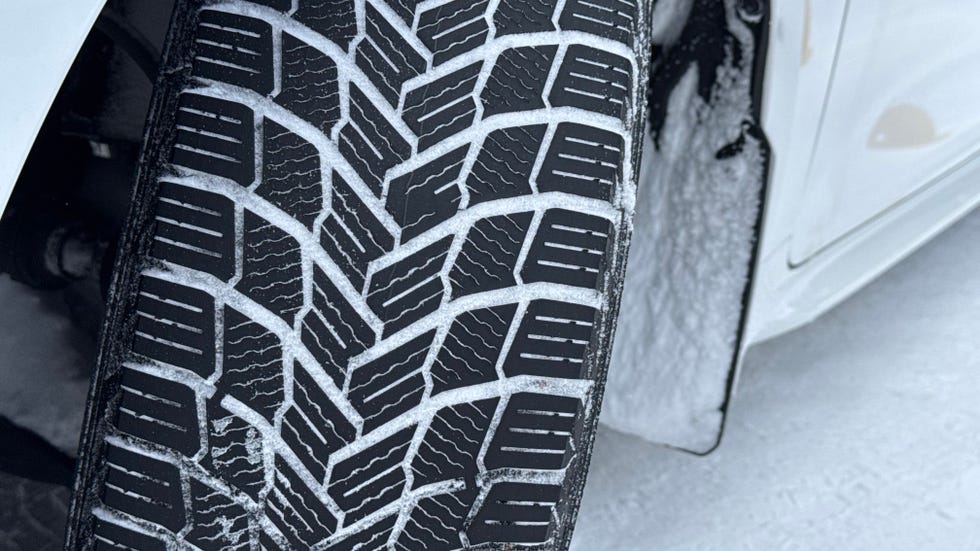
The new tire, the Michelin X-Ice Snow+, is an update to the existing X-Ice Snow tire. This is Michelin’s all-around snow-and-ice tire, as evidenced by the straightforward name. Big changes for this, almost the tire equivalent of a mid-cycle refresh, come mostly in the form of a new tread compound. Michelin calls this Flex-Ice 3.0 and says it will improve durability while retaining the same tread pattern as the previous X-Ice Snow option.
Another major development, a new ice-grip certification symbol, is actually not necessarily new; Michelin says that the previous X-Ice Snow launched before the certification for this was codified. Every winter tire Michelin currently sells comes with the same three-peak mountain snowflake (3PMSF) certification for snow performance, but the updated X-Ice Snow+ is the first in the brand’s portfolio to get a separate certification for its performance on ice.
Fred Smith
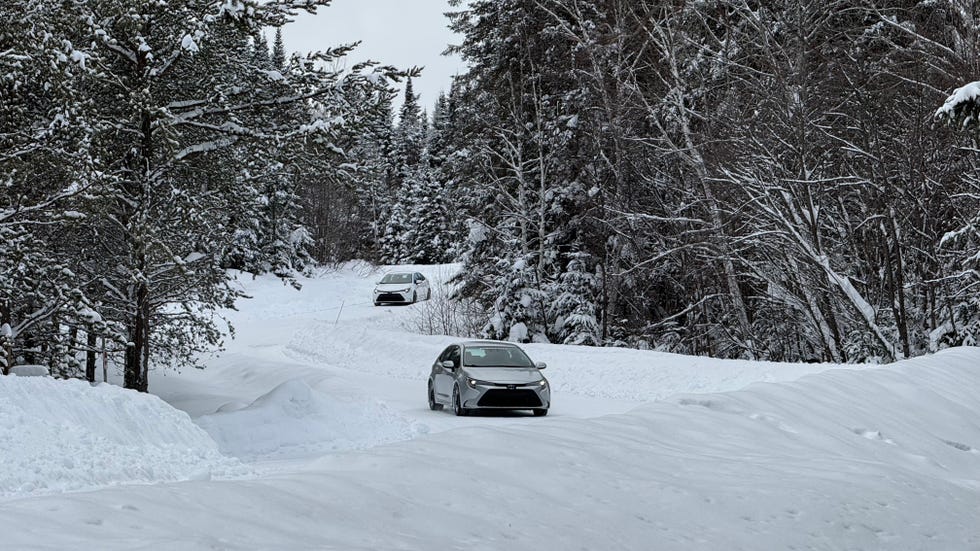
Michelin gave me a chance to sample the new tire in four tests at a snow-covered ice track outside of Montreal. Three tests compared the tires directly with their competition from Continental, Nokian, and Bridgestone fitted to different cars and on different surfaces, showing the tires’ relative strengths in practice. The fourth test was, inexplicably, head-to-head ice racing in GMC Terrains locked in selectable front-wheel drive. With a little patience for the obvious limitations of a front-wheel-drive crossover being pushed through slaloms on ice, the tires were even capable of handling that.
In the first test, Michelin rotated me through a handful of effectively identical Chevrolet Equinox EVs shod in the new X-Ice Snow+, Continental’s VikingContact 8, and Nokian’s Hakkapeliitta RS EV. The point was to show off that the new tire was effective on a heavy EV despite not carrying specific EV branding, something the tire proved admirably on an ice racing course dusted with a light layer of snow earlier in the morning.
Performance was stable with all three tires, and none felt like they were unprepared for the challenge. Still, the Michelin tire seemed to provide shorter braking distances and particularly predictable grip on snow-layered sections and on the exposed ice underneath. It was not a runaway win for the new tire, though. Although Michelin says that it chose not to put sound-dampening foam in the X-Ice Snow+ because it is already quiet enough, it did seem relatively noisy compared with the EV-specific Nokian tire in this test.
Fred Smith
The second test involved shaved tires on a front-wheel-drive Toyota Corolla sedan. Two cars, one with a set of Michelins and one with a set of Bridgestone Blizzak WS90s, were sent out in medium snow with tires shaved down to 4/32 of an inch (3.2 mm) of tread depth. This, Michelin says, is the point when it recommends that Canadian drivers change out their winter tires.
Even here, the X-Ice Snow+ was still capable of getting a Corolla through a decent amount of snow. The Bridgestones lagged a bit behind, most notably when trying to get the car rolling again after stopping in deep snow going uphill, but neither car ever got anything close to stuck, and both tires still felt safe in the conditions. It seemed like reasonable enough proof that the Michelin tire could still be effective late into its life.
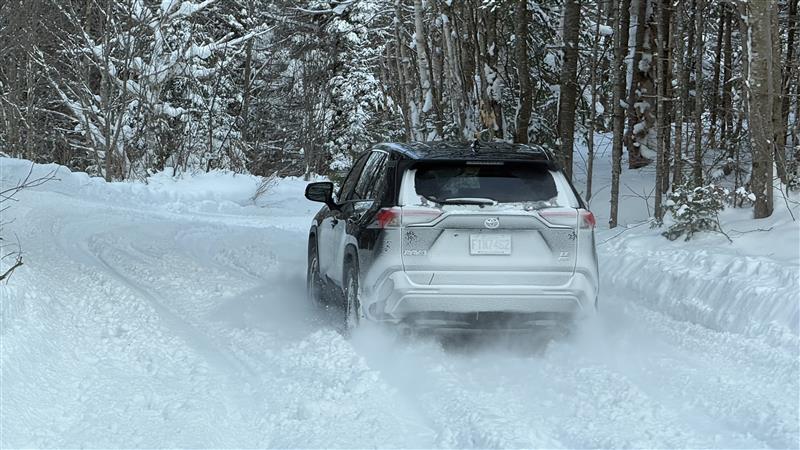
Another head-to-head snow test saw two Toyota Rav4s sent out in deeper stuff. One car was on the new Michelins set up against another on the same new Continentals used on the Equinox EVs.
Fred Smith
I actually did briefly get stuck in the Continentals during this test, but this was a case of user error by a California native with precious few winter driving miles under my belt. The lack of progress was quickly solved by rocking back and forth, and both tires seemed more than capable of continuing on in a depth of snow above the Rav4’s ground clearance.
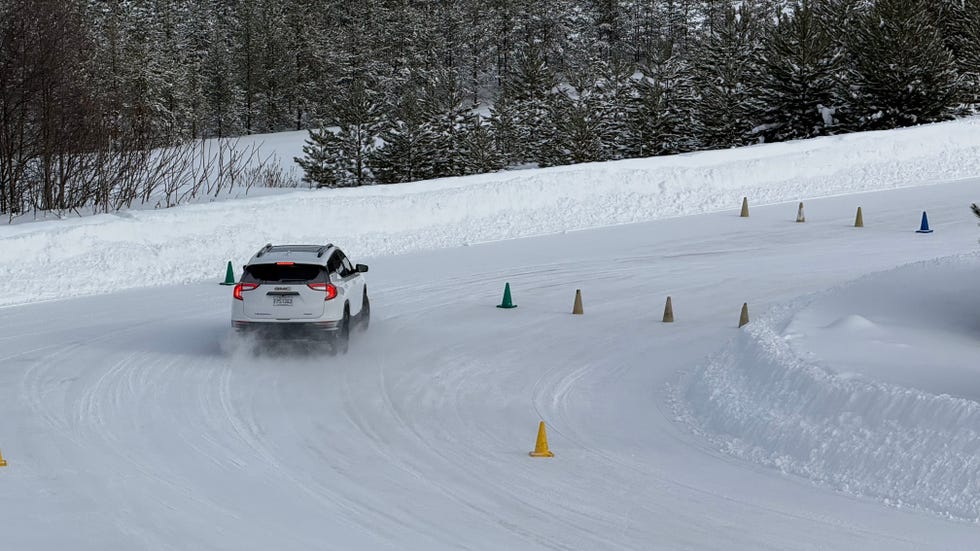
The final test was in the Terrains. Journalists were dropped in the SUVs and pitted against one another on opposite ends of a slalom built into a short course. I tried to push harder here out of my own deep well of pointless competitive drive, and in doing so, I found out that the tires were not enough to overcome the simple fact that ice racing in a front-wheel-drive crossover is not a great idea.
Fred Smith
While the Winter tires were enough to instill the confidence I needed to actually try to extract some performance, understeer and the simple nature of a heavy car on ice were consistent obstacles. I occasionally overestimated the car’s braking performance, leading to a few awkward corrections to avoid hitting any cones. That meant skating forward for a bit before the front end finally gripped once, but it still never meant anything resembling actual trouble.
In the head-to-head tests, the tire did not necessarily prove to be a dominant option in a field of pretenders. Instead, the test seemed designed to show that Michelin’s newest winter tires could compete with the best and offer their own strengths in a variety of situations. That makes these a strong option for winter-tire buyers but not a certain performance improvement like some of the brand’s model-specific summer tires.
The tires are meant for everything from conventional sedans to larger EVs and sold in sizes from 15 to 23 inches. Tires are being made available to dealers in May, so drivers looking to get their hands on a set of X-Ice Snow+ tires will have the chance to get them mounted well before snow starts falling again next winter.
Fred Smith’s love of cars comes from his fascination with auto racing. Unfortunately, that passion led him to daily drive a high-mileage, first-year Porsche Panamera. He is still thinking about the last lap of the 2011 Indianapolis 500.