

It all started at the 1986 Canadian Mixed Curling Championship in Kamloops, B.C.
Forty years later, the man known as the “Voice of Curling” is calling his last bonspiel as Vic Rauter will retire following the World Men’s Curling Championship in Ogden, Utah.
His final broadcast will be Saturday afternoon at 4 p.m. when he calls the gold-medal game of the tournament.
Rauter’s unique cadence – silky smooth and conversational, while thunderous and operatic when appropriate – has become synonymous with the granite game in Canada.
In terms of longevity and impact in Canadian sports broadcasting, Rauter is in the same class as the likes of Foster Hewitt, Bob Cole and Don Wittman.
“There will be no one that ever touches him in curling. I don’t care who it is – and we’ve got some wonderful people that have covered the sport,” long-time TSN curling analyst Cathy Gauthier said. “People will emulate him.”
“He’s Johnny Carson,” added fellow analyst Russ Howard, who’s worked with Rauter since 2009.
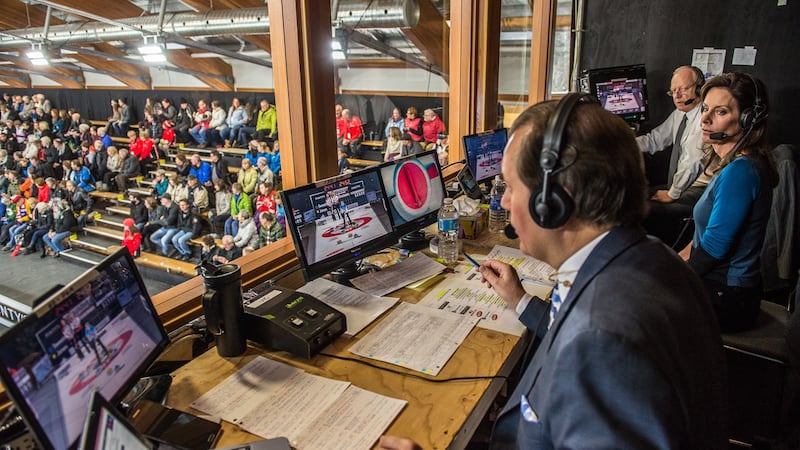 Vic Rauter, Cheryl Bernard, Russ Howard Vic Rauter, Cheryl Bernard, Russ Howard
Rauter, who will turn 72 in May, has mused over the idea of calling it a career the past few seasons and finally felt it was time to retire after more than five decades in the industry.
“I am a spiritual guy. I’m a blessed guy with a wonderful wife. And now it’s time for us to enjoy what 53 years of work has given me,” said Rauter, who’s looking forward to travelling more with his wife, Marianne.
“I started this when I was 19. I’ve been mentored well, taught lessons well, had wonderful experiences all along the way.”
As an up-and-coming broadcaster, Rauter was hired by TSN in 1985, a year after the network first went to air, initially anchoring SportsDesk, which is now known as SportsCentre. Rauter was soon approached by TSN’s vice president of production Jim Thompson who wondered how much he knew about curling.
“I curled in a Sportsman’s League down in the old Terrace in Toronto. It doesn’t exist anymore. A lot of media guys curled in it,” Rauter told his boss at the time. “It’s mostly a hit and a giggle and have a beer. Then he said, ‘Okay, because we’d like you to do the curling with Ray Turnbull.’”
Rauter and Turnbull, a Brier champion in 1965, began working together in January of 1986. The rest is history.
Rauter has been in the booth for TSN at every Tournament of Hearts and Brier since 1986, save for the 2006 season, when the broadcast rights were fully owned by CBC.
No matter who Rauter was partnered with in the booth, the chemistry seemed effortless.
Whether it was Turnbull, Vera Pezer, Linda Moore, Cheryl Bernard or the current iteration of Howard, Gauthier and Joanne Courtney, Rauter believes “defined roles” made the broadcast flourish.
 Vic Rauter, Linda Moore and Ray Turnbull Vic Rauter, Linda Moore and Ray Turnbull
“I am the play-by-play guy. I will always set it up for them [analysts], hopefully to make them look good, and they in turn make me look good,” explained Rauter. “If I can bring something out of them, we have our defined roles. Simple as that.”
Another skill Rauter has mastered over the years is asking the questions a non-curling expert may be wondering while watching the broadcast at home. Curling can be complex game for a newcomer or even someone with a basic familiarity of the sport. Rauter has always done his best to simplify it.
“Jim Thompson always said to me every year, ‘What do you know about the game?’ And I said, ‘Nothing.’ And he said, ‘Perfect’ because he always wanted me to be the eyes of the viewer who knows something but maybe doesn’t know it as in-depth,” Rauter said.
“He’s not trying to prove to Wayne Middaugh or Rachel Homan how good he is,” said Howard. “He’s asking the question that the fan wants to hear, wants answered.”
Aside from his ability to facilitate conversation, Rauter truly shines in the big moments, pumping up the volume and drama for countless memorable calls over the years.
Brad Gushue’s winning draw at the 2017 Brier in St. John’s, Nfld., and Homan’s ninth-end split for three at the 2024 World Women’s Curling Championship in Sydney, N.S., are two that stand out in recent memory.
“That’s what I’m going to miss the most, is that he makes every last shot exciting and important,” said Gauthier, who’s been with TSN for 30 years. “And I know that there are a billion broadcasters that can make a last call, but no one’s made the final like him. The excitement that he makes people feel that it’s such a pivotal shot. Even if it’s a draw for two, he brings the excitement as if you were in the building.”
“We just know to get the hell out of the way and let him do his thing,” added Howard.
Rauter’s natural delivery and cadence are one of a kind. Rauter made a conscious effort during his career to not sound like anybody else, sometimes even watching other broadcasts on mute.
“I don’t want to pick up on anything of them. Even watching Don Wittman, and Don Wittman was very good. But I didn’t want to be Don Wittman,” explained Rauter. “I wanted to be me.”
As for his famous “Make the Final” call, that was born during his days working with CBC prior to TSN.
“It just stuck, it just kept going,” said Rauter, who was inducted into the Canadian Curling Hall of Fame in 2006. “You don’t go looking for this stuff. I don’t think Al Michaels looked for a chance to say, ‘Do you believe in miracles?’”
Must See: ‘He is the heartbreak kid no more’ – Dunstone wins his first career Brier Matt Dunstone clears both of Kevin Koe’s rocks out of the house with his final stone to secure the first Brier title of his career.
Vic the newsman
Becoming the “Voice of Curling” was never the dream for Rauter growing up.
The son of Swiss immigrants, Rauter took after his father’s interest in current affairs and inspired to be a foreign correspondent.
After going to Humber College, Rauter got a job at CFTR radio in Toronto as a reporter where he covered City Hall, provincial politics, and “chased fire truck and ambulances,” looking for news.
Before long Rauter was asked to do sports coverage on the weekends.
“And you’re off and you never go back. I do tell you though, when a fire truck or a police car screams down the street, I do wonder where it’s going because you never lose that,” said Rauter.
He got his first television gig with Toronto’s Global TV in the early 1980s, reporting on local sports for their morning show. A few years later, Rauter was working alongside Brian Williams, covering the 1984 Olympics in Los Angeles for CBC. He joined TSN a year later.
“A door opens, a door closes, that one closed, another one opens, and you go through,” Rauter said.
Of course, curling isn’t the only sport Rauter has called. From ringette, rhythmic gymnastics and cricket to MLB and MLS games, there isn’t much he hasn’t covered.
“The only thing I have not called, honestly, I swear to you, is a CFL game,” said Rauter. “I never did a CFL game.”
Rauter has been to numerous Olympics as well. In fact, he was the first reporter to interview Canadian swimmer Mark Tewksbury after he captured the gold medal in the 100-metre backstroke at the 1992 Barcelona Games.
“Everything was a little more innocent before 9/11, of course. And a smile and a Canadian pin could get you a lot of places,” said Rauter. “I ended up going down to the back of the pool. When he came out all smiling, I was the first guy he saw. We did an interview and that was how I ended up in his book.”
The most prepared man in curling
Like baseball, curling is a sport where the back-and-forth action is not constant. Being well-prepared with research and talking points is integral for any curling broadcaster to be successful.
And Rauter is one of the best.
“I don’t believe there’s a broadcaster, news, sports, whatever it is, that’s as prepared as Vic Rauter,” said Howard. “It’s insane what he does, the amount of work he does before.”
“If we went to dead air for two hours, he could easily fill it,” Gauthier said.
There was a moment early in his TSN career when Rauter was caught unprepared.
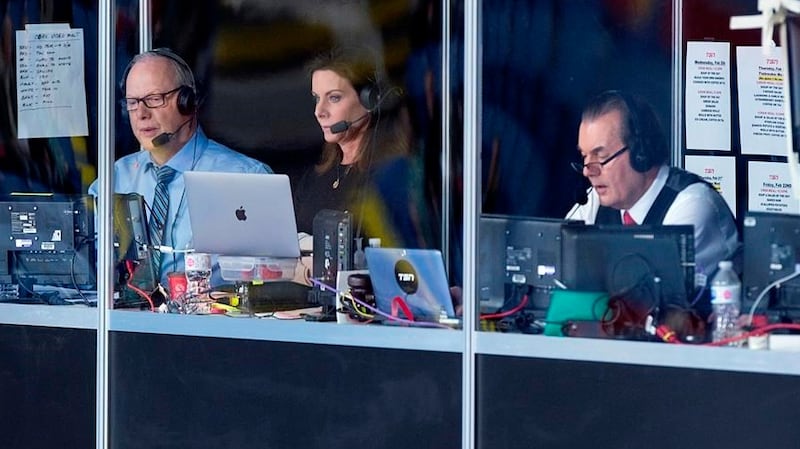 Russ Howard Vic Rauter Cheryl Bernard Russ Howard Vic Rauter Cheryl Bernard
During the opening ceremony of the 1987 World Men’s Curling Championship in Vancouver, members of the Squamish Nation came out to bless each sheet of ice at BC Place. Rauter and broadcast partner Turnbull were caught off guard and had “nothing to say” to add context to what the viewers at home were seeing.
“After the show, Jim Thompson came to me and said, ‘You weren’t prepared, were you?’ And I said, ‘No,’” explained Rauter, who lives in Orillia, Ont. “I wasn’t expecting that, but I should have expected it. And now I over-prepare.”
Rauter does hours of research ahead of events, looking for nuggets of information about the athletes and cities that can add colour to the broadcasts. He won’t use all those tidbits, but they’re available if the show needs it.
“If I do an opening ceremony now or a Canada Summer Games or something that requires that, I want to know what the trombonist had for lunch,” said Rauter. “Because 1987 taught me that I wasn’t prepared. That has stayed with me throughout my entire stay at TSN.”
On the road
The Season of Champions is a grind.
From the Scotties to the Brier to the men’s and women’s world championships, TSN’s curling crew covers four 10-day events in less than a two-month period during a typical season.
That’s a lot of time spent at the rink, airports and hotels, and not a lot of time at home.
“There’s never been a place that we’ve gone to that he doesn’t know more about than the locals,” said Gauthier. “We know Chinese buffets in every city in the country and many across the world. And if you can get him out for one night, you suck up every moment of it because he doesn’t like to go out when he’s working.”
Some of Rauter’s most fond memories from the road were going out with cameraman and long-time fried Jim Young, affectionally known as Gyraffe, to shoot vignettes and tell stories about the city they were in.
Their wide-ranging adventures took place on a ferry between Dartmouth and Halifax, down a mineshaft in Sudbury and even in a submarine.
“They were the fun ones to do because it broke up the monotony of just going from hotel to arena and then home again,” said Rauter.
Young, who was Rauter’s best man at his wedding, passed away in November of 2022 after a long battle with cancer.
“For more than 30 years, you have seen the game through the eyes of Jim Young. However, those eyes have now closed and for the moment our curling family sees darkness.” @TSNVicRauter pays tribute to longtime TSN camera operator Jim Young. pic.twitter.com/HA2lNPjlmX
— TSN Curling (@TSNCurling) November 7, 2022
Spending time with Young and others from the broadcast is what Rauter will miss the most when TSN Curling rolls on without him next season.
“Ask any athlete, what are they going to miss most? Are they going to miss the games? Not necessarily. Are they going to miss the travel? No. The hotels? No,” said Rauter. “Who are they going to miss? They’re going to miss their teammates. They’re going to miss the kibitzing in the locker room and the chatter. That’s what I’m going to miss.
“When February comes around, Will I think of them? Sure. How could I not?”
Rauter and Marianne plan to travel to the Far East next winter and hope to get back to Switzerland as well.
“We spend often more time with our curling family than we do some time at home during the curling season,” said Rauter. “So, she’s been alone a lot and totally understanding of it, but now it’s her time, it’s my time. It’s our time.”