
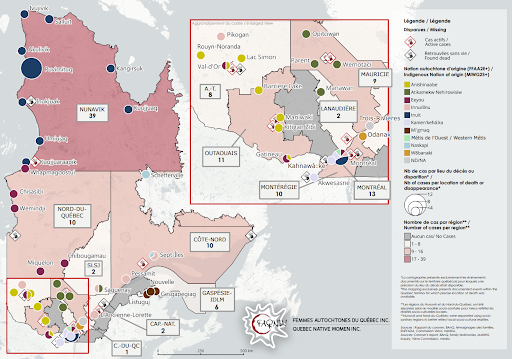
Nunavik has the most cases involving missing or murdered Indigenous women, girls and two-spirited people of all of Quebec’s regions, according to a new database unveiled Tuesday.
Workers with non-profit organization Quebec Native Women and the University of Quebec in Outaouais, who have been working since 2023, released numbers they have compiled so far during an event in Quebec City.
The data shows 124 Indigenous women, girls and two-spirited people went missing or were murdered in Quebec between 1950 and February 2026.
Nunavik alone has 39 cases, with 12 of those coming out of Puvirnituq. The next highest is the region of Montreal, with 13 cases.
Two more categories will be added to the map, including suspicious deaths and deaths with aggravating circumstances, said Marjolaine Étienne, president of Quebec Native Women.
She said that will add another 100 cases.
Seventy-five per cent of the documented disappearances in the database happened while the victim was outside of their home community.

Étienne said the map is part of a history that has been following Indigenous women for years.
“It is a topic so sensitive, it is a topic that touches Indigenous women, girls, and families,” she said.
The map does not represent all cases, and project leaders say they intend to continue adding cases as they discover more.
“Too often, we, Indigenous women, have the impression we do not have rights,” said Étienne. “But we do have rights. We were given the responsibility to protect women and girls by our ancestors.”
She said the data shows how alarming the situation is, and that it’s a result of systemic problems.
“If we protect women, we protect children; if we protect our children, we protect our collectivity,” she said.

To compile the data, the team reviewed police records, compiled coroners’ reports, pored over old newspaper records and conducted community outreach.
They also collected around 220 life stories from family members affected by cases of missing and murdered Indigenous women and girls.
The online and interactive version of the map will become available in the near future.
“What this data tells us is that those are not isolated cases, but it is a systemic inequality that persists to this day,” said Étienne. “This map is a tool for mobilization.”