
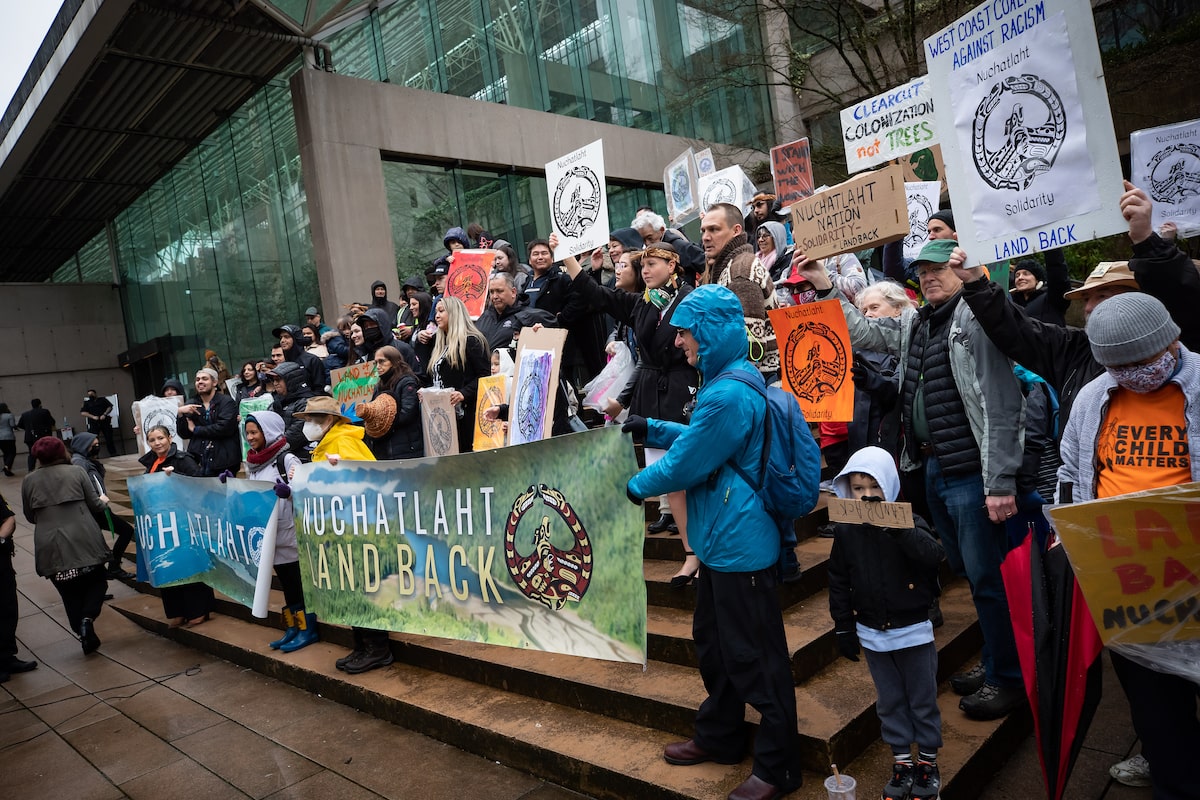
Members of the Nuchatlaht First Nation and supporters rally outside B.C. Supreme Court in Vancouver in March, 2022. The First Nation has now sufficiently proven they occupied the area at the time Britain asserted sovereignty over Nootka Island, the B.C. Court of Appeal has confirmed.DARRYL DYCK/The Canadian Press
The B.C. Court of Appeal has confirmed a First Nation with 180 members has Aboriginal title over more than 200 square kilometers of land off Vancouver Island’s west coast, including increasingly rare old growth forest.
The Nuchatlaht won Canada’s second-ever finding of Aboriginal title in 2024, but that B.C. Supreme Court ruling only applied to a small fraction of their claim area.
On Thursday, three members of the provincial Court of Appeal recognized the First Nation’s full claim, saying the lower court erred by disregarding material evidence, setting an arbitrary boundary, and incorrectly limiting evidence of occupation to village and reserve sites.
“In combination, these errors indicate the judge misapplied the test for sufficient occupation and made palpable and overriding errors in applying the law to the facts,” the judgment stated.
The 2024 B.C. Supreme Court decision found that the Nuchatlaht proved Aboriginal title to 11.4 square kilometres of land on the north end of Nootka Island, including a large portion of Nuchatlitz Provincial Park. That was roughly five per cent of the claimed area.
The Court of Appeal decision gives the Nuchatlaht title over a larger portion of Nootka Island.
Last year, the Globe reported the B.C. government quietly gave up control of a portion of Nuchatlitz Park as a result of the 2024 decision. Kayakers and recreational boaters learned via word-of-mouth that part of the popular destination was no longer public land.
Meanwhile, the First Nation had commenced building a road through the former parkland for its members. A band council member said last year the plan was to develop their title lands, which could include some logging.
While the north end of Nootka Island contains intact old growth, it has been heavily logged and the Nuchatlaht argued in court that industrial harvesting destroyed culturally modified trees that recorded an integral part of their culture.
The appeal court decision means the First Nation has proved sufficient of occupation in the year 1846 – when Britain asserted sovereignty over Nootka Island – using the test for Aboriginal title that was established in the Supreme Court of Canada’s landmark Tsilhqot’in decision in 2014.
Ottawa says Musqueam deal unrelated to private property rights
The Nuchatlaht’s lawyer, Jack Woodward, said the latest ruling sets a precedent for other places.
“It particularly stands for protection of the archeological sites and the old growth cedar forests on the western coast of British Columbia,” he said in an interview.
“British Columbia has been chastened by this decision for its long-standing refusal to protect the archeological heritage of the First Nations.”
Aboriginal title is the right to land based on ancestral occupation and it is protected under Section 35 of the Constitution. But it has been left to the courts to determine what that title entails and where it exists.
In a statement, Attorney General Niki Sharma said the province will review the decision before responding.
The Nuchatlaht’s claim was deliberately limited to an area smaller than their traditional territories to avoid issues that had complicated and prolonged other Aboriginal title claims. The Nuchatlaht did not claim title to any land over which there were competing claims including privately owned lands, or lands claimed by neighbouring First Nations.
They also did not rely on oral history as evidence, instead turning to historic documentation, including work done by early anthropologists and ethnologists.
That evidence showed the Nuchatlaht had a firm concept of ownership, with territorial boundaries defined on both sea and land, according to the judgment.
The trial lasted just 54 days – unusually short for an Aboriginal title case. By comparison, the Cowichan case has already spanned more than 500 days in trial, and is still not over.
After the Tsilhqot’in in B.C.’s central interior, the Nuchatlaht were the second in Canada to have their Aboriginal title affirmed by the courts. In August, 2025, the Cowichan tribes also won a title case to a small, but developed portion of Richmond, including private lands. All seven parties in the case have said they plan to appeal.