
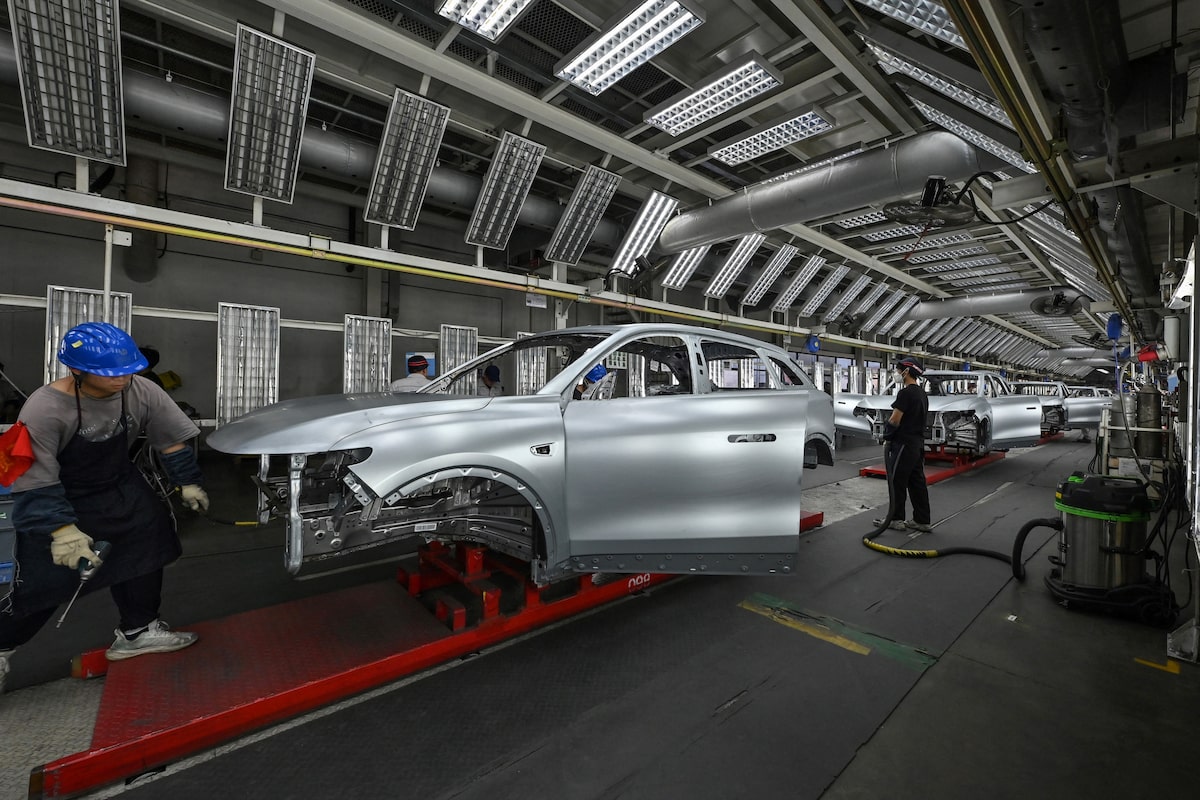
An EV is assembled on the production line at Leapmotor’s factory in Jinhua, China. Stellantis proposed assembling vehicles from the Chinese automaker – which it partly owns – at its idled Brampton plant.ADEK BERRY/AFP/Getty Images
Industry Minister Mélanie Joly has rejected Stellantis NV’s STLA-N plan to assemble electric cars with kits shipped from China at the automaker’s idled factory near Toronto.
Stellantis has proposed assembling the cars made by its partly owned partner in China, Leapmotor, says Unifor, the union representing 3,000 of the Brampton plant’s laid-off workers. The automaker is seeking a way to fulfill its public funding agreement at the plant, which was retooled with millions of taxpayer dollars.
News of the plan on Wednesday was met by opposition from Ontario Premier Doug Ford and Unifor. They say the process of assembling cars from what are known as knock-down kits requires few jobs and contributes nothing to the local parts-supplier base.
Ms. Joly, speaking to reporters in Vancouver on Thursday, said production at the plant must be supported by Ontario and the union.
“We can’t bring cars in a kit to Canada,” Ms. Joly told reporters. The plant’s production “needs to support the local supply chain.”
The Stellantis vehicle assembly plant in Brampton, Ont., in October, 2025. The Brampton plant closed more than two years ago for retooling.Nathan Denette/The Canadian Press
The Brampton plant closed more than two years ago for retooling. Stellantis had planned to make the Jeep Compass at the plant, but moved production to Illinois last year after U.S. President Donald Trump imposed 25-per-cent tariffs on Canadian-made cars. The government then filed a notice of default against Stellantis and began talks to either get its money back or ensure production returned.
Stellantis declined to comment on Thursday. Instead, it referred to to its Wednesday statement, in which spokeswoman LouAnn Gosselin said the company “remains focused on a strong Canadian footprint and is actively evaluating future programs for Brampton, with the objective to ensure that any investment decision is sustainable and a long-term commitment that supports workers and suppliers.”
Stellantis must operate the Brampton plant until 2035, unless levies, adverse market conditions or other factors have a “material impact” on the plant, according to the 2022 federal funding agreement. Stellantis is also required to maintain an average Canada-wide employment level of 4,475, a number that is exceeded by the Windsor workforce. The heavily redacted document was obtained by The Globe and Mail under the Access to Information and Privacy law. Ottawa pledged to provide up to $529-million to Stellantis for work on its plants in Brampton and Windsor.
Chinese EV maker BYD in talks to open Canadian dealerships, consultant says
Stellantis posts huge loss after ‘over-estimating’ EV transition
The federal government has been repairing ties with China as it seeks to reduce dependence on U.S. trade. Prime Minister Mark Carney in January reduced tariffs on up to 49,000 of China’s EVs to 6.1 per cent from 100 per cent. He did so in exchange for lower Chinese duties on Canadian canola and other food.
Ottawa said the agreement is expected within three years to attract Chinese joint-venture investment in the Canadian EV supply chain.
Assembling cars from premade kits is a method used for decades by such manufacturers as Volvo in Nova Scotia and Volkswagen in Mexico, South America and elsewhere.
Chinese electric car makers, including Leapmotor, have lately used the process to fuel part of their 21-per-cent international sales expansion to Europe, Latin America and other regions.
Peter Frise, a professor of mechanical and automotive engineering at the University of Windsor, said the method allows China to expand overseas sales while utilizing their own factories – and lower-cost structure – at a time when they have excess capacity.
For Brampton, the method would mean fewer jobs, with lower skill requirements.
“It’s not the same as building a car here,” Prof. Frise said. “It basically means that the car is actually built somewhere else, and then it comes to the plant in a crate or container and a few finishing touches are put on it in that plant.”
‘A house of brands’: After a steep decline, can Stellantis turn things around?
Automakers that work with knock-down kits ship them in various states of assembly, Prof. Frise said. But most of the high-value work and components – welding, electronics, batteries – are already completed and in place when the cars arrive at the final destination.
“When the car comes out of the crate, it’ll look like a car,” he said. “It might not have the doors on it. It might not have the wheels on it, but my guess is it’ll be a painted, finished car body with an interior and a powertrain already installed. And it’s a long way from there to building a car with parts made here.”
Industry representatives have been pointing to Brazil, where the Chinese EV giant BYD Auto Co. Ltd. last year opened an assembly plant, as a cautionary example.
The factory in the Brazilian state of Bahia, which has the capacity to produce up to 150,000 EVs and hybrid vehicles annually, has been immersed in controversy, largely because of allegations of forced labour by Chinese workers trafficked there.
The factory was also initially granted a contentious exemption from Brazilian tariffs on parts sent there for use in knock-down kits. That exemption was allowed to expire this year, after pushback from other automakers with an existing manufacturing presence in the country. They warned that the practice would bring minimal economic benefits while hurting their competitiveness and potentially causing tens of thousands of job losses.
BYD now says it is aiming to locally source 50 per cent of components for the Bahia plant by the end of this year.