


Listen to this article
Estimated 3 minutes
The audio version of this article is generated by AI-based technology. Mispronunciations can occur. We are working with our partners to continually review and improve the results.
Nova Scotia will soon begin recruiting for a new five-person team dedicated to incorporating artificial intelligence into provincial government operations.
Jennifer LaPlante, deputy minister of cybersecurity and digital solutions, says the team will establish protocol for staff across all departments.
“It’s identifying tools that can be adopted by civil servants within government that will increase productivity and efficiency in the way that they do their work,” said LaPlante, citing as an example Microsoft Copilot, an AI-powered tool that helps with tasks like drafting documents, summarizing data and creating emails.
The province already has regulations outlining which AI meeting tools and virtual assistants staff can use and how, LaPlante said, and it’s developing a responsible use policy to establish which other AI tools staff can utilize on the job.
This team will build on that work and develop more comprehensive AI use strategies.
“You don’t want to limit individual innovation,” said LaPlante. “But at the same time, you want to make sure you’re protecting government systems.”
Funding for the team will come from the province’s $4.4-million investment for this fiscal year to “establish artificial intelligence capabilities.”
‘Area of real opportunity’
The province will use a portion of that funding to acquire artificial intelligence licensing and software.
LaPlante said she believes the team of five established this year could grow in the future.
Artificial intelligence was among the six priority sectors attached to the province’s $1.5-million infusion to Invest Nova Scotia for this fiscal year alongside defence and aerospace, clean and conventional energy, natural resources, fisheries and agri-food, and housing and construction.
“This is the area of real opportunity for us as a province,” LaPlante said.
“We don’t want people to be afraid of it, but we also want to understand that we need to take our time.”
Ask Scottie
In February, the department launched a free-to-use chatbot called Scottie, which uses artificial intelligence to answer questions about government services and operations.
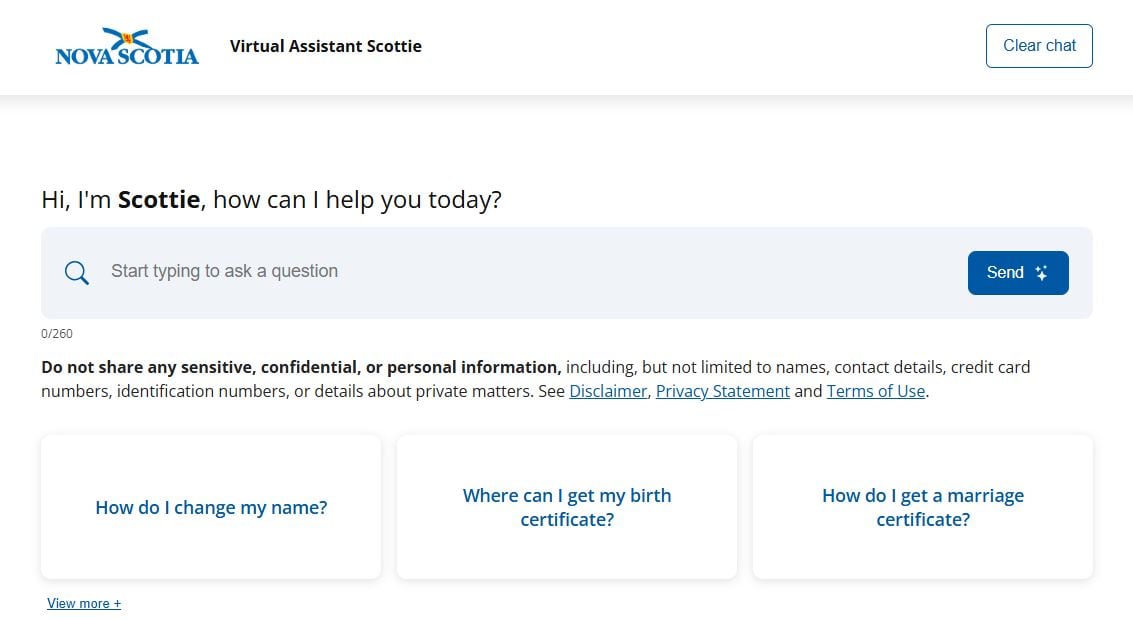 Users can ask Scottie things like ‘How can I get a driver’s licence?’ and ‘What is the capital of Nova Scotia?’ (Province of Nova Scotia)
The chatbot’s creators consulted other government departments to determine the types of questions staff members fielded most commonly. The idea is that now Scottie can answer those questions for citizens instead, said LaPlante.
People can use the chatbot to ask, for instance, how to go about acquiring a marriage licence or to find out the open hours of an Access Nova Scotia location, she said.
Department staff who built the chatbot over a period of six to eight weeks ensured its output is not generative in nature. It is intended to pull facts from government sources already available to the public and present them without creating anything new, LaPlante said.
Her department will work with others to feed Scottie up-to-date and accurate information, she said.
Another goal was to increase ease of use for people trying to navigate the province’s website.
“Our website is very complex. There are so many different pages and this is all about trying to help people find information a little bit faster,” said LaPlante.
“There was a recognition that as we update our website, it’s still not going to make navigation easier.”
LaPlante did not share the estimated cost of Scottie’s creation and maintenance.
MORE TOP STORIES