
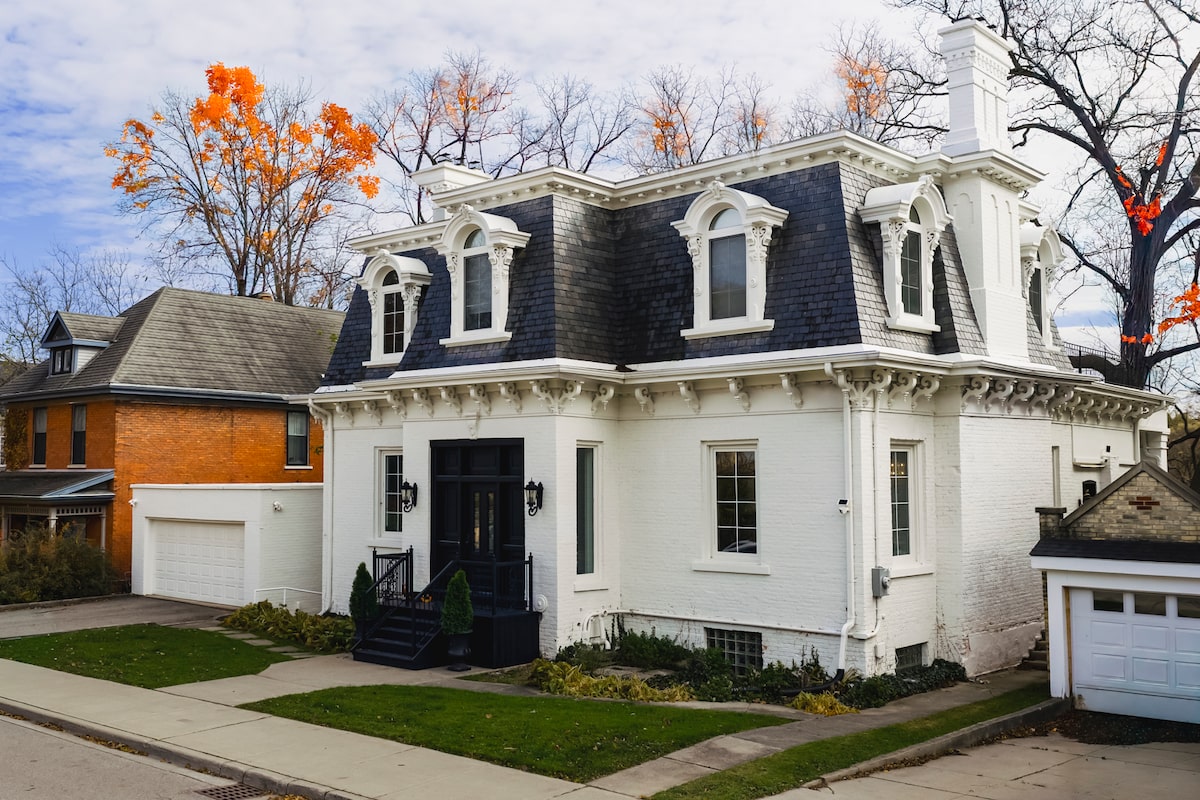
113 William St., Stratford, Ont.
Asking price: $4.2-million
Lot size: 78 by 188-feet
Property taxes: $14,283.53 (2026)
Listing agents: Barb Hiller Thibeault, William Thibeault and Mark Thibeault, Royal LePage Hiller Realty
The backstory
If most of what one knows about Stratford, Ont., is that it has a theatre festival anchored by, but not exclusive to, Shakespeare, then arriving there after a few hours’ drive from Toronto to look at a house for sale could take a moment of adjustment.
“We came out here to visit, and I said, ‘There’s no way I can live in Stratford,’” said Candice Shuster, speaking of her first visit to the leafy, culturally rich small city. “When we walked into the house, I said, ‘Wow, maybe I can.’”
The house is sometimes called Avon Castle, a Second-Empire-style manse built in 1870 by William (Boss) Easson, a local sawmill owner and businessman. It’s one of only a few dozen family homes that share the northern shore of Lake Victoria, the widened portion of the Avon River that flows through the centre of town.
Initially, Ms. Shuster didn’t know what lay beneath the plaster and timber of the castle. The first impression was grandeur, 14-foot ceilings, impressive amounts of ornate plaster crown mouldings and thick outer walls that gave the place a quiet solidity. However, over the decades, the interior supports had sagged a bit: “The floors were all lopsided, from one end of the room to the other,” she said.
Major engineering would be required, stairs not done to code had to go, and when walls were opened up to redo the electrical and HVAC, raw timbers with bark still on them were found instead of beams.
“The whole interior of the house is absolutely new,” said Ms. Shuster, who teamed with friend Julie Ballard, a creative director with Lori Morris’s design studio, to reimagine what an almost total interior gut and replacement would look like. The result is essentially a new-build house inside the old structure. “The only thing intact is the outside, the crown mouldings and a fireplace,” said Ms. Shuster.
The house today
The brief for the new front door was to find something that evokes the TV series The Gilded Age (about New York’s robber baron society from the 1880s). Gone is the old single door framed by stained glass panels; now the opening is a sturdy double door in dark timber smack in the centre of the house.
The foyer under no fewer than three tiers of wedding-cake style elaborate plaster moulding (all of which was meticulously preserved and restored when necessary) looks straight through to the back of the house, where new, larger-scale windows draw in light from the riverside. To the right is the black-walled bar area and dining room, to the left is the soft-ivory-walled living room. Pre-gut, all these rooms had either bold colours or wallpaper; now they are solidly either black or white from floor to ceiling.
“I hate colour; I only wear black,” said Ms. Shuster, a fashion consultant who has worked with brands such as Michael Kors and is currently with Canadian outerwear company Nobis. She was not afraid to paint the ceilings or ornate plasterwork black in the bar and dining room. Dark colours on ceilings or detail work can make some rooms feel small, but not this lofty space with this amount of natural light. “It makes me feel very comfortable,” she said.
This is a house designed to entertain, and the full U-shaped bar near the front door is stocked and ready (the Johnny Walker? Black.). All the walls on this level have picture-frame millwork, and some of the panels in the dining room actually hide storage: press in, release, and the hutch/cabinet reveals itself.
Ms. Shuster isn’t a fan of clunky hardware, so the kitchen island (black cabinetry, black granite with white veins, just like the bar counters) behind the dining room has no handles, only push-and-release drawers and doors. The exception is the built-in refrigerator.
The rest of this L-shaped kitchen is overflowing with prep space and storage: A long run of lower cabinets fills almost the entire back wall of the house, anchored by the sink in front of large windows facing the rear balcony and the waterfront.
Upstairs, there are more ornate arches, medallions, plaster crowns above door frames and different styles of crown mouldings in the three bedrooms. The primary bedroom’s ensuite bathroom is painted black (with white ceilings this time), more picture frame walls and hardware-less drawers in the cabinetry. Even the tub, framed in the windows, is black on the outside.
There’s less black in the shared bathroom: just on one wall, the vanity and the floor. A sunroom looks onto the rooftop balcony.
The basement has one more surprise: a light and modern in-law suite (a second gut reno) with in-floor-heat and a walkout to the riverfront backyard with its hedge maze.
For the amount of work, it might have been easier to knock the whole thing over and start again, but that was never in the cards. “It had been vacant for a long time,” said Ms. Shuster, who often heard from neighbours that many in the town were excited to see someone breathe new life into the place. “People were so appreciative that we were keeping the integrity of the home.”