
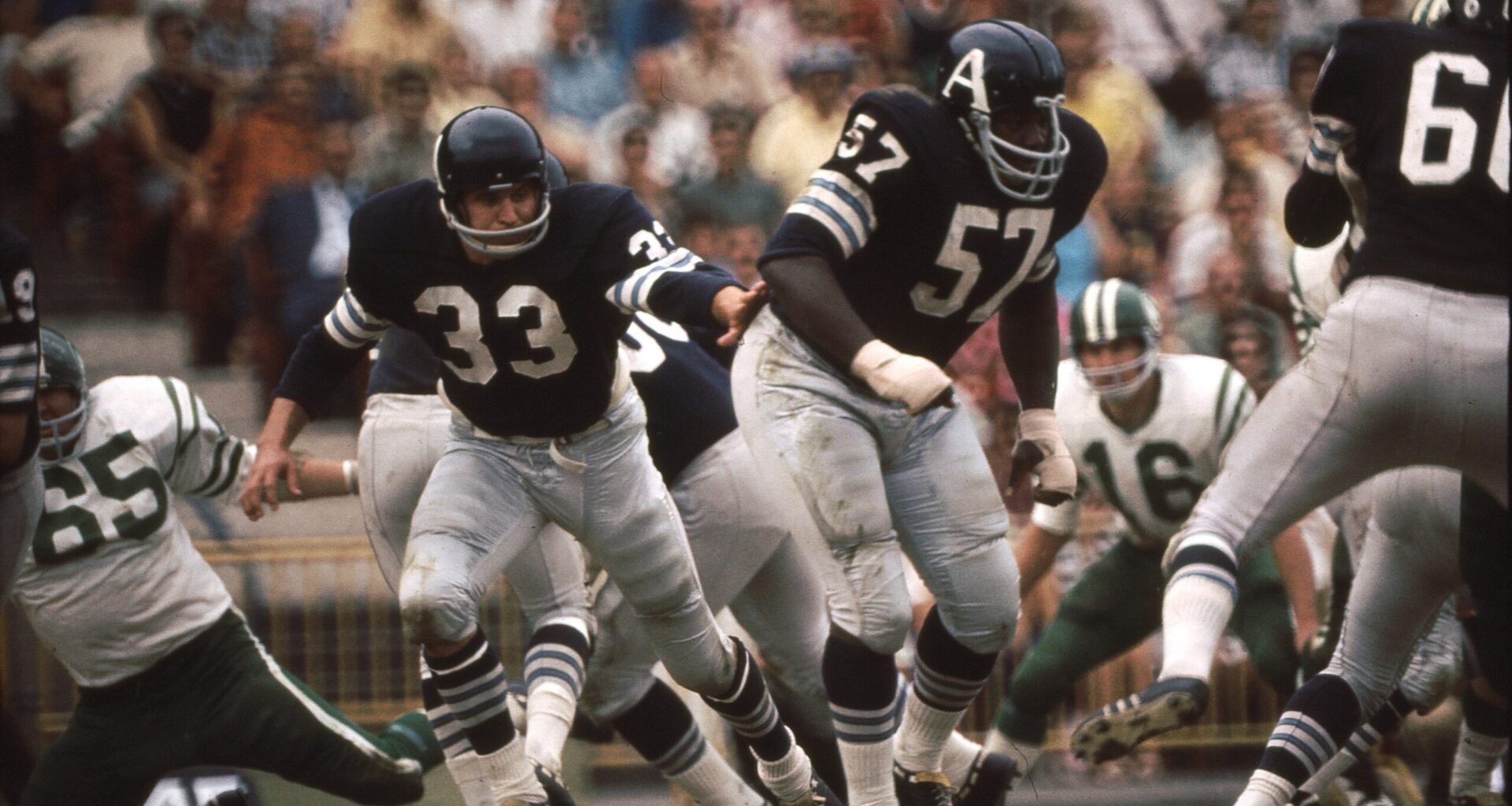
His is a name from the Toronto Argonauts past, not long enough in a 152-year-old franchise’s life to be called its ancient history, but enough time has passed since he retired for most fans to need a refresher, if not an introduction.
Charlie Bray was an all-star guard on one of the most popular teams ever to wear Double Blue, Leo Cahill’s teams from the late 60s/early 70s. Twice named a CFL all-star, with a divisional nod thrown in for good measure, Bray, along with tackle Bill Frank, were the key people movers up front that allowed the likes of Bill Symons, Dave Raimey, and Leon McQuay to work their magic as running backs.
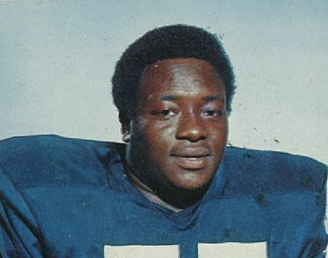
Bray had been playing for Orlando in the Continental Football League, coached by Perry Moss, who had played college football at Illinois with Cahill. Moss called his old teammate to tell him about Bray, who had another suitor at the time.
“I had the chance to sign with the Cleveland Browns or Toronto,” Bray told Argonauts.ca. “Cleveland offered me $12,000 and a $2,000 signing bonus, Toronto offered me $15,000 and a $4,000 signing bonus. I said, ‘I’m not patriotic, I’m going where the money is.”
How different was that era? Not only did the Argos outbid the NFL for Bray, but the American dollar was only worth roughly 92 cents Canadian in 1968. The offensive lineman had hit the financial motherlode.
He’d play for Cahill until the coach was fired following the 1972 season. Bray would play one additional year in Toronto before re-connecting with “Leo the Lip” in 1974 with Cahill’s Memphis Southmen of the World Football League.
The coach was someone that rarely elicited an indifferent reaction. Players, and basically anyone who knew or knew of Cahill had a strong opinion of him. Bray was someone who enjoyed his time with the coach.
I liked Leo, Leo was alright,” said Bray. “A lot of guys didn’t like Leo’s ways, but that’s alright. He treated all the guys pretty well the same, but some guys didn’t like that because they thought he was a little soft. But that was his nature, he was a good-hearted person, and I thought he was a great coach.”
The Argos of that era were a collection of not only talented football players, but a team filled with characters. There were extremely outgoing people like Mel Profit and Dick Thornton, intellectuals like Mike Eben, brash youngsters like Joe Thiesmann, country folk like Bill Symons, and type-A football junkies like Pete Martin.
Where did Bray think he fit into this eccentric football family?
“I guess I was a knucklehead,” said the Pittsburgh native with a laugh. “When I came up, I didn’t have a lot of discipline, but I fit right in with them because I was in all kinds of trouble and stuff, but that’s a part of life. They taught us to be hostile, mobile, and agile, no control. That’s what I was missing coming up as I didn’t have much control being raised by a single parent. Bobby Taylor was like that, he didn’t have control, Leon McQuay was like that. We had a lot of guys like that.”
But somehow it worked. The team came painfully close to winning the ’71 Grey Cup, the only Argos Grey Cup appearance between 1952-82. That didn’t mean the Boatmen didn’t have some memorable games in that era, far from it.
Bray was involved in one of the most memorable plays in Argonaut history, selected as the team’s 69th top moment as a part of the team’s 150th anniversary celebrations in 2023. In a 1968 playoff game against Hamilton, Bill Symons took a handoff, followed his then rookie guard to the right, then used the hole Bray helped create to rush for a 100-yard touchdown, still the longest rushing play in CFL post-season history.
Said Symons of the run, “Wally Gabler handed the ball of to me, and I just followed big Charlie Bray.”
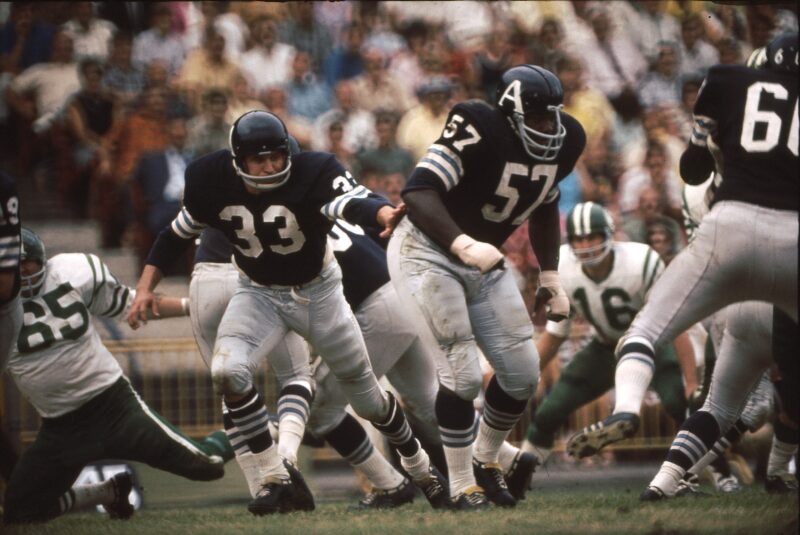
Bray lined up at right guard and chipped one Ti-cat player and rolled into a second, with Symons hitting the hole caused by #57.
“When we pulled,” Bray recalled, “I said I’m going to try to get one of two of these guys and Bill will maybe be able to get a few yards. I came around the corner and just rolled like a bowling ball and I got a couple of them. Bill was a great running back, Dave Raimey too. When we ran a sweep, they would go out like they were running outside, then cut back inside of me. They got the outside guys in a great position to be blocked.”
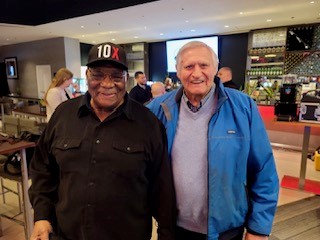
Teammates Charlie Bray and Bill Symons reunited at the Argos 150th celebration reunion in 2023.
Bray has stayed in Ontario since retiring after one final season with the Tiger Cats in 1976, spending most of his time in Toronto and now living in St. Catharines. It’s not unusual to see him at games or Argonaut Alumni Association events, broadly smiling his way through each gathering. He’s still active with youth sports despite turning 80 years old last September.
That youth sport is sumo wrestling.
“After I got out of football I said I must research sumo because I was always intrigued by leverage and position,” Bray explained. “I was always a little shorter than the guys, so I had leverage on them automatically. I started researching sumo because I liked the way the sumo guys came off the line and made that smack. I realized it’s all about leverage.”
He then corralled eight former players and they started performing sumo wrestling at sporting events in Canada and the U.S., for instance, doing a halftime exhibition at football games. But it wasn’t that aspect of sumo that appealed most to Bray.
“I realized it’s the training regimen,” he said. “I wish I had that at a young age because it teaches you self-control, it teaches you discipline.”
Though Bray was a great athlete, he wishes he had learned the philosophies of sumo while he was still playing.
“I would have been 100-percent better. During the season I’d run hard and work hard on the football field, but I’d be doing other crazy stuff (off the field). You’ve got to sacrifice during the season, you can’t be running around doing this, doing that, because every game you want to be the same. If you can balance what you do off the field and on the field, you’ll see the end results and be productive all the time.”
“I signed a deal with Youth Assisting Youth in Toronto, they provide programs for kids. We also work with the Salvation Army in Buffalo. I’ll get a group of kids together in Toronto and starting training them, and we’ll get a group of kids in Buffalo and train them, then we’re going to compete against each other.”
He’s done it before, working with the Japanese Canadian Culture Centre, working with at risk kids, kids with disabilities, and other youngsters, having the kids mix with one another into what Bray described as “a beautiful cake.”
The next step is to raise funds so they can animate their program to give children outside of the area the opportunity to benefit from their work and the discipline of sumo. To find out more about Bray’s work, visit sumoraiteams.com