

May WTI crude oil surged sharply in the holiday-shortened week ending April 3, settling at $111.54, up $11.90 or +11.94%. The move was driven by a combination of geopolitical escalation, supply disruption risks, and growing concerns about global oil infrastructure security. Traders were forced to rapidly reprice risk, with volatility spiking across the energy complex as headlines intensified into the close.
War Risk and Supply Shock Drive Breakout
The dominant catalyst behind this week’s rally was the rapid escalation in tensions between the United States and Iran. Reports of direct military engagement and retaliatory strikes shifted the market narrative from “risk premium” to “active supply threat.” This distinction matters. Traders are no longer pricing hypothetical disruption—they are pricing real-time risk to physical flows.
The Strait of Hormuz quickly became the focal point. Roughly 20% of global oil supply passes through this corridor, and any credible threat to tanker traffic immediately tightens supply expectations. Even without a full closure, increased insurance costs, rerouting, and delays effectively reduce available supply. This is classic supply-side tightening, and the market reacted accordingly.
Spot Brent followed WTI higher, reinforcing the global nature of the move. The Brent premium widened at times during the week, reflecting heightened sensitivity to Middle East exports. This spread behavior confirmed that the rally was not just…
May WTI crude oil surged sharply in the holiday-shortened week ending April 3, settling at $111.54, up $11.90 or +11.94%. The move was driven by a combination of geopolitical escalation, supply disruption risks, and growing concerns about global oil infrastructure security. Traders were forced to rapidly reprice risk, with volatility spiking across the energy complex as headlines intensified into the close.
War Risk and Supply Shock Drive Breakout
The dominant catalyst behind this week’s rally was the rapid escalation in tensions between the United States and Iran. Reports of direct military engagement and retaliatory strikes shifted the market narrative from “risk premium” to “active supply threat.” This distinction matters. Traders are no longer pricing hypothetical disruption—they are pricing real-time risk to physical flows.
The Strait of Hormuz quickly became the focal point. Roughly 20% of global oil supply passes through this corridor, and any credible threat to tanker traffic immediately tightens supply expectations. Even without a full closure, increased insurance costs, rerouting, and delays effectively reduce available supply. This is classic supply-side tightening, and the market reacted accordingly.
Spot Brent followed WTI higher, reinforcing the global nature of the move. The Brent premium widened at times during the week, reflecting heightened sensitivity to Middle East exports. This spread behavior confirmed that the rally was not just U.S.-centric but rooted in global supply fears.
Infrastructure Risks Add Fuel to Oil Prices Projections
Beyond direct military conflict, traders focused heavily on infrastructure vulnerability. Energy facilities, pipelines, and export terminals across the region were suddenly viewed as potential targets. This added another layer of uncertainty to supply expectations.
Markets are highly sensitive to infrastructure risk because damage can create longer-term disruptions. Unlike temporary shipping delays, infrastructure outages can take weeks or months to resolve. That risk premium was aggressively priced in this week.
At the same time, U.S. infrastructure came into focus. Any perceived threat to domestic refining or transport capacity adds to bullish momentum, especially when global supply is already under pressure. Traders understand that bottlenecks anywhere in the system tighten the overall balance.
Trump Factor and Policy Uncertainty Support Prices
President Donald Trump’s involvement in shaping U.S. response added another layer of complexity. His stance on Iran and potential escalation pathways introduced policy uncertainty that traders could not ignore.
Markets tend to react strongly when political leadership signals a willingness to take a harder line on geopolitical conflicts. In this case, rhetoric and positioning suggested that de-escalation was not imminent. That perception alone supported higher prices as traders hedged against prolonged disruption.
Policy uncertainty also impacts expectations around sanctions enforcement and strategic reserves. Any indication that the U.S. might tighten sanctions or refrain from releasing reserves further supports bullish positioning.
Demand Destruction Concerns Take a Back Seat
Despite the sharp rally, demand destruction remains a secondary concern—for now. At $111+ crude, there is growing awareness that high prices will eventually curb consumption. However, this week’s price action showed that supply shocks are currently outweighing demand-side fears.
In trader terms, the market is operating in a “supply-first” environment. Demand elasticity matters, but only after supply stabilizes. Until then, buyers are willing to pay a premium to secure barrels.
That said, some analysts, including major banks, have started to flag the risk of demand erosion if prices remain elevated. High fuel costs can slow economic activity and reduce consumption, particularly in price-sensitive regions. This is not yet the dominant narrative, but it is building in the background.
Weekly Light Crude Oil Futures
Trend Indicator Analysis
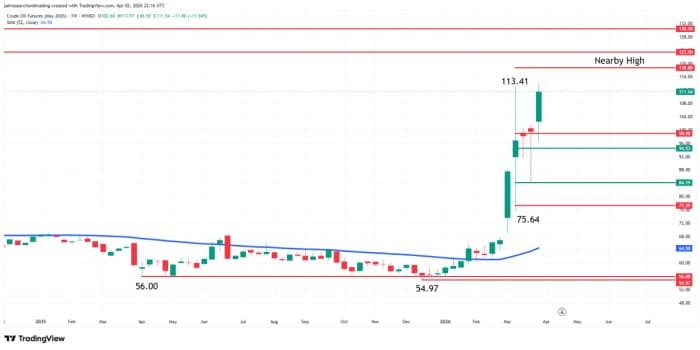
The main trend is up according to the weekly swing chart and moving average analysis. A trade through $113.41 will reaffirm the uptrend. The short-term range is $54.97 to $113.41. Its 50% to 61.8% retracement zone is $84.19 to $77.29, This is support. It was tested successfully when the market rebounded from a plunge to $84.37 two weeks ago.
The minor range is $113.41 to $75.64. Its retracement zone at $94.53 to $98.98 is new support. The current rally began inside this zone at $96.50.
Trader reaction to $111.54 should set the tone next week.
The longer-term trend is up according to the 52-week moving average at $64.50.
Weekly Technical Forecast
The direction of the weekly Light Crude Oil Futures market for the week-ending April 10 is likely to be determined by trader reaction to $111.54.
Bullish Scenario
A sustained move above $111.54 will signal the presence of buyers. This move could create the upside momentum needed for a breakout over $113.41. This would put potential targets and former tops at $118.80, $123.50 and $130.50 on the radar.
Bearish Scenario
The inability to hold $111.54 will signal the presence of sellers. If the selling is strong enough, we could see a retest of $98.98 to $94.53. But be careful selling weakness because this is where the dip buyers may re-emerge. If they fail to show up then don’t be surprised by an acceleration to the downside into $84.19 to $77.29.
Oil Prices Forecast: Bullish Bias with Volatility Ahead
The near-term oil prices forecast remains bullish, driven by ongoing geopolitical risk and constrained supply expectations. As long as tensions between the U.S. and Iran persist and the Strait of Hormuz remains under threat, the market is likely to maintain a strong risk premium.
However, traders should expect elevated volatility. Headline-driven price swings will dominate, with sharp moves in both directions depending on developments in the conflict. Any signs of de-escalation could trigger quick profit-taking, while further escalation could push prices even higher.
From a structural standpoint, the market has shifted into a tighter supply regime. Infrastructure risks, policy uncertainty, and active conflict have all contributed to a repricing of crude oil. While demand destruction is a longer-term consideration, it is not yet strong enough to offset current supply fears.
In short, the path of least resistance remains higher, but with wide trading ranges and fast-moving conditions. Traders should stay focused on geopolitical headlines, shipping flows through the Strait of Hormuz, and any changes in U.S. policy signals.
Technically, look for higher-highs to signal a resumption of the uptrend, and reversal tops to signal that the selling is greater than the buying at current prices levels.
Note that this type of nearly runaway rally almost always ends with a dramatic closing price reversal top with extreme volume. It will serve as an early sign that the selling is greater than the buying at current price levels, but not necessarily indicate a change in the trend. It could just be a formation that alleviates the tremendous upside pressure.
Expect heightened volatility because big money will want it all if prices are poised to move higher. They are not going to be shy about rattling a few trees and burning a few longs just to shake the weaker buyers out of the market so they can buy more at a cheaper price. This is why selling weakness will be risky.