
We broke down the pure dominance of AAA in March’s PlayStation top 5 by copies sold earlier this week, but the Steam data – as always – reveals a different dynamic. And it brings up an important difference in audiences, too.
Like on PlayStation, Resident Evil and Crimson Desert make a showing here too, but so do indies, early access, and a Resi game you probably weren’t expecting.
Let’s have a gander.
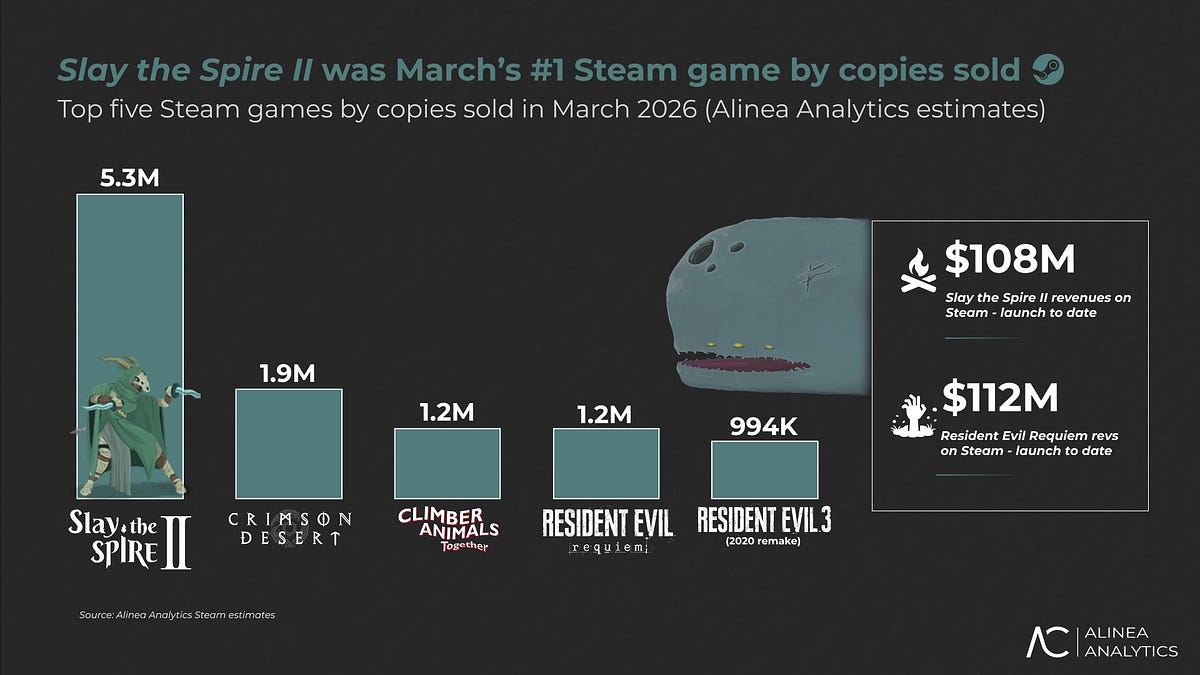
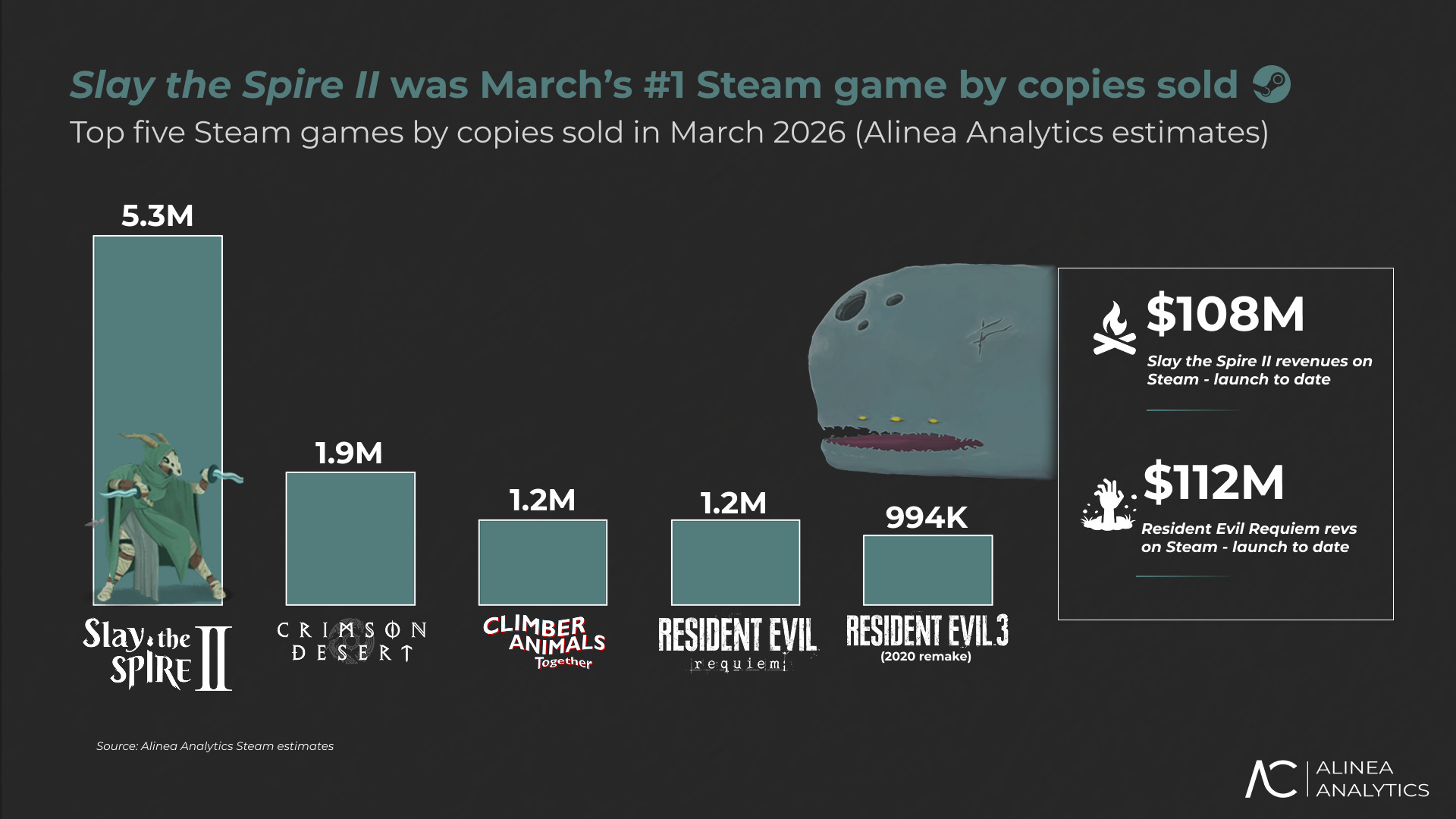
Mega Crit’s Slay the Spire 2 moved a nuts 5.3M copies in March for its early-access debut. To date, it has generated $108 million on Steam alone. All this is to say that Slay the Spire 2 easily takes Steam’s #1 copies sold spot for March:
 Slay the Spire 2 will go down as an all-time great early-access launch on Steam
What a launch, and thoroughly deserved. Anyway, over a third of Slay the Spire 2’s current player base is based in China, which has been true since launch.
Regional pricing is a huge factor here. Thee lower Steam cost in China means that while StS2’s Chinese volume is world-beating, the average revenue per user (ARPU, pronounced are-poo, no joke) is lower than a Western-only analysis might suggest.
That said, Slay the Spire 2’s dominance in China is having some adverse effects on user reviews. Our Steam review sentiment data shows that Chinese gamers in particular were unhappy with certain balance changes made during early access.
We’ve added more granular Steam review data to our platform, including splits by language and playtime. Across the board, we’ve observed that gamers in China are significantly more likely to use Steam reviews as a primary forum for feedback, and they’re way more negative, generally speaking:
Because of the Great Firewall and regional internet restrictions, many Chinese players lack access to international community hubs like X, Reddit, or official Discord servers.
As Steam is something of a grey area in China, Chinese players have become accustomed to making their views heard globally via Steam user reviews.
For early access games, which actively encourage community feedback, this is doubly true. And Slay the Spire 2 is certainly no exception.
In our platform (get a free trial!), we looked at our language-specific data for over 100K Slay the Spire 2 Steam reviews. While the game maintains a respectable 79% positive user score overall, that average is being heavily pulled down by the Simplified Chinese segment:
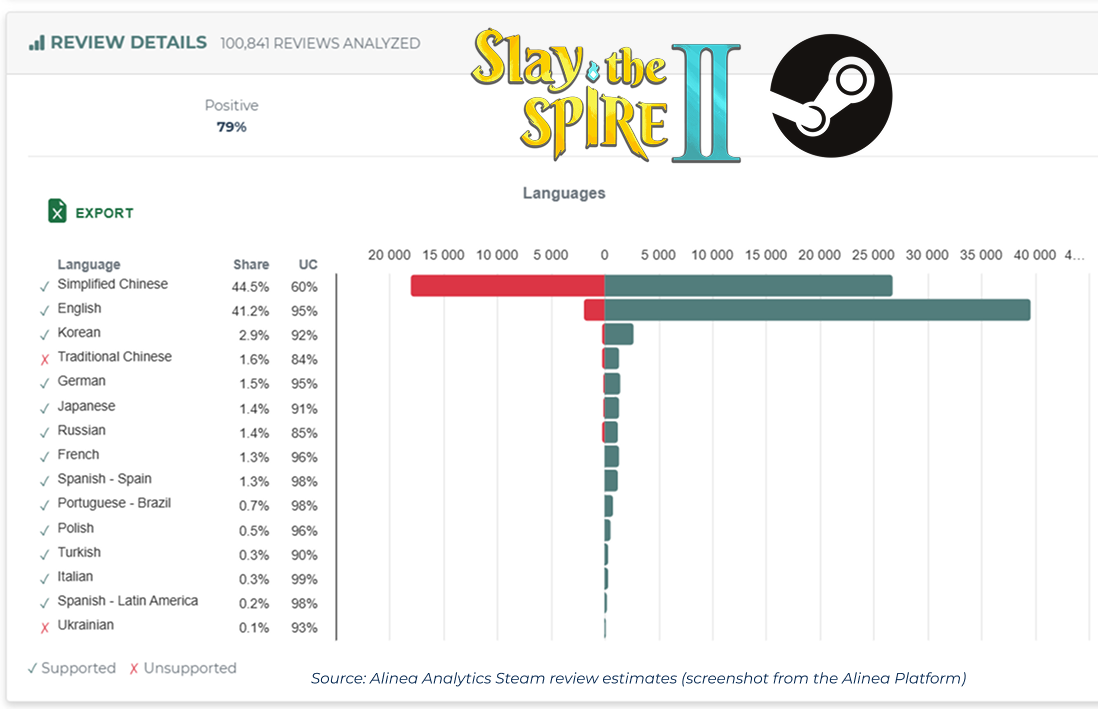
As you can see:
Most language groups score Slay the Spire 2 at 90% positive or higher. This holds for English-speaking players, who represent the second-largest demographic at 41.2% of the user base. They’re over 95% positive.
But reviewers playing in Simplified Chinese, the #1 language group accounting for 44.5% of all players, currently sit at only 60% positive.
When we take Traditional Chinese out of the equation, the positive review score jumps from 79% to 94%.
This underlines just how much of a juggling act community management can be – especially when a game is popular across different demographics, often with different needs, wants, and sentiments.
Speaking of awesome community management…
Our estimates show that Crimson Desert sold nearly 2M copies on Steam last month. As per official publisher announcements, Crimson has now sold through over 4M copies across platforms. And it did so in under two weeks. You love to see it, but Crimson Desert had far from a smooth landing.
The initial launch was a bit of a mixed bag, with many critics simply not getting Crimson Desert. Many players found the rough first-time user experience frustrating.
I played Crimson Desert at launch – a lot of it, truth be told – and while I was in camp ‘’this game is rad’’, there’s a clear lack of tutorialisation and plenty of mechanical friction.
I can see why this put off a lot of folks. The controls were complex at launch, with basic actions requiring multi-button combinations. Luckily, this has largely been fixed.
Crimson Desert’s early friction was always worth pushing through, anyway. Our playtime-indexed data shows just a 31% positive user score for players with less than one hour of game time, signalling that Crimson Desert was its own greatest enemy during the first sixty minutes or less.
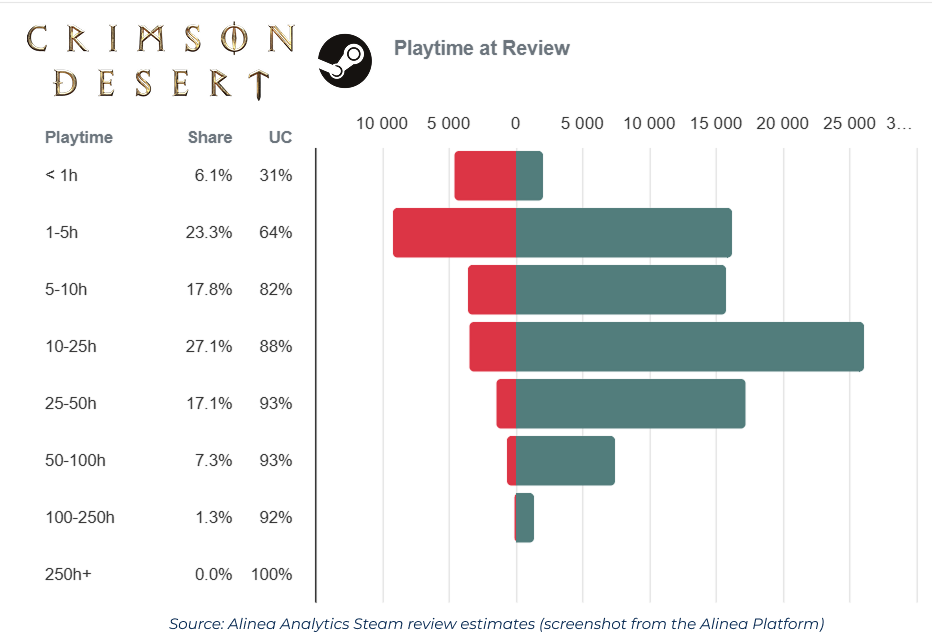
But as you can see, for players who persisted through those early hours, the narrative shifts dramatically, and the game has been fantastic:
Crimson Desert’s positive user score jumps to 64% for the 1-5h group, already a massive increase from the 31% for sub-1h players.
Positivity jumps further to 82% at the 10-hour mark and hits a peak of 93% forthe hardcore cohort logging 25h+.
This suggests that while the mechanical friction is real, it is eventually overshadowed by the fantastic sandbox adventure that Pearl Abyss has crafted.
The market reward for this responsiveness has been .. a thing. While the early reception led to a stock dip and many folks questioning the game’s market viability, Crimson Desert has stuck the landing and proven naysayers and fickle traders wrong.
While the stock market is typically a bollocks barometer for sentiment, Crimson Desert’s stock has now stabilised, and positive Crimson Desert word of mouth has continued spread. The game’s community management has been frankly incredible so far. The marketing, PR, and community folks have smashed it.
This is worth commending, as Crimson Desert’s polarising start could have easily spiralled into a longer-term commercial and PR failure – if not for the studio’s agile community management.
In the critical day after the Crimson Desert’s March 19 release, Pearl Abyss avoided the common pitfall of corporate silence during rough times.
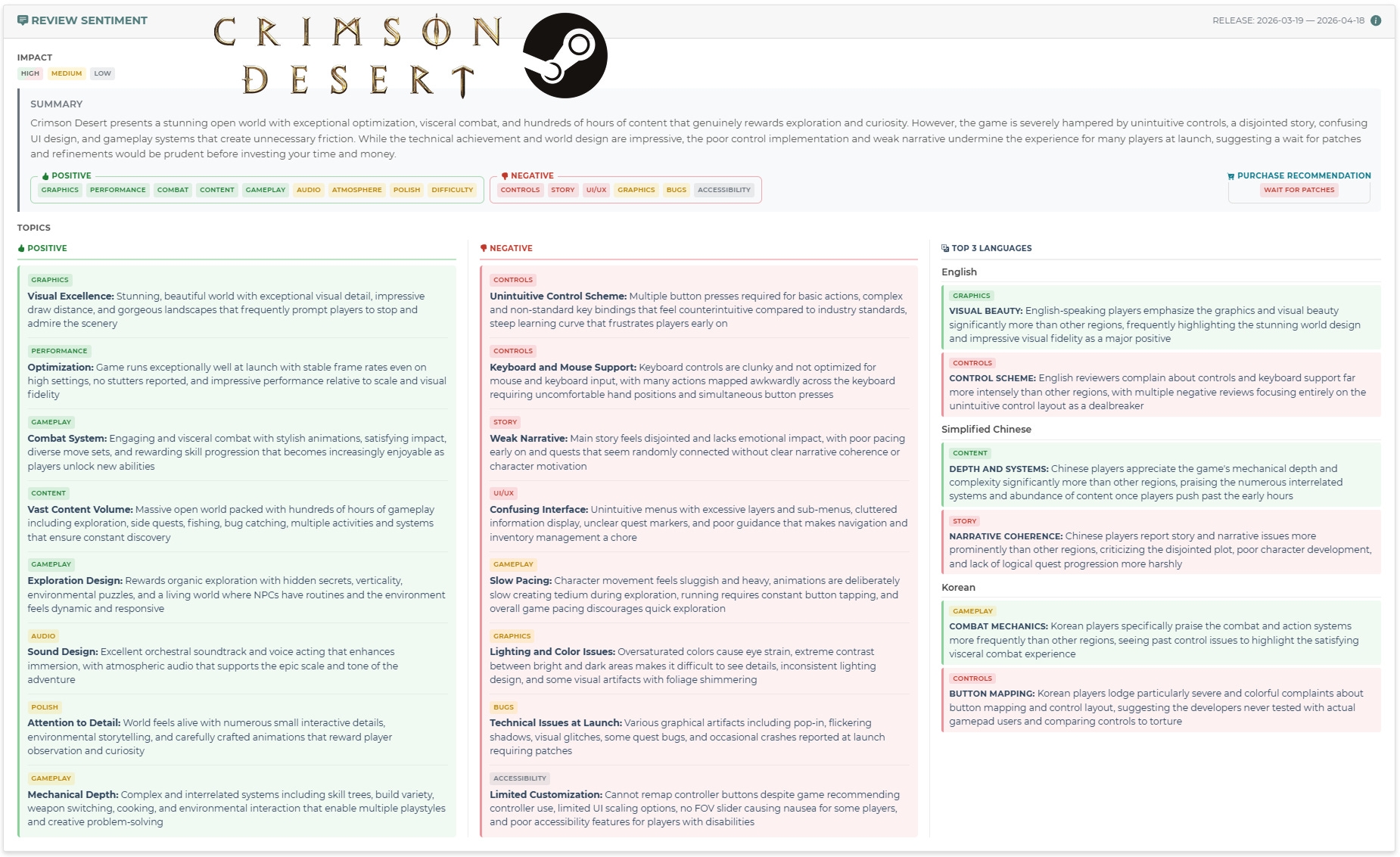 The review data in our platform shows that players love a lot about Crimson Desert. Want to see our sentiment data on your competitor’s game? Reach out for a free trial
Instead of staying tight-lipped, Pearl Abyss sent out a direct apology for the controls. This immediate acknowledgement was a pressure valve for the community’s frustration, also signalling to prospective buyers that the launch-day friction was a technical oversight rather than a fundamental design choice.
Words are cheap. Luckily, Pearl Abyss, though, followed through just days later with the release of Patch 1.01.00 on March 28. This update fundamentally changed key aspects of the player experience, addressing the clunky keyboard and mouse selection and the much-maligned stamina costs for aerial traversal.
The devs shipped these changes within a week and communicated them perfectly. Positive word of mouth for Crimson Desert has been incredible, converting many of these “Wait for Patches” sceptics into active players, as shown in our estimates.
Given the stellar community management surrounding Crimson Desert, the team’s agility in hearing the community and shipping fixes, and the veracity of the player base, this title is clearly moving beyond its launch phase confidentally.
Crimson Desert is now firmly established as a permanent IP and will go down as one of 2026’s defining success stories when all is said and done. It’s also a lesson for the stock market and certain aspects of the internet: critics are awesome and necessary for our industry, but it’s players – and communities – that matter most.
Hell yeah.
As for the rest of the Steam’s March copies sold ranking:
Climber Animals Together took #3 with 1.2M copies sold in March. After a relatively quiet debut in 2024, Climber Animals exploded in early 2026 following a successful self-release strategy in China. So-called friendslop games often land on short-video-streaming platforms, then they blow up. And the same goes in China on platforms like Douyu or Bilibili, Even after the fact. Still, despite being #3 on the copies sold list, Climber Animals generated under $6M in March revenue due to its ultra-low price point. The next game on our list – a premium title – generated over 10x that revenue with nearly identical unit volume.
Resident Evil Requiem also moved 1.2M on Steam last month, but the financial outcome was a massive $70M. This brings Requiem’s Steam total to 2.9M copies, technically edging out the PS5’s 2.8 million. Yet, as we highlighted in our PlayStation report, the PS5 version has generated more – now at $201M in versus Steam’s $168 million. This is due to regional pricing and the tier-1-market concentration of the console audience. However, the next game – also a Resi one – highlights a longer-term benefit of Capcom’s Steam-first strategy.
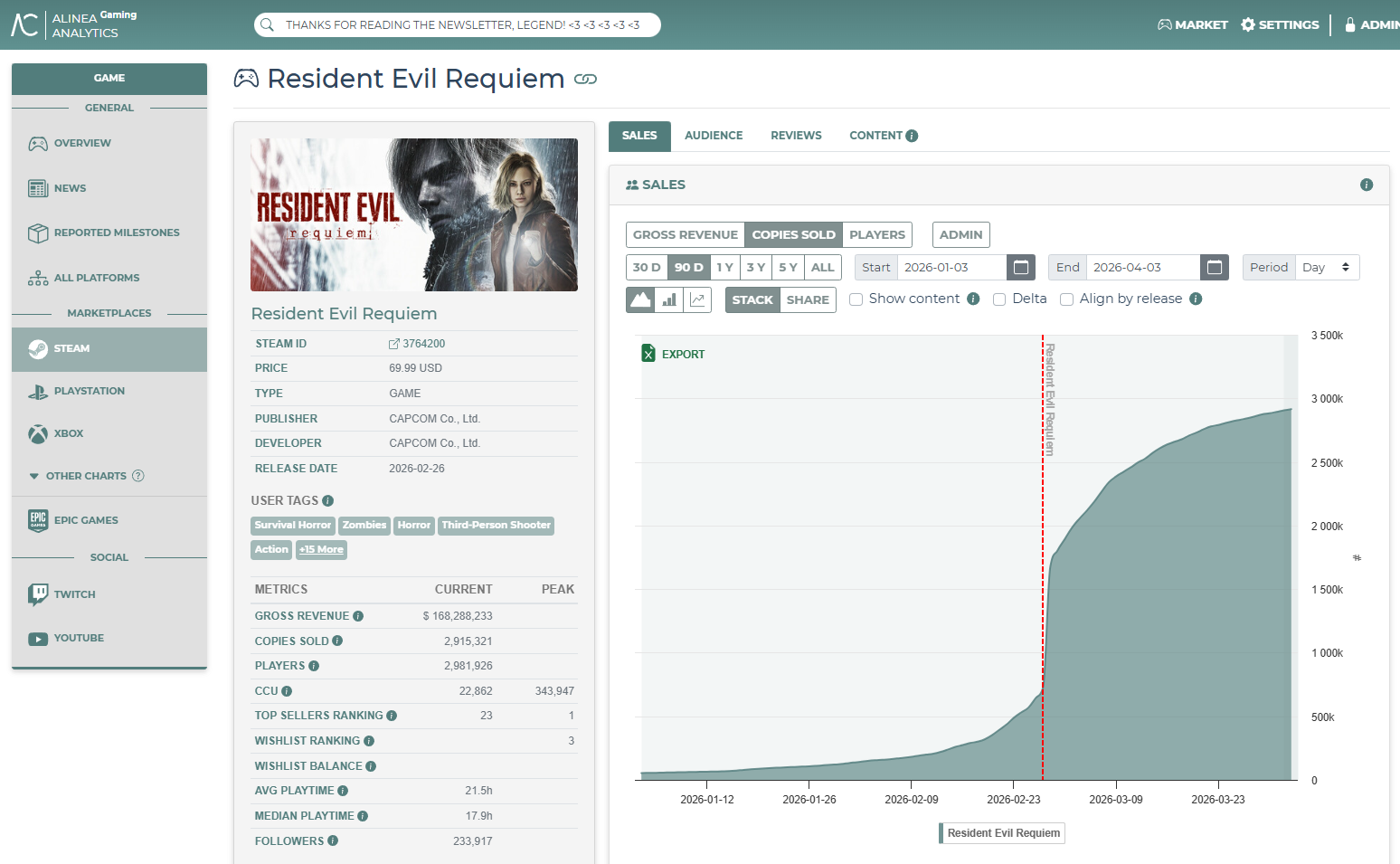
Resident Evil 3’s 2020 remake nearly one million copies on Steam in March. Sure, a bit of this is the halo effect from players Requiem, but the real driver was a massive 90% Steam discount that dropped RE3’s price to $3.99 on March 19. Capcom sold 95% of its March volume during this 11-day window, generating a respectable $8 million in passive back-catalogue revenue. This is another reason for Capcom’s PC-first mindset: the Steam audience is far more receptive to deep, aggressive discounting than other platforms
Food for thought: While console players often wait for subscription services like PS Plus or Game Pass to satiate their backlog needs, Steam users are primed for the impulse buy during smart discount windows. Publishers know this.
Third parties like Capcom are now masters of managing these deep-sale cycles, making sure legacy titles continue to act as revenue generators years after the initial release. While this is true on console as well, these kinds of discounts have far more impact on Steam – partially due to the higher share of players from price-sensitive markets.
The March data across Steam and PlayStation shows that the death of consoles narrative is overblown. Steam acts as a high-volume engine for global reach and deep-sale liquidations, but PlayStation is still a fortress for the $70 premium standard.
These platforms co-exist as different tiers of the same funnel. So, successful publishers in 2026 are not choosing one over the other. Companies like Capcom and Pearl Abyss are using the strength of different platforms to usher in massive launches.
We’re offering a free trial of our platform for games companies.
Send us a message here, or reply to this email, and we’ll set you up.
Reply to this email – or reach out here – if you have any feedback for the newsletter – or want to request a game for us to cover.
[Alinea Analytics boasts the most accurate PC and console estimates in the business. Game makers use our platform to understand their audience, keep an eye on the competition, monitor sales trends, and spot new opportunities. We equip game studios and financial institutions with accurate data and the confidence to make smarter, data-driven decisions. Want to talk about all things games market data? We’d love to chat!]