
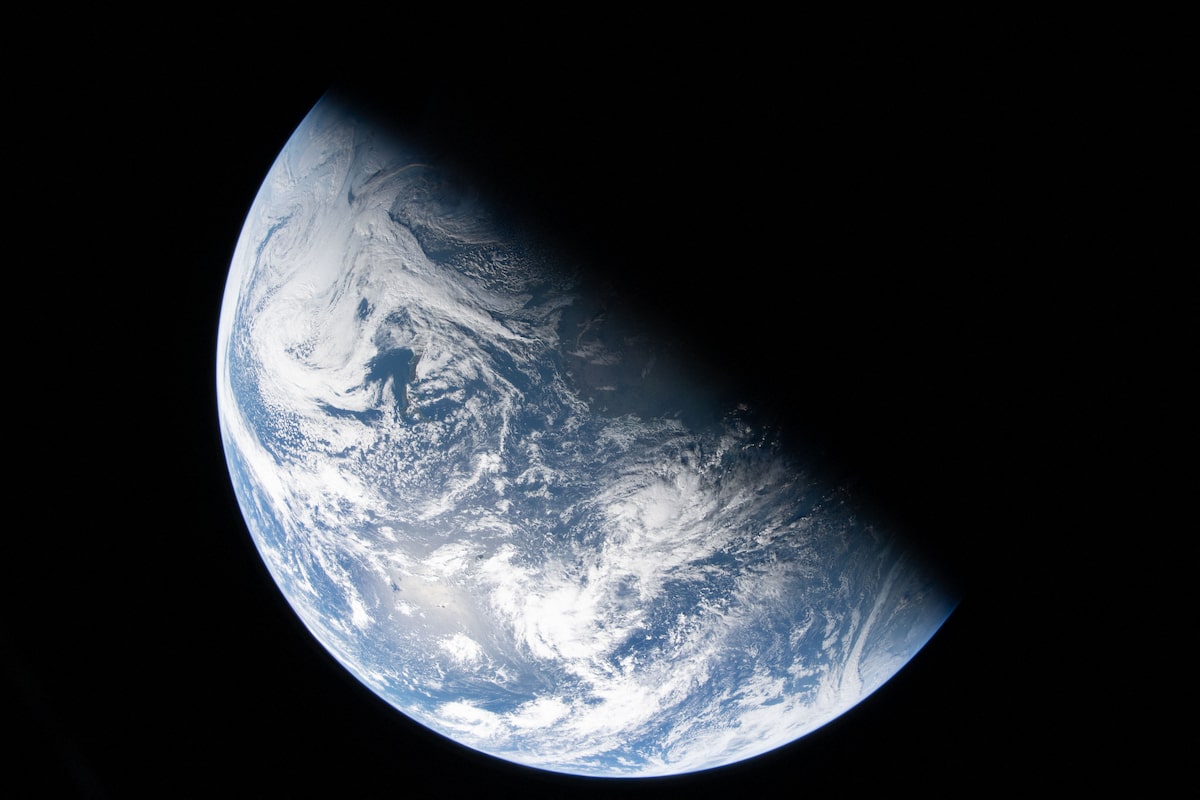
Earth as seen through the Orion spacecraft’s window, photographed by NASA astronaut Reid Wiseman, commander of Artemis II, on April 3, after completing the translunar injection burn.REID WISEMAN/NASA/AFP/Getty Images
From the Stone Age to Sinatra, there is ample evidence that the moon has always commanded our attention.
Precisely why is a deeper question. Perhaps John Keats put it best more than two centuries ago, when he wrote:
“What is there in thee, Moon! That thou shouldst move my heart so potently?”
It’s a good bet that Keats wasn’t thinking about space travel when he penned those memorable lines. But it’s also fair to say that without a moon to aim at, the desire to explore what lies beyond the limits of our home planet may have burned less intensely.
Prior to the invention of the telescope, astronomers already knew the moon was nearest among the celestial objects. And well before rockets were technically feasible, Jules Verne and other writers were imagining what a voyage to the moon would be like.
For a four-year period starting in 1968, astronauts with NASA’s Apollo program brought that fantasy to life. Now the crew of Artemis II is on its way to do the same when they reach their closest point to the moon on Monday afternoon.
The four astronauts, including commander Reid Wiseman, pilot Victor Glover and the crew’s two mission specialists, Christina Koch and Canadian astronaut Jeremy Hansen, lifted off from the Kennedy Space Center in Florida on Wednesday evening.
One day later, their spacecraft fired its main engine to put them on course for a lunar rendezvous.
From the outset, the main purpose of the mission is to test NASA’s Orion crew capsule with people on-board. For their journey around the moon, the crew have named their vehicle Integrity.
To that end, the crew spent much of their first two days in space checking the performance of environmental controls and testing out equipment, such as the capsule’s exercise machine. They also had the opportunity to communicate with family members and held a live press conference from their capsule on Thursday night.
In a briefing at Houston’s Johnson Space Center on Friday, mission managers provided an overview of the progress that has been made so far, including various challenges related to maintaining temperature and humidity in the crew cabin.
NASA also shared some of the crew’s first images of the entire Earth – something that can only be seen from a distance of thousands of kilometres. The International Space Station is far too close for such a view, so by nature, these pictures imply a very different kind of space voyage.
Referring to one image with parts of the capsule in the foreground, Orion program manager Howard Hu said, “It just brings a lot of great emotion to me to see that picture.”
Now rapidly moving away from Earth, the crew said they can also see the moon. It will soon be growing larger.
The crew of NASA’s Artemis II mission contacted Earth via video on Thursday (April 2) to talk about their experience just after completing the translunar injection burn that is leading them towards the moon.
Reuters
In the coming days, Integrity will trace a figure-eight loop around the moon and back. Along the way, the astronauts are set to witness something that very few have seen before: the moon’s far side. Lunar researchers are keen to seize this opportunity.
“We have a number of objectives for lunar science on the mission, and they’re prioritized based on what humans can uniquely contribute to them,” said Kelsey Young, a planetary scientist at NASA’s Goddard Space Flight Center in Maryland, who leads the lunar geology campaign for Artemis II.
The moon is gravitationally coupled to Earth in such a way that the same hemisphere is always facing toward us. The far side remained hidden until spacecraft could get there and send pictures. These days, the most comprehensive look at the far side comes from the Lunar Reconnaissance Orbiter, a robotic spacecraft that has been mapping the moon since 2009.
This image shows a view of Earth taken by NASA astronaut and Artemis II Commander Reid Wiseman from of the Orion spacecraft’s window.NASA/Reuters
But robot eyes are not the same as human eyes. And because of the way the Apollo missions were timed, there are parts of the far side that have yet to be seen by people.
This is why part of the Artemis II crew’s training regimen has included a deep dive into lunar geology. The aim is to help them spot interesting features and potentially see the moon’s surface in a new light.
The timing of the mission launch largely dictates what Colonel Hansen and the others will see. As things have worked out, the moon was full on the evening that Integrity rocketed into space. At that moment, the far side was in near-total darkness, because the near side was fully illuminated.
By Monday afternoon, when Integrity is behind the moon, the sun’s angle will have shifted and about 20 per cent of the far side will be in daylight. This may not seem like very much, but geologists have prepared the crew for all scenarios, including one where the far side is receiving light from a low angle.
With a mighty burn, Artemis II flings itself moonward
Such conditions make for long shadows, and features along the line that separates light from dark will be particularly crisp, which can amplify details on the moon’s surface. It’s there that the crew will be likely be training their eyes and cameras the most during closest approach.
No matter what, it will make for interesting viewing. Even at its closest, Integrity will be thousands of kilometres from the moon, so the effect will not be an ultra close-up, but a big picture.
For the broader lunar program, it will also be a taste of things to come.
“Being able to see the lunar surface with human eyes is a huge milestone” said Artemis II flight director Judd Frieling at Friday’s briefing. ”It just articulates the point that we’re going back to the moon.”