
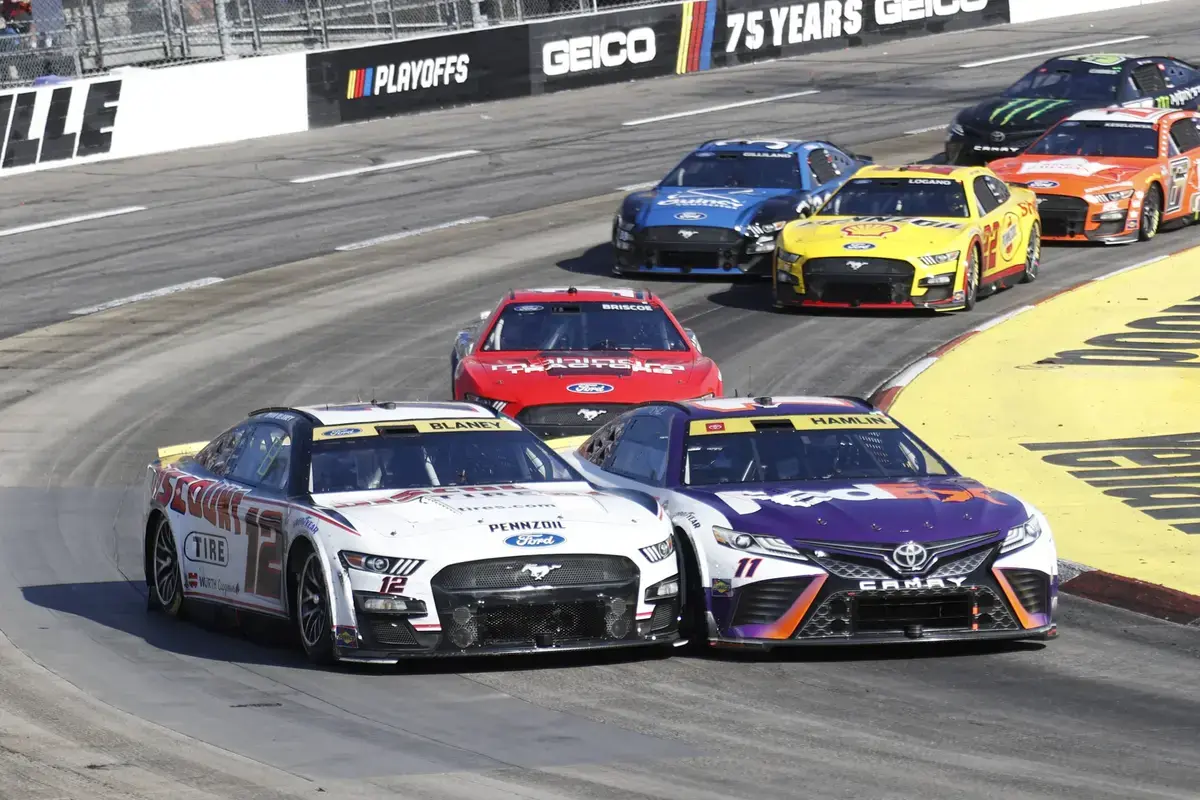
Hamlin’s aggressive driving style creates controversy following Martinsville incident.
Veteran racer continues testing limits while rivals weigh intensity against overreach.
Another late-race collision leaves the field questioning Hamlin’s reputation.
Punches thrown, middle fingers raised, and relentless door-to-door battles have long defined NASCAR’s edge over more finesse-driven open-wheel racing. But where is the tipping point between intensity and overreach? It’s a question long embedded in NASCAR’s DNA.
Now, with the NASCAR Cup Series on an off-week, that debate has resurfaced, this time with Joe Gibbs Racing veteran and 2025 championship runner-up Denny Hamlin at the center of it. The Cook Out 400 at Martinsville Speedway added another chapter, as Hamlin’s late-race contact with Ryan Blaney sent the No. 12 into the wall.
Blaney has since downplayed the incident, calling it a racing deal. But given Hamlin’s reputation for walking the fine line, how long will the rest of the field keep giving him the benefit of the doubt? Here’s a deeper look at the No. 11’s Martinsville flashpoint and the growing pattern that’s becoming harder to ignore.
Same move, different driver: Hamlin’s NASCAR playbook hits Blaney
The tension was evident, and so was Blaney’s frustration. Speaking after Sunday’s race, he didn’t hold back, telling NASCAR, “I got ran in the fence. It’s definitely unfortunate what happened. I don’t really think I deserved what happened. It was the first time we were around each other all day, so I’m pretty curious why I got stuffed in there like that.”
The 2023 Cup Series champion came into the half-mile track following a pit road miscue at Darlington, eyeing his second win of the season, but the contact with the JGR Toyota ultimately forced him outside the top-5.
Battling for third and fourth in the closing stage, Hamlin and Blaney went head-to-head until contact on lap 334 sent the latter sliding down the order. Coming to the line a lap later, Hamlin held the inside lane while Blaney ran high, but the No. 11 drifted up on corner exit and squeezed the No. 12 Ford of Blaney into the outside wall.
Hamlin later explained he had lost rear grip in the moment, with the car stepping out and carrying him higher than expected. Although the 2023 champion was frustrated by the veteran’s shove, he softened his stance after Hamlin offered his take, as the two spoke post-race.
In the end, Blaney came sixth, racking up his fifth top-10 finish of the season while the JGR ace finished second behind race-winner Chase Elliott.
Hamlin under the spotlight
Later on, reflecting on the incident, the Team Penke driver told SiriusXM NASCAR, “We talked after the race. We’re all good. He got free off of turn four trying to put the throttle down, so he was higher than I thought he would be… We both went into the fence. Obviously, I got the bad end of it, but I don’t think it was anything intentional.”
In hindsight, the Martinsville incident marks the second straight week Hamlin has found himself under the spotlight. Just a week earlier at Darlington, the three-time Daytona 500 winner spun fellow Toyota driver Erik Jones of Legacy Motor Club.
Hamlin took responsibility for that incident, and Jones appeared to accept the explanation. It once again raises the question: How long will Hamlin continue to get the benefit of the doubt?
A pattern of aggression: Hamlin’s history of walking the line
If the Martinsville contact felt familiar, it’s because the 45-year-old has operated on this razor’s edge for much of his career, particularly in high-pressure moments where track position is everything.
One of the clearest examples dates back to October 29, 2017, at Martinsville. Chasing a spot in the Championship 4, Hamlin made heavy contact with Elliott in the closing laps, spinning the Hendrick Motorsports driver from the lead. Elliott’s retaliation on the cooldown lap became an instant flashpoint, but the bigger takeaway was Hamlin’s willingness to force the issue when the stakes were highest.
The incident lingered for years, fueling frustration among Elliott and the HMS fanbase toward Hamlin. However, the No. 9 driver has since cleared the air, saying everything between the two is now water under the bridge following his recent win.
That same trait resurfaced twice years later at Pocono Raceway. The veteran leaned on Trackhouse Racing’s Ross Chastain during a late restart, squeezing the No. 1 driver into the wall en route to victory. Whether viewed as hard racing or calculated aggression, it reinforced a growing perception: Hamlin rarely yields once he commits to a line.
A year later, on July 23, 2023, Pocono delivered deja vu. This time, the victim was Hamlin’s friend-turned-rival Kyle Larson. As the two battled for the win, Hamlin again drifted up on corner exit, forcing the reigning champion into the wall. The contact drew sharp criticism, with Larson openly questioning Hamlin’s approach and whether it crossed the line from assertive to excessive.
NASCAR reputations stick
Even outside race-winning scenarios, similar moments have surfaced. From tight squeezes with William Byron at Texas to mid-pack run-ins that don’t always grab headlines, the underlying theme remains consistent: Hamlin maximizes exit speed and track position, often leaving his competitors to decide whether to lift or risk the consequences.
That context is what gives the Blaney incident its weight. On its own, it’s defensible as a racing deal. But stacked against years of similar situations, it becomes part of a broader pattern that drivers are increasingly aware of.
Blaney may have moved on from the latest stint, but the rest of the field is always watching. And in NASCAR, reputations stick. Hamlin is good enough to race right on that edge. The real question is how long he can stay there before someone decides they’ve had enough.