
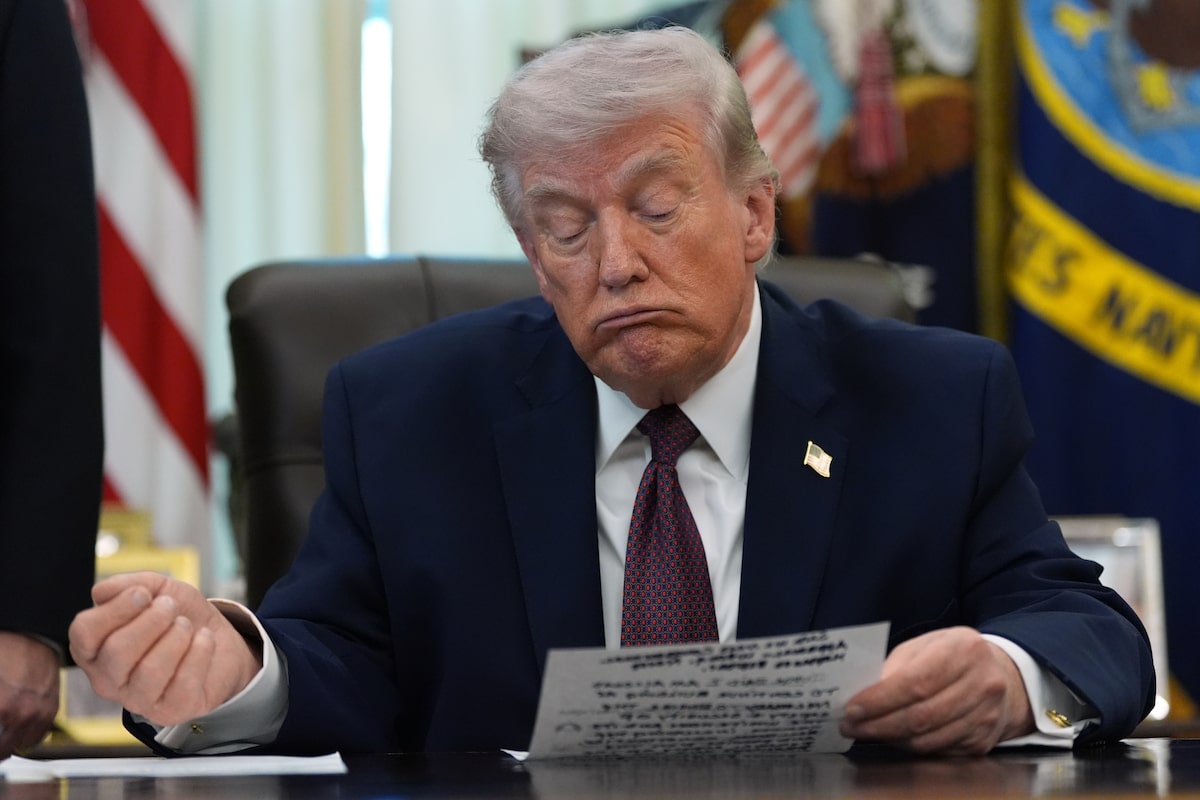
U.S. President Donald Trump after signing an executive order in the Oval Office of the White House on March 31, in Washington.Alex Brandon/The Associated Press
The president proposes, Congress disposes.
For generations, every American schoolchild learned in Grade 9 civics class that those five words were an effective shorthand to understand much of the country’s government.
No more, as demonstrated in recent days by the President’s release of his fiscal-year 2027 budget, Congress’s continued deadlock over the 2026 spending plan and Donald Trump’s peremptory order to pay Department of Homeland Security personnel despite congressional inaction.
The budget that Mr. Trump released Friday and the spending impasse on Capitol Hill provide vivid demonstrations of the failure of a superpower to manage its own counting house.
For Trump, putting his mark on things is another way to display his power
On the surface, Mr. Trump conformed, broadly speaking, to the structures of the Congressional Budget and Impoundment Control Act of 1974, which established a process in which a president submits a budget and the twin budget committees of two branches of Congress then examine and debate it.
The fact that the Trump budget came two months after the statutory requirement for its submission, is both relevant (another example of the breakdown of process in the capital) and irrelevant (the budget process pretty much is meaningless).
Likewise, the contents of the Trump budget are both relevant (he’s likely to get most of the US$1.5-trillion he’s requesting in military spending, plus some of the 10-per-cent budget cuts to domestic matters he’s proposed) and irrelevant (because in the end, unless Mr. Trump intervenes with another executive spending order, Congress makes the granular decisions, if it can actually bring itself to do so).
“The President submits a budget and then Congress is pretty much free to ignore it,” said Kimberly Clausing, an economist at the University of California, Los Angeles Law School.
Almost always it does. From the Ronald Reagan years to the Barack Obama era, lawmakers liked to describe presidential budgets as “DOA” (dead on arrival). In the Trump years, even with pliable Republican lawmakers on Capitol Hill, they range from being in critical condition to resting on the precipice of interment.
Even so, there is a secondary value to taking White House budget submissions with some seriousness.
They are discrete glimpses of presidents’ visions, statements of their priorities, and catalogues of their proposals. In one document, presidents set forth their road maps for governance with more clarity and more specificity than they can achieve in a campaign stump speech, a national-convention party policy platform, or a set-piece address in the Oval Office or at a joint session of Congress.
Thus, the relevance of Mr. Trump’s request for a substantial increase in defence spending, which comes amid a drawdown of military assets in the Iran war. The U.S. would then be at roughly 4.5 per cent of GDP, approaching the 5 per cent that the President has set for NATO countries by 2035. (Canada reached the current 2-per-cent NATO goal in March.)
The proposed increase in defence spending – still putting it at about half the rate of the Cold War 1960s – is a statement of the administration’s determination to continue to match military power with the muscular foreign policy that has taken form in Venezuela and Iran.
The unknown in this calculus is the President’s sway over the Republicans who control both houses on Capitol Hill, but whose hold on that power is slim and endangered. Polls and analysts’ estimates suggest the likelihood of the Democrats taking over the House of Representatives and the possibility, though not the likelihood, of seizing control of the Senate.
In this environment – and with Oxford Economics estimating an average forecast for Brent crude oil prices of US$113 per barrel in this quarter of 2026, indicating continued high gasoline prices that imperil Republican political prospects – lawmakers may proceed with caution.
They likely will look favourably at increases in immigration enforcement and, after several air travel accidents including the Air Canada collision in New York, at proposed increases in aviation safety and increased hiring of air-traffic controllers.
But other cuts in popular domestic programs may not fare as well.
There may be resistance to Mr. Trump’s proposal to eliminate teacher-training programs (similar programs, which the budget document dismisses as “$70-million used to indoctrinate new teachers,” have won broad bipartisan support in the Michigan legislature, for example) and to cut US$15-billion in clean-energy subventions (perhaps these projects are more appealing at a time of high oil prices).
The legacy of Trump, multitasker-in-chief, might amount to far less than his ambitions
Already, some Republicans have broken with Mr. Trump on some domestic spending cuts, particularly health care for the working poor. GOP Sen. Josh Hawley of Missouri, a potential 2028 presidential candidate, last year described such reductions as “morally wrong and politically suicidal.”
The Trump budget submission sets the stage for an animated political debate over the broader philosophy of American government. The following passage alone, which introduces requests for cuts in housing, banking, minority business enterprises and environmental programs, is the predicate not only for this year but also for the 2028 presidential election:
“President Trump is committed to eliminating radical gender and racial ideologies that poison the minds of Americans. The President’s FY 2027 Budget upholds the Constitution by eliminating funding for cultural Marxism.”
In that regard, if not in others, the Trump budget may be relevant after all.