
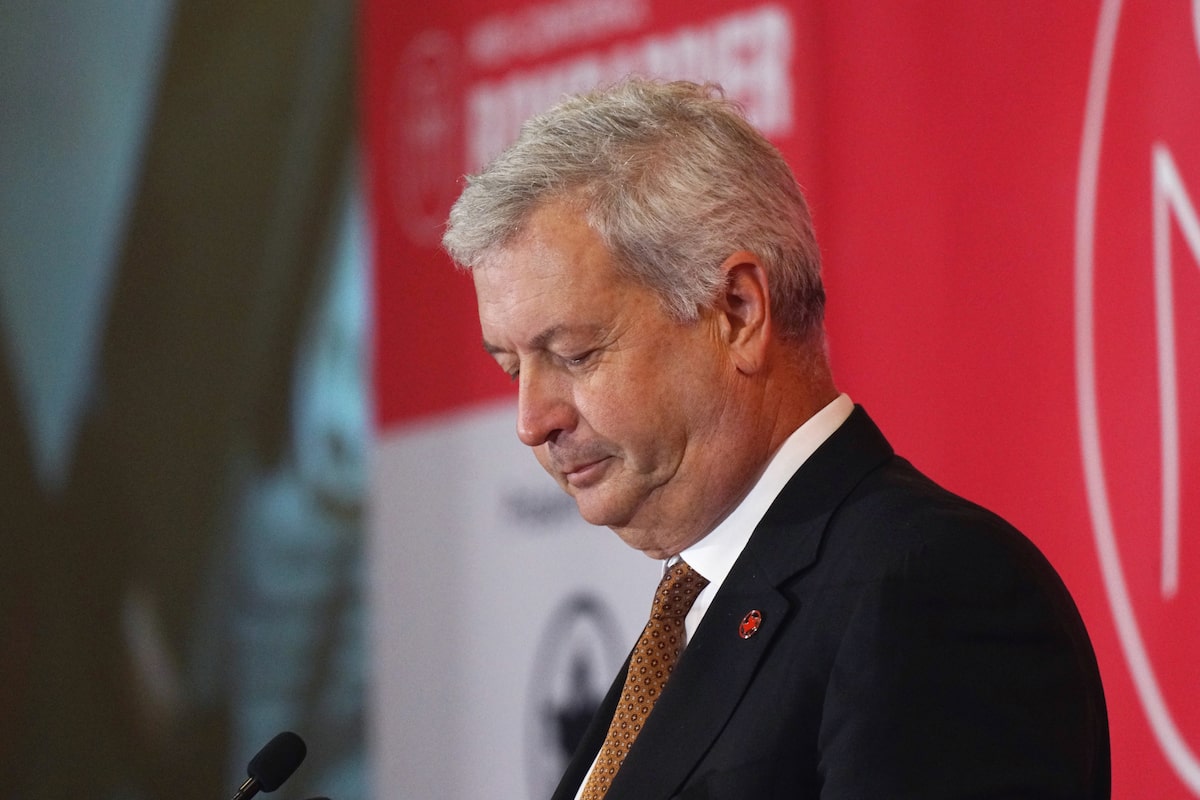
Rousseau giving a speech — famously, in English — at the Montreal Chamber of Commerce in 2021.Mario Beauregard/The Canadian Press
It took exactly one week for Air Canada AC-T CEO Michael Rousseau’s English-only statement on the New York plane crash to escalate to the point the airline’s board announced his retirement. It won’t take much longer for the fallout to rip through the corporate world.
In boardrooms and C-suites across the country, directors, executives and their advisors are still dazed at the speed at which Mr. Rousseau’s gaffe blazed into a crisis for his employer and forced his premature departure. Some even argued the whole thing was a farce that was overblown.
But for many in Quebec, a province fighting to save its language in a continent of English-speakers, the CEO’s exit is the inevitable outcome of an executive who was deeply out of touch with his milieu and a board that arguably failed to monitor his obvious shortcomings. And in that, there’s a warning for others.
Bradley Akubuiro, former head of media relations for Boeing Co., said language holds a deeper meaning in Quebec.
“Language isn’t just a means of communication in Quebec, and it isn’t just a legal requirement. It is an identity,” he said. He now leads consultancy Bully Pulpit International’s corporate communications practice from Chicago.
“For leaders watching this and wondering whether to pull back on public statements: There was never a scenario where a clean win was possible here – the incident was truly tragic,” Mr. Akubuiro said. “But a real understanding of your most critical stakeholders can keep you from unforced errors that create further crisis.”
Air Canada CEO Michael Rousseau’s retirement advanced by a year after English-only video controversy
Last Monday, before heading off to the crash site in New York, Mr. Rousseau and his handlers recorded a four-minute video in which he shared the latest information about the collision and expressed his condolences to the families of those dead and injured. Despite vowing to learn French five years earlier and taking courses, he spoke exactly two words in French in the message: “Bonjour” and “Merci.” The rest was translated into French using subtitles.
The CEO sought to provide reassurance and sympathy in his video. Instead, he alienated thousands of French-speaking Air Canada employees and Canadians in what Prime Minister Mark Carney called a “lack of judgment and lack of compassion.” Quebec’s National Assembly passed a nearly unanimous motion demanding the CEO resign.
The flight’s captain, who died, was a francophone. So too is a flight attendant who was thrown violently from the aircraft and found down the runway still strapped to her jumpseat. She’s now in hospital recovering from serious injuries.
Two big Air Canada shareholders, the Caisse de dépôt et placement du Québec and Desjardins, said a bilingual video would have been more appropriate. Under legislation that privatized the airline in 1988, Air Canada is subject to the Official Languages Act and has to provide services in English and French.
Pierre Rodrigue, a strategic adviser with public affairs agency TACT Conseil in Montreal, said there’s going to be “a call for prudence” from Quebec boards in the weeks ahead, telling staff to stay focused on the business and think through their relationships with stakeholders.
“There’s going to be a reminder from them to say ‘Look what happened at Air Canada. Are we fully aware of our own business reality and all the potential impacts of our projects, our decisions? Closing a factory, shutting credit union outlets. Doing this or that. Are we sure we’re not heading towards any slippery ground?’”
Opinion: Air Canada’s board shares blame for CEO’s latest French faux pas
For Quebec companies with anglophone CEOs, there’s a more immediate problem: Making sure they’re not lumped in with Air Canada. That’s especially true in a provincial election year, when political candidates are often keen to score points at the expense of others.
Quebec corporations are sometimes cagey when asked about the language competencies of their senior leadership. The Globe reached out to several companies requesting information on how they manage the situation but received no detailed replies.
Canadian National Railway Co. was one exception. Based in Montreal and run by CEO Tracy Robinson, a former executive with CP and TC Energy, the railway operator is also subject to the Official Languages Act as a former Crown corporation.
Ms. Robinson began French lessons after taking the job four years ago. “Tracy continues to improve her French,” said CN spokesperson Jonathan Abecassis. “She has taken and continues to take every opportunity to do so and, as a result, her French continues to improve, notably her written and oral comprehension.”
CN came under fire from shareholders and others in 2022 for failing to nominate any executives whose first language is French to its board of directors.
Richard Leblanc, professor of law, governance and ethics at York University, called it “a little embarrassing” for a Quebec-based organization. “The signal could be that French-speaking employees and customers are second-class citizens because they’re not represented. And the query is: Why?” he said at the time.
CN eventually rectified the situation.
Questions about the use of French in Quebec’s corporate offices have multiplied since 2021, when Mr. Rousseau made a speech in Montreal almost entirely in English. He later told reporters he has managed to live in the city for 14 years without learning French, sparking widespread condemnation on Parliament Hill and in Quebec City.
In many ways then, Mr. Rousseau “already had a target on his back,” Mr. Rodrigue said. “I never saw any scenario where he would keep his job after this.”
In a bid to correct a language pendulum it says is swinging too far away from the use and adoption of French in daily life, Premier François Legault’s government enacted a major update of Quebec’s Charter of the French Language that came into force in June, 2022.
The law mandates employers to communicate with their employees in French and empowers citizens to sue businesses that fail to serve them in French. It also tightens the use of languages other than French on product packaging, signs and commercial advertising.
Opinion: Air Canada learned nothing during the five years since its last French scandal
Most companies doing business in Quebec back the spirit of these rules and comply with them, particularly multinationals that are used to operating in several languages. Many of those with unilingual English CEOs have also learned that they need to empower other senior executives who can speak publicly in French if needed.
The last time Quebeckers elected a provincial government four years ago, the French language skills of CEOs became a campaign issue. The trigger? Alimentation Couche-Tard and its then-CEO Brian Hannasch, who still didn’t understand French after nearly 8 years in the job and told a reporter he didn’t intend to learn it.
Gabriel Nadeau-Dubois, a spokesperson for the Québec Solidaire party, called out “the arrogance of the big bosses” during that campaign. Parti Québécois Leader Paul St-Pierre Plamondon used it to argue for Quebec separation, saying Canada’s institutional bilingualism creates no incentive to learn French.
Mr. St-Pierre Plamondon is saying the same thing now at a time his party is riding high in the polls, particularly among francophones. “I maintain that we would be wrong to think that the Rousseau case is an isolated episode that has now been resolved for good,” he wrote on social media.
Whether the topic will generate headlines again during the next provincial election in October, or lead to any other meaningful and lasting developments, remains to be seen.
“The status of French in Quebec is always a hot-button issue,” said David Boudeweel, a public relations specialist whose firm advises companies on business development in Quebec. “Still, it’s not necessarily the role of politicians to meddle in the internal management of businesses.”
The Rousseau affair has shown that sustained media pressure can have a major impact, said Louis Hébert, professor of management at HEC Montréal. For business leaders with limited French language skills, “it’s keep quiet, keep calm, and make sure you’ve got a good communications team,” he said.
It also proves that attitude counts for a lot in Quebec, another senior communications professional said privately. No one in the province expects a high-profile CEO or hockey star to speak perfect French. But they do expect them to make at least a minimal effort to try. If they don’t, the backlash can be career-ending.
With reports from Eric Atkins