
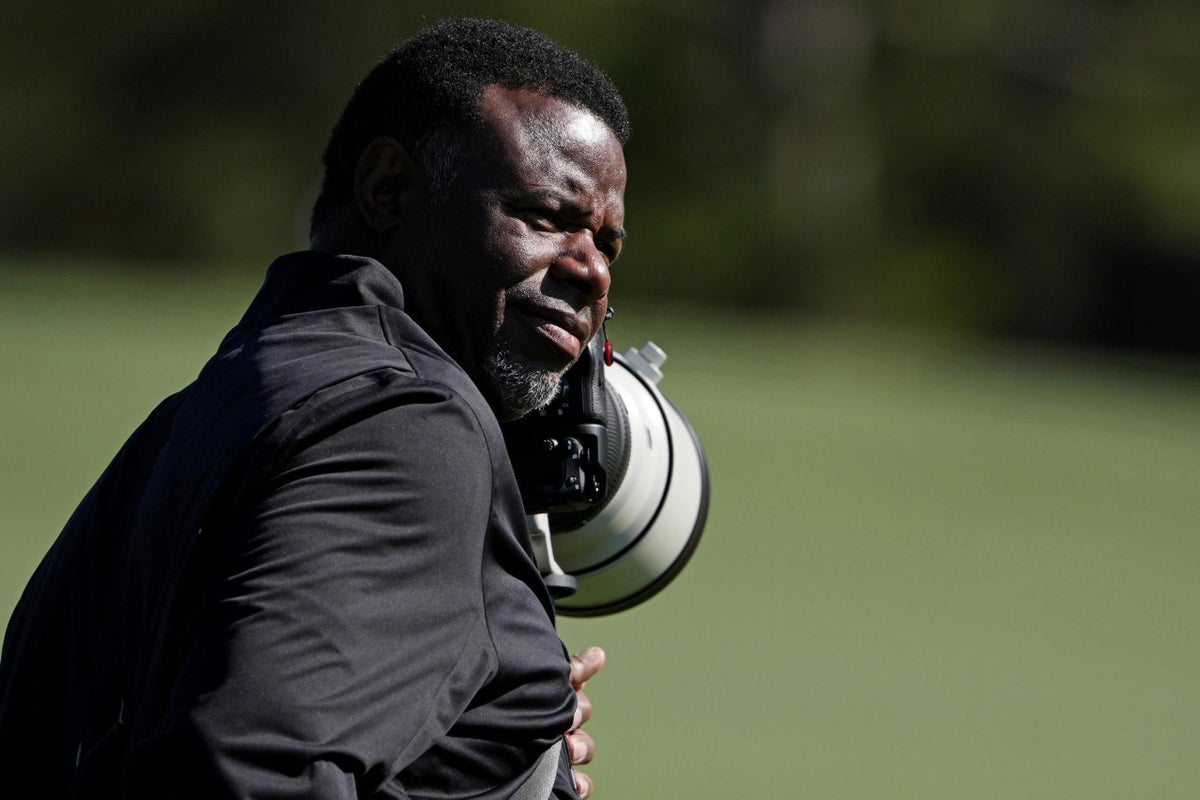
Ken Griffey Jr. couldn’t have asked for a better view.
A 6-foot-3 action hero, he had a clear line as Rory McIlroy pulled back his putter, brushed it forward, and rolled in a 4-foot putt to end an 11-year major drought and crown him as the sixth man ever to win golf’s career Grand Slam. The kind of moment that finds its way onto walls. Griffey watched through the viewfinder of his camera as McIlroy flung the putter over his head, raised his hands in relief, and fell to his knees in disbelief. Griffey’s finger fired, snapping picture after picture after picture. Each frame a story of its own, as long as the photo is executed.
Amid the ensuing delirium, looking down upon his camera, Griffey’s thumb spun the dial of his Sony Alpha 1, flashing a sequence of pictures on the monitor. Like anyone and everyone tasked with capturing what happened that day, he wanted to know, did he get it, or did he blow it? His eyes widened and he started laughing. Then he got moving.
You’d be surprised to know how far the 18th green is from Augusta National’s Press Building. Media members exit the course from a gap in the fencing underneath the familiar scoreboard along the first fairway. From there, golf carts line up to drive writers and photographers to the northwest corner of the property. Coming off the course, hauling his equipment, Griffey hopped on one of those carts and leaned back for the ride. Arriving at the Press Building, he turned down a hallway to peek into what’s called the working arena — a room of 350 leather chairs lining 10 long rows of desks.
“Y’all crazy,” Griffey recently told me. “You gotta realize, I’m used to a baseball locker room. We’d get 15 minutes to decompress, then in came the media, so I have no understanding of working on deadline. But it was pretty intense in there. I looked around — everybody’s head down, nobody saying nothing. I don’t think anyone even saw me.”
I was amid those hunched writers. And I can confirm no one in that room saw a gawking Ken Griffey Jr. All attention was on blinking cursors and blank pages. McIlroy winning the Masters was like Sisyphus finding his footing. How do you write that? Specifically, how do you write that very quickly?
It’s a rush. Like witnessing a magnificent volcano erupt, then immediately realizing you’re far too close to it. The emotion isn’t only in the deadline, but in the finality of it all. In this very odd world that we exist in, you get one chance. The story you produce, the picture you take, the video you shoot — there’s no do-over. The bigger the moment, the higher the stakes. The higher the stakes, the greater the pressure. It is not particularly glamorous. It is not particularly lucrative. It is most definitely stressful. But if you take such things seriously, it means something.
Which all really makes you wonder, why in the world is Ken Griffey Jr. taking such things seriously?
“I don’t think I’d waste someone’s time, if it was a joke,” he says early on in “Photographer 24,” a film chronicling Griffey’s week at the 2025 Masters that’s slated to air this weekend on NBC in advance of this year’s tournament.
It was perhaps assumed, as images of Griffey popped up across social media last year, that his photography work was some kind of novelty act. He is, after all, Ken Griffey Jr. The Kid. The upright swing. The one-handed finish. The fitted backwards hat. The signature Nikes. The NES video game. The Upper Deck rookie card. The impossibly cool version in the amber of the 1990s; the one that, by God, those of us of a certain age will never let go of because those were better times and A Tribe Called Quest is still playing in these headphones.
That is, except characters in sports are not characters in life. Ken Griffey Jr. was never particularly interested in growing old as The Kid. Or at least everyone else’s version of The Kid.
Now a 56-year-old father of three adult children, Griffey has spent the entirety of his non-baseball life wanting to find the next thing and do the next thing. In the late ‘90s, at the peak of his powers, with his world changing amid a trade from Seattle to his hometown of Cincinnati, he bought scuba lessons. This isn’t to say Griffey merely made a few dives and explored a coral reef. No, he made 60 dives in 60 days with the best instructors he could find. Years later, in his mid-30s, while living in Orlando amid a fading career, Griffey realized his two oldest children would likely land at Florida’s scattered in-state schools — Florida State or Miami or UF — to play their respective sports (Trey in football, Taryn in basketball), and he imagined travel for games being a nightmare from Orlando. His solution? A pilot’s license.
(In a twist, both Trey and Taryn landed at the University of Arizona, while Tevin Griffey, the family’s youngest by seven years, later played football at Florida A&M and Boise State. Nevertheless, today Griffey owns and flies a personal jet.)
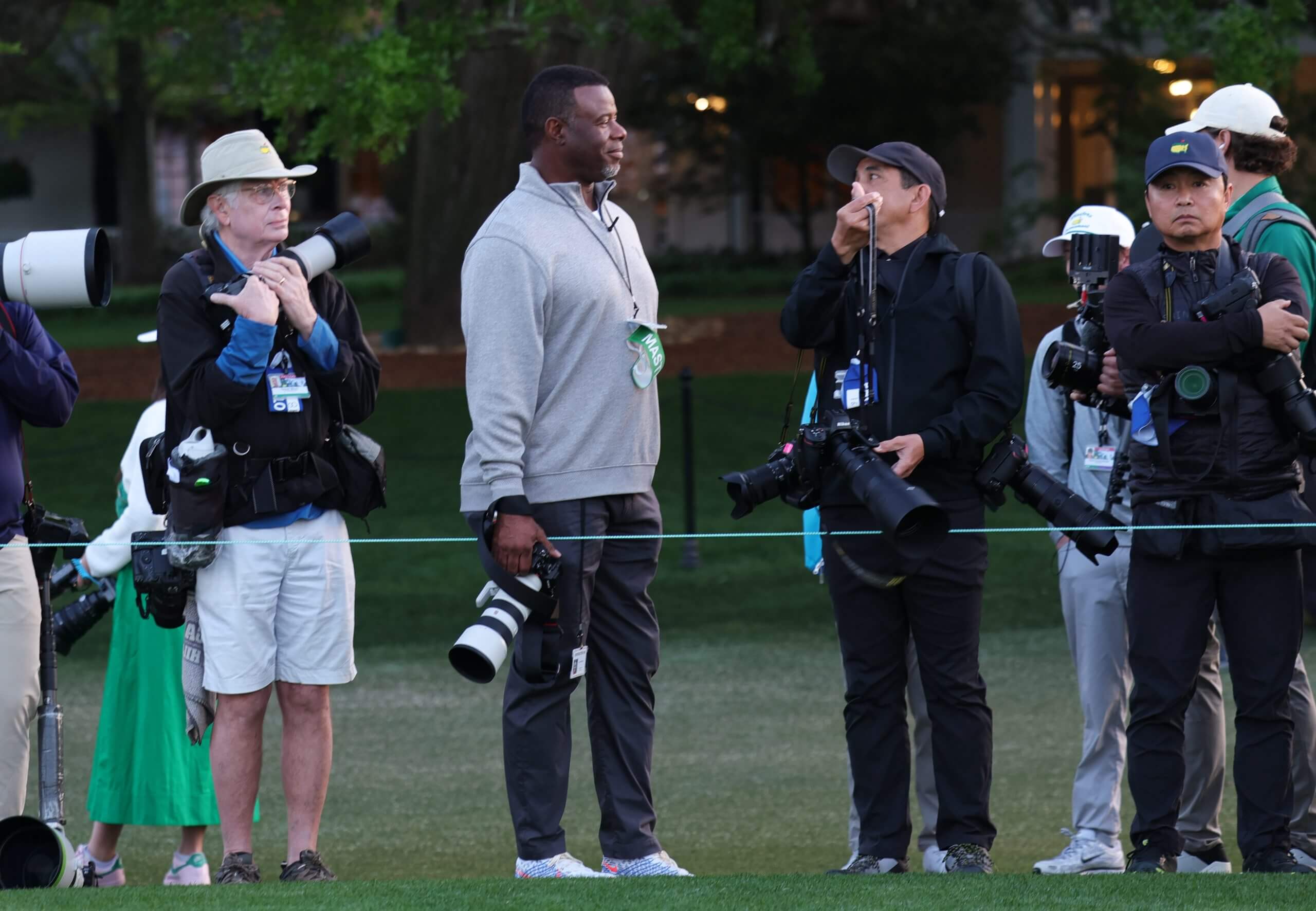
Ken Griffey Jr.’s challenge at the Masters was to produce work good enough to be published regardless of his name. (Andrew Redington / Getty Images)
Now it’s photography. Coming up in the big leagues, Griffey traveled with an old Sony point-and-click film camera. Boxes of curling old photos exist as proof. In time, he moved to a Nikon digital camera. As the kids got older, Griffey found he could attend their games in peace if he did so from behind a camera. He graduated to more professional equipment and asked photographer friends from ESPN for some tips. Soon, whatever exists inside Griffey — apparently a kerosene canister of competitive instincts — found an open flame.
“I think it’s all about getting better and trying to learn things,” Griffey said on a call last week. “I feel like if you get stuck or you only do one thing, your mind is going to die. You can always get better and learn different things. I like taking pictures. So why not learn to take better pictures?”
That’s hard to argue. However, there’s a difference between taking some photo lessons, or maybe signing up for a MasterClass, and working as a staff photographer at the Masters. That is, unless you’re Griffey. In which case, a simple hobby turns into him being introduced to a room full of world-class photographers in Augusta.
“We have a young photographer in the corner, new to this, coming to join us today,” Bob Martin, the managing editor of Masters photography, is shown announcing in “Photographer 24.” “Anything you can tell him — help him.”
Martin meant it. Not one to suffer timidity, Martin is a large man with a large personality and a large British accent. His week with Griffey began with him eyeballing some photos taken during Tuesday’s practice round and calling one “dreadful,” another a “waste of time,” and later saying in an interview that Griffey lacked a “refined eye.”
“When I first heard Ken Griffey was coming, I was like, well, why?” Martin says in the film. “Why is this man coming here and ruining my day? I’m stressed enough as it is without having him here.”
This was not shtick for the camera. Martin is a legend in the field and a recipient of all imaginable sports photography awards. In pointing out the obvious — that the Masters is not a place to cut your teeth — he added that Griffey’s photos would only be published if they met a standard. After all, not only was Griffey shooting key assignments like Bernhard Langer’s final Masters round on Friday, but he was doing so beside the best competition imaginable. The same way Junior’s swing was so sweet the ball seemed to want to find the gaps; the best photographers at the Masters are so good the dogwoods lean to get in their shot.
Some will be quick to say Griffey can only land a gig like the Masters because he’s Ken Griffey Jr.
Thing is, Griffey will agree. But then he’ll add: “Yeah, I’m the most high-profile person in that room, but I’m the low man on the totem pole. I’m there to soak up as much as I can.”
And how’d that go?
Turns out, the man pictured on 24 different Sports Illustrated covers is getting a different view on the other side of the camera.
“The learning curve is massive,” Griffey told me. “There’s that old saying, be comfortable being uncomfortable. That was that whole week at Augusta. I was uncomfortable the whole time, but also understood certain things in the big picture.”
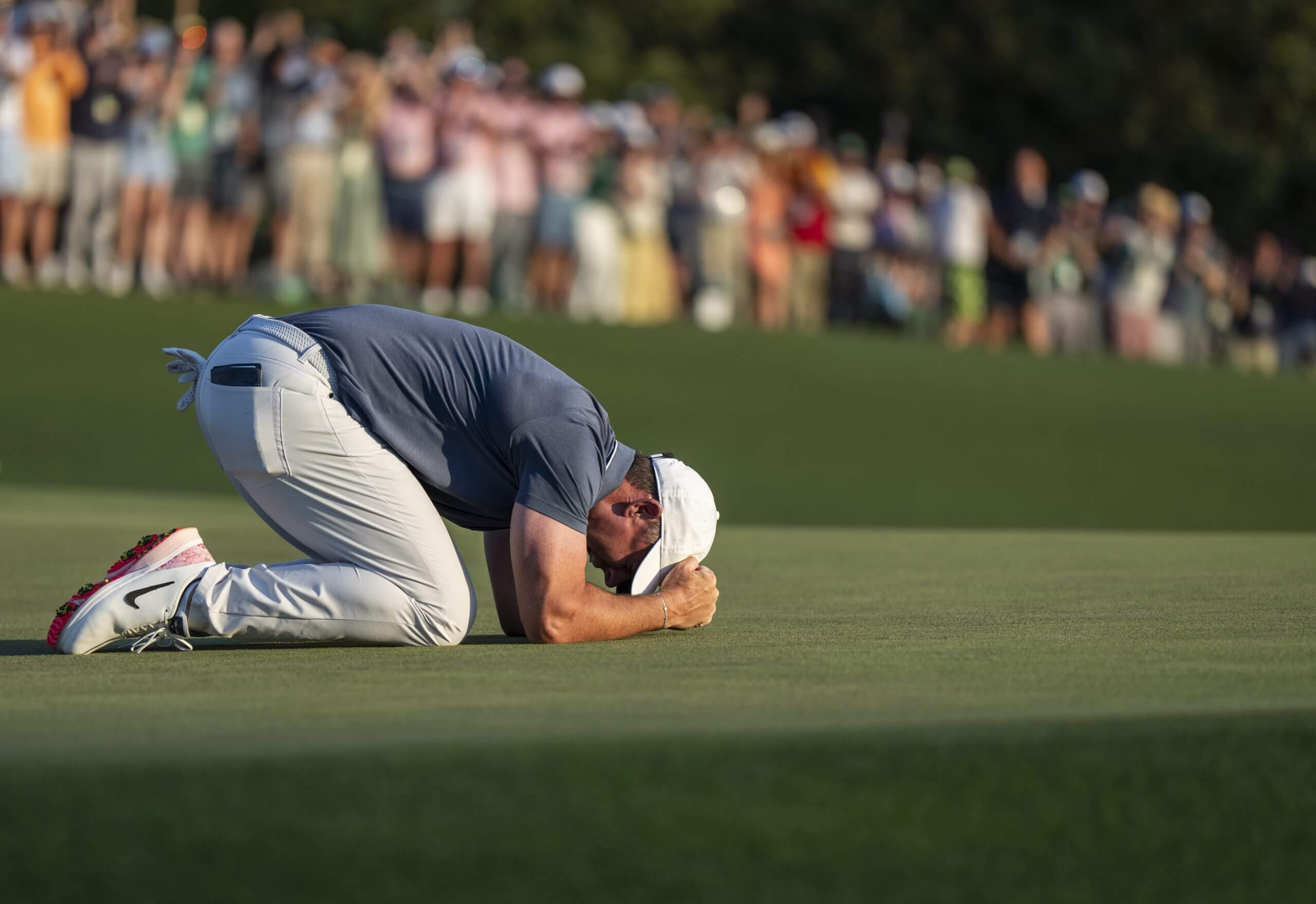
Ken Griffey Jr.’s eye caught this frame of Rory McIlroy’s post-win celebration. (Ken Griffey Jr. / Augusta National via Getty Images)
It’s that picture where Griffey’s perspective resides, and what makes this venture all the more interesting and all the more valuable. He does not see himself as a professional photographer. Nor does he ever intend to see himself as a professional photographer. He is, as he sees it, still a professional athlete. That’s the view.
“I’m taking a picture of another athlete,” he said. “Not a subject, not a character. To me, that’s a normal person who happens to be at the top 1 percent of his or her sport. All I want is to get a great shot of that person doing something spectacular.”
No matter how good the writer, or how good the photographer, that’s a vantage point that can’t be found on most sidelines.
Like from the 18th green at the 2025 Masters. As everyone in the Press Building that day raced to finish our stories and file our pictures, Griffey sat with Martin and sorted through a collection of photos that, upon seeing on a computer screen, Martin pushed Griffey aside to take over, publishing as many as he could as fast as he could. The difference between Griffey’s photos of the moment and everyone else’s was that Griffey didn’t see those pictures as his. He saw them as McIlroy’s.
“The story in those pictures came from him,” Griffey continued. “That’s what he did. Not what I did. I just happened to capture one moment in his career.”
Maybe a lesson for the rest of us.
Three months after Griffey’s work at Augusta, I glanced up in the Ryder Cup Media Center to see Griffey walking across the front of the room, sweating, hat backward, a giant 600mm lens drooped over his shoulder. And there he was at last year’s MLB All-Star Game, and at this past winter’s World Baseball Classic. This summer, he’s planning to work World Cup matches in Seattle and a handful of other events. Long days. Hard work.
The Kid better be careful.
Sometimes, the difference between a hobby and a job is how you view it.