
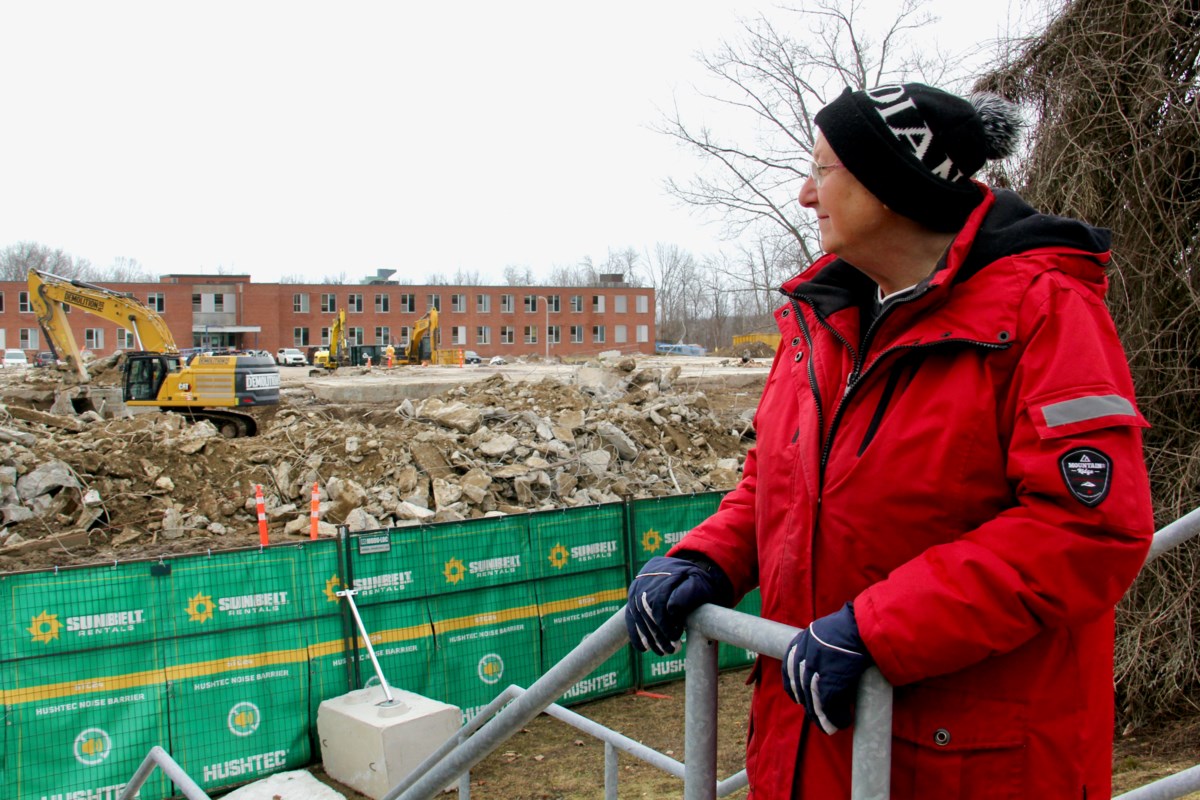
‘It’s long overdue … All the survivors want to see it torn down,’ says Orillia woman and former HRC resident who has been keeping an eye on the demolition
Huronia Regional Centre (HRC) survivor Cindy Scott wishes she could operate one of the excavators razing old buildings at the sprawling site on Memorial Avenue, while fellow survivor Harold Dougall says he would love to direct the wrecking ball.
Both say they can’t wait to see all 49 buildings that make up the former institution for people with intellectual disabilities demolished.
“Finally,” said Dougall, 77, who lived in what he calls the prison-like institution for two years between 1960 and 1962.
“We want all these buildings down. Every time I go past there, I get shivers for the good because it’s coming down.”
Scott, 62, lived at the HRC for six torturous years of her childhood.
“We don’t want to see those buildings again because it brings back bad memories,” she said.
Scott has been taking Orillia Transit to the former HRC site often to witness the progress of building demolition.
“It’s long overdue,” she said while watching the work from behind the construction perimeter. “It’s a blessing to get all these cottages down. I’m very satisfied. All the survivors want to see it torn down.”
Debbie Vernon, a former staff member at the HRC, was a supporter of some of the survivors during the class-action lawsuit against the provincial government. The lawsuit was brought by former HRC residents who suffered sexual, physical and verbal abuse at the institution.
In 2013, a $35-million settlement was reached, providing compensation to residents who had developmental disabilities. Dougall and Scott were both recipients of funds.
The HRC operated for 133 years, opening in 1876 and closing in 2009. The closing marked a change that saw people with intellectual disabilities moved back into society, attending public schools and living with their families, in group homes or independently.
Both Dougall and Scott now live independently in Orillia.
Vernon continued to help with the formation of the survivors’ continued advocacy through the Remember Every Name website and the Facebook page.
In 2017, the Ontario government held hearings looking for input from Orillia survivors of the HRC for an Infrastructure Ontario report.
“Survivors got up in front of the crowd and expressed their opinions on the use of the future of the Huronia Regional Centre. One of the recommendations that the survivors put forth to Infrastructure Ontario was that the buildings had to come down,” Vernon said.
“They always said they wanted the buildings to come down because it represented their nightmares.”
Then, in 2024, survivors collectively wrote a letter to Kinga Surma, minister of infrastructure, to remind her of the 2017 report findings.
“We got a letter back saying that 49 buildings and 11 tunnels were going to be demolished,” said Vernon.
Phase 1 of the demolition started in January with Bird Construction. Buildings already torn down include two service buildings, Coral Cove Camp, the admission and isolation building, the old infirmary, and the multi-sensory house.
A long row of one-storey buildings, referred to as the medical infirmary unit, is currently being demolished.
Still to come down are the McGee apartment building, a service building, Cottage D, and the nurses residence. The superintendent’s house and other houses, which served as group homes, are also coming down.
Phase 2 will include the demolition of the main administration building, located close to the waterfront.
“Survivors plan to organize a celebration ceremony to watch the final and main building come down,” said Vernon.
Also part of the report was a request from survivors to construct a museum close to the memorial sculpture in the HRC Cemetery, which is located across Memorial Avenue beside OPP General Headquarters.
“Those are our future plans,” Vernon said.
Both Scott and Dougall say they want to see a museum constructed to educate the public about the thousands of people who died at the institution and the survivors who were treated in an inhumane way.
“It means a lot to all of us survivors,” said Scott.