
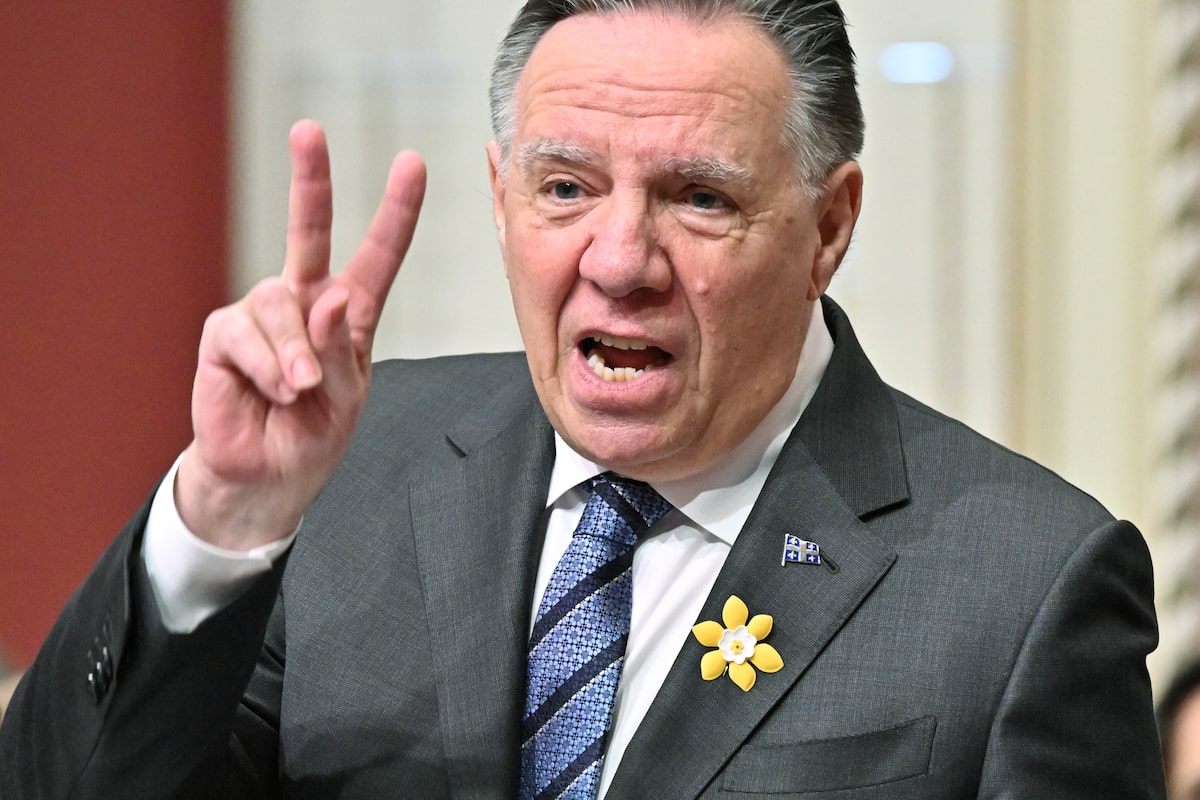
It is likely that François Legault will be remembered less for concrete achievements such as infrastructure or government programs and more for the rhetorical landscape he left behind.Jacques Boissinot/The Canadian Press
François Legault had the chance to travel the world as Premier of Quebec. His province has dozens of international delegations and trade offices in far-off places, from Tokyo to Barcelona to Los Angeles.
But the foreign region that most impressed him, according to one friend and former colleague, was somewhat unlikely: the German state of Bavaria.
Mr. Legault visited the land of beer steins and lederhosen early in his time as leader of the Coalition Avenir Québec, and again last year, coming away inspired by its combination of material prosperity and traditional values, said Guy Laforest, an emeritus professor of political science at Laval University.
“He liked the economic-identity combination.”
The Premier’s fascination with the rich, conservative bastion still shaped by its Catholic heritage and folklore – along with an increasingly anti-immigration bent – is revealing. Although Mr. Legault came to power promising to use his business background to make Quebec a smoothly run leader in innovation, a “Silicon Valley of the North,” he governed as a defensive nationalist, devoting as much energy to protecting Quebec’s culture and closing the wealth gap with the rest of Canada as to cutting red tape and building a cutting-edge economy.
As he prepares to leave office, Quebec is indeed richer, having continued its recent trend of stronger economic growth than the Canadian average. It is also arguably more inward-looking, often at odds with the rest of the country and its own minority populations.
When he steps down on April 12 with the election of a new party leader, after announcing his resignation as Premier in January, he will leave behind a province that is more Bavarian, and less Californian, than he found it.
François Legault urges Quebec to protect identity in farewell speech
The co-founder of Air Transat put his economic credentials at the heart of his political rise. An accountant by training, it has often been said of him that “he knows how to count.”
Even when he joined the sovereigntist Parti Québécois as a minister in 1998, it was in heavyweight, managerial roles such as commerce, science and technology, and later education and health. The narrative of a culturally fragile Quebec needing to be protected by legislation didn’t appeal to him.
“His nationalism was really an economic nationalism,” said Éric Bédard, a speechwriter for Mr. Legault at the time, and now history professor at Quebec’s Université TÉLUQ. “Earlier in his career he wasn’t comfortable with that defensive discourse. For him it was a discourse of losers.”
By the early 2010s, with the PQ languishing in opposition, he set out to found the Coalition Avenir Québec, a new political party that would unite federalists and sovereigntists, put the endless debate about independence to rest, and focus on the economy and good governance. He spoke of addressing long-simmering tensions about Quebec identity in the face of rising immigration, but he also promised a tech-driven knowledge economy using the province’s strong postsecondary sector as a springboard. When he won a majority in 2018, it was as the first entrepreneur to become Premier of Quebec, after generations of leadership by the liberal professions, said Prof. Bédard.
The Legault vision of an economy-first premiership quickly confronted a building mood of anxiety about the place of French and Quebec values. Whether out of expediency or sincere conviction – even former colleagues like Mr. Bédard aren’t sure which – he leaned hard and fast into a role as folksy defender of the nation.
Legault’s legacy leaves many religious, linguistic minorities feeling less welcome in Quebec
His government’s Bill 21, passed into law in 2019, banned the wearing of visible religious symbols on the job by public servants in positions of authority, including police, judges, prison guards and, most controversially, teachers. Its biggest impact was on hijab-wearing Muslim women and, despite a fierce public controversy that continues with the recent Supreme Court hearings, the law was popular with the Quebec public.
A similar dynamic played out with Bill 96, Mr. Legault’s 2022 effort to protect French by requiring its use by medium-sized businesses (not just large ones) and requiring immigrants to receive services in French after six months in the province, among other provisions.
Both laws were passed with the pre-emptive use of the Charter’s notwithstanding clause, in theory shielding them from judicial review, although the Supreme Court is considering whether that is true in the case of Bill 21. Many religious and linguistic minorities, especially Muslims and anglophones, felt targeted.
Julius Grey, the veteran Montreal constitutional lawyer, said that Mr. Legault succumbed to a “desire for uniformity,” and that in his identity legislation, including a proposed Quebec constitution and ban on most public prayer, the Premier was “worse than” Maurice Duplessis, the autocratic and reactionary premier of the 1940s and 50s.
“It’s another attempt to freeze our beliefs today, and saying this society can’t change.”
Mr. Legault has invited analogies to the notorious Chef before, including by comparing his party to Duplessis’s Union Nationale, but even most of his critics agree the parallel is imperfect.
Eric Andrew-Gee: Legault’s ‘third way’ Quebec nationalism down but not out after resignation
Unlike his swaggering, corrupt predecessor, Mr. Legault is widely seen, for all his faults, as an honest and sympathetic character. The progressive author Francine Pelletier, who has criticized his hardline stance on Quebec identity, admitted that she would miss his presence on the political stage.
“Why he’s forgiven, and why I think history will forgive him: He wasn’t arrogant,” she said.
Never was Mr. Legault’s avuncular persona more appreciated than during the COVID pandemic. His emotionally vulnerable and plainspoken press conferences during the height of the crisis made him Canada’s most popular Premier, with approval ratings that reached 85 per cent.
The affection was returned by a leader visibly moved at the spectacle of a society making painful sacrifices for the collective good. The pandemic lesson Mr. Legault evokes most often, tellingly, is not the importance of science, an efficient administration or the heroic contribution of a heavily immigrant health care workforce, but the “solidarity” of the Québécois people.
It was the more technical aspect of governing that ultimately tripped up Mr. Legault and ended his honeymoon with voters. Despite a deeply-felt communion with the nation, as he saw it, results were consistently lacking on major files, especially in his second mandate, after another majority victory in 2022.
His government waffled on building a controversial third link between Quebec City and its neighbours across the St. Lawrence, failing to square the complex engineering of the project with its even more sensitive politics.
Legault resignation shakes up Quebec’s political landscape at uncertain time for businesses
The digitization of the province’s auto insurance board was a fiasco, half-a-billion dollars over budget, glitchy, and with problems hidden from the public by bureaucrats and possibly even government ministers.
The province lost another quarter-of-a-billion on a failed investment in the Swedish battery-maker Northvolt, which declared bankruptcy last year to the embarrassment of a government that had made the partnership a centrepiece of its green-economy strategy.
The provincial budget in the Legault years has swung from a $2.6-billion surplus to a projected $8.6-billion deficit.
“It’s one thing to know how to count when you’re starting a business,” said Ms. Pelletier – and quite another when you’re managing a de facto nation state.
It is likely that Mr. Legault will be remembered less for concrete achievements such as infrastructure or government programs and more for the rhetorical landscape he left behind. The Premier used dramatic language to describe the position of Quebec francophones in a context of rising immigration and ubiquitous English-language content online. He warned that they risked “Louisianization,” evoking the decimation of French as a living language among Louisiana Cajuns; in another interview he said it would “suicidal” for the Quebec nation to accept more than the province’s current intake of newcomers.
That rhetoric was criticized at the time for being too extreme, but the ostensible decline of French in Quebec, and the need for nationalistic measures to counter the trend, have become givens in provincial politics.
Before Mr. Legault came to power, “the political discourse was very different,” said the conservative intellectual and former Legault staffer Étienne-Alexandre Beauregard. “The Liberals didn’t say they were nationalist.” Now, describing yourself that way is de rigueur across the partisan spectrum.
Even some allies found that Mr. Legault’s nationalism could be limiting, that it could produce a certain insularity in his approach to leading the province. He spent relatively little effort cultivating relations with Ottawa and foreign governments, for example, said Mr. Laforest, the political scientist who was involved in discussions around founding the CAQ.
“That’s one thing I would reproach him for.”
In fact, apart from Mr. Legault’s love affair with the moneyed conservatism of Bavaria, he didn’t travel much as Premier, preferring the confines of the “beautiful nation” whose ramparts he worked hard to build up.