
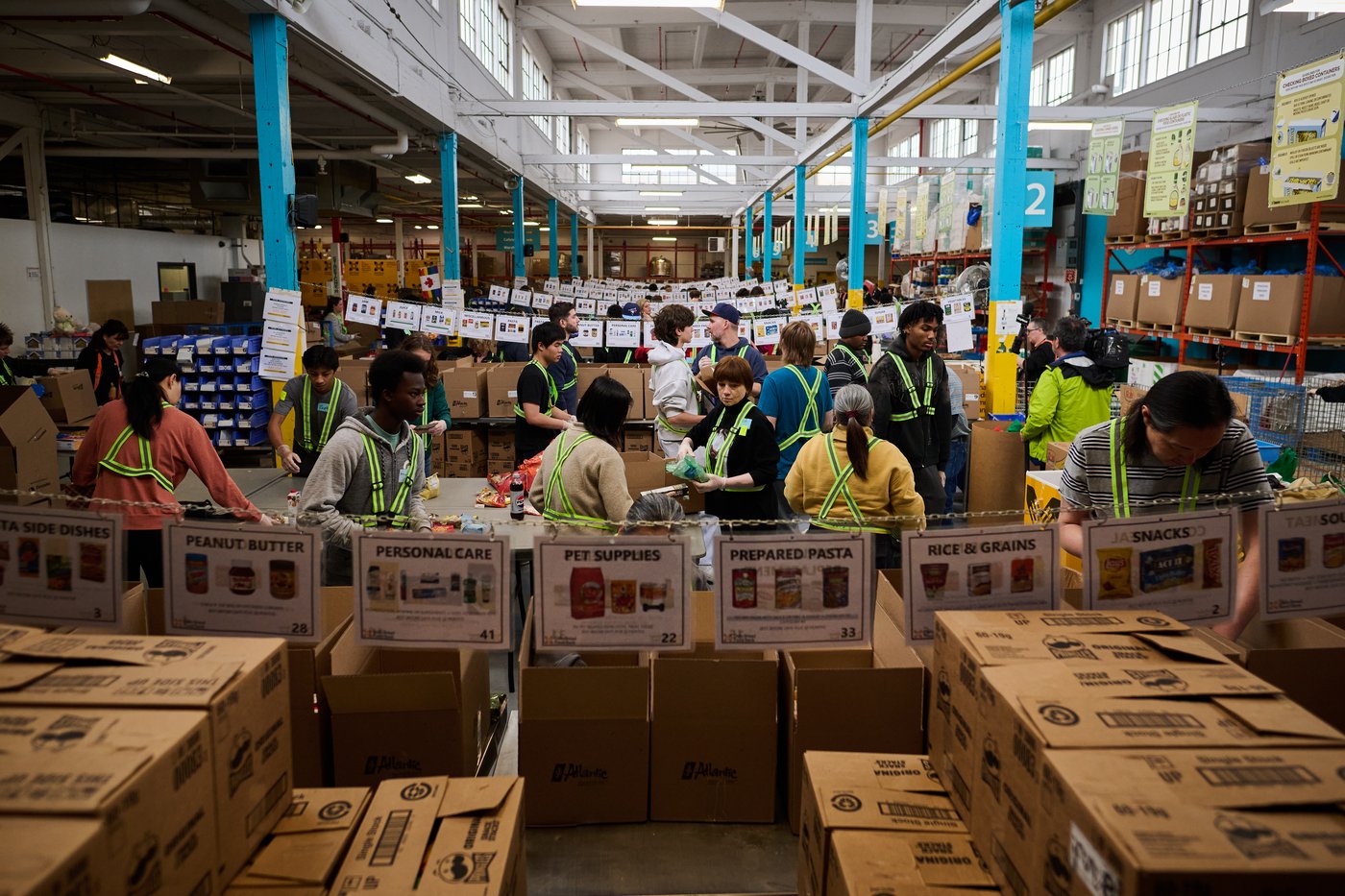
At a volunteer event at its headquarters on Saturday, over one hundred people, including Premier Doug Ford and Toronto’s mayor, Olivia Chow, rolled up their sleeves to sort through giant bins of donations to prepare foodstuffs for distribution across Daily Bread’s network.

Ford addressed the crowd and thanked volunteers for their efforts, saying his government is focused on finding good paying jobs for everyone in Ontario to address food insecurity.
“The foundation of everything in our province, absolutely everything – from healthcare, (to) education, (to) infrastructure, (to) supporting food banks – is one thing, it’s called the economy,” he said.
But for some, employment isn’t even enough to avoid the food bank.
One of Daily Bread’s employees, Augustina Michael, said she uses the food bank about once a month to afford fresh vegetables, even though she makes over minimum wage at her job.
“Even as someone that has a job, it’s actually not enough,” she said. “Before your paycheck comes in, you already have expenses. You’ve got to pay rent, you’ve got to pay your phone bills, transportation and all that. You’re left with little or nothing to fall back on for food.”
Daily Bread said there have been over 920,000 visits to member food banks since the year started, surpassing the number of visits seen at this time last year.
Hetherington said rising gas prices impact the economy as a whole, and he’s expecting food costs to rise along with it as everyone from urban workers to rural farmers and food producers feel the pinch at the gas pump.
While that could drive even higher demand at food banks, Hetherington said Daily Bread has already seen a real, direct impact to its operations due to the conflict in the Middle East.
Just last month, a vessel carrying a shipment of rice for the Daily Bread Food Bank was struck near Iran, delaying the arrival of the much-needed food, Hetherington said.
“It’s just come on top of hit after hit,” Hetherington said of the impacts of the Iran war. “You had a massive rise in rents (and) you had incomes that weren’t keeping pace with (the cost of living).”
“Before the pandemic … we saw 60,000 client visits per month. The number last month was 330,000,” he added.
To meet rising demand for its services, Hetherington said Daily Bread has had to ramp up its fundraising efforts and rely on the generosity of private donors.
In Daily Bread’s latest annual report, the food bank said about 46 per cent of food bank users are employed or have someone in their household who is employed.
Hetherington said, despite the added pressure of the Iran war, the long-term solution for Ontario’s rising food bank usage is for governments to step up affordable housing efforts, noting that some of the food bank’s clients are spending 100 per cent of their income on housing.
This report by The Canadian Press was first published April 4, 2026.
Kathryn Mannie, The Canadian Press