
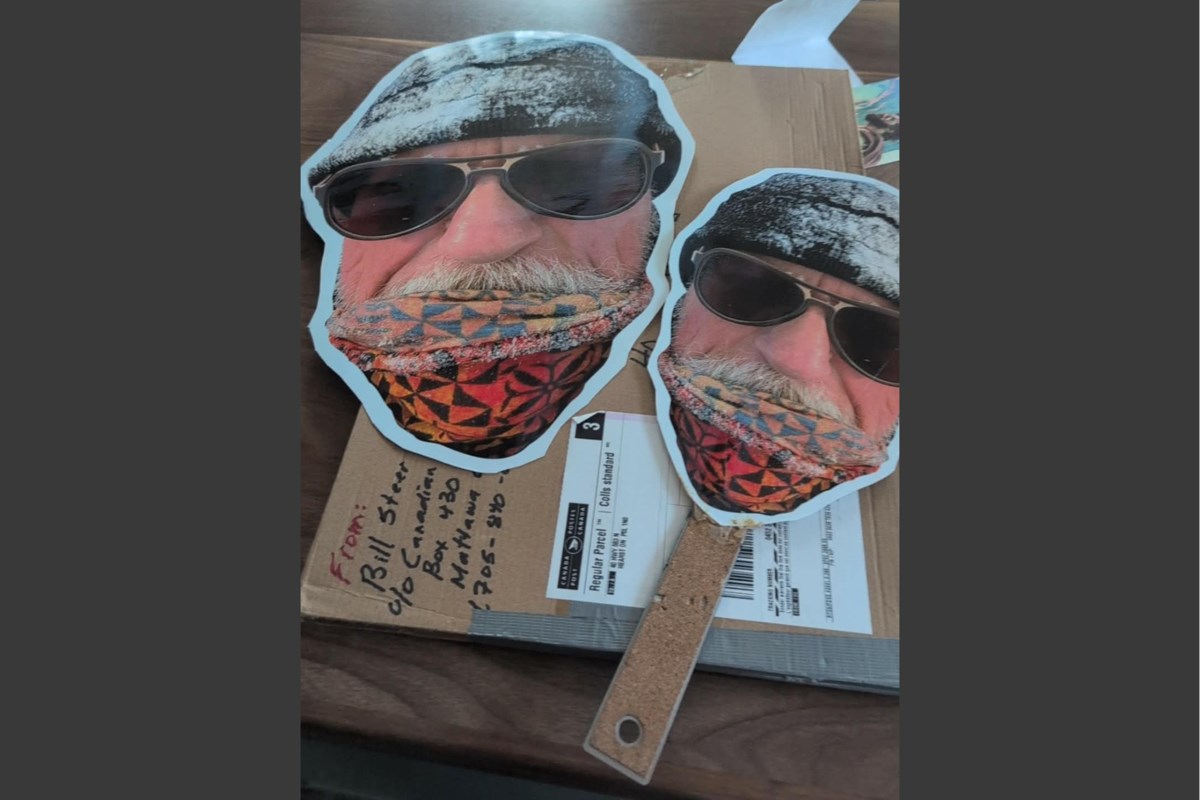
The photo that ‘came along’ was taped to a customized ping pong paddle. While Mylène Coulombe-Gratton, her father Danny Gratton and partner Alexis Hebert rode for real — logging more than 2,000 kilometres in six days — Back Roads Bill followed vicariously, tracking their progress through some of the most remote sections of the James Bay coast
Vicariously. I thankfully tagged along.
Through the actions of another person, I went on a challenging northern expedition – and wondered if I could make it all the way.
“This whole trip is uncomfortable from the start to the end. No sit-down, order food kinda spots. You don’t even know if you will make it in time for the only store to be open to buy yourself some food,” said Mylène Coulombe-Gratton, proprietor of Follow Her North, an outfitting business based out of Hearst, Ontario.
There were reasons to go on this trip beyond this test.
I first met Mylène during The final chapter of a Cold War tragedy story. I knew then Mylène was made of the right stuff. Then it was a challenging cold weather day for two aging white guys to get to our destination, accomplish the unimaginable and get back.
But there’s more.
She was just 21 years of age back then, already four years into running her own outfitting business – Follow Her North. Amazing, one time said, but there will be more.
During this recent March 14 story, in Attawapiskat, she unveiled the trip of a lifetime. I hinted I was coming along.
And I did, sort of, kind of, but not really. I was alone for the ride in spirit. A Back Roads Bill profile photo was affixed to a customized ping pong paddle.
Right stuff
There was another reason to write this story, which has to do with kindness.
“I started snowmobiling as soon as my thumb was strong enough to squeeze a throttle. From that very young age, most of the riding was off-trail on rivers, creeks, logging roads, and muskeg, Mylène said. “And in the past few years, covering over 13,000 km per year by guiding people across northern Ontario. My body has been building endurance for many years. I realized I was ready.”
Mylène is not selfish; she has foresight.
She founded the Find Your North fund. The North for her is more than a place on a map. “It’s a moral compass inside us.”
After five years of guiding youth, schools, and communities across northern Ontario, one truth became clear to her – the land changes people.
“Confidence grows. Healing begins. Direction appears,” she said succinctly. She wants to remove financial barriers to outdoor access.
“It exists so more young people can access those life-changing moments outside.” (I can relate.)
“Finding Your North means discovering confidence, identity, belonging, and direction — often through challenge, land connection, and shared experience.”
The fund will help youth (especially northern and remote communities), high school students with entrepreneurial goals, individuals pursuing outdoor industry training, Indigenous youth and land-based healing initiatives through schools and community.
I donated – because.
On International Women’s Day, she posted: “Being a woman today makes me deeply appreciate the trailblazers who pushed boundaries so women like me could stand where we do now. Because of them, I get to work in places that were once considered only for men. I get to guide, build a business, explore the land, and create a life on my own terms.
“It doesn’t mean the challenges are gone. Being young and a woman in business, especially in a male-dominated field, still comes with moments where you have to work harder to be taken seriously, stand a little taller, and prove that you belong. But those challenges have never been big enough to make me step back.
“If anything, they push me forward.
“Because I’m not only doing it for myself. I’m doing it for the girls who are watching, for the next generation of women who will dream even bigger.
“Strong women didn’t just appear overnight. They were shaped by courage, resilience, and the women who lifted them along the way.
“And today, I’m grateful to be part of that chain.”
A strong person. (I am sold on the trip.)
Anticipation
Here’s the map of the proposed trek. It is a long way to go through the subarctic, but there’s that remote section north of Attawapiskat to Peawanuck that causes me to toss and turn.
This is not a regular snowmobile trail; it is a remote trek with stages of about 500 km each day. “You have to be self-sufficient,” she reminds me. I needed to get ready…extra socks.
The Churchill trip was inspired by her father’s two friends taking on the challenge in 2003.
“My dad was supposed to be with them, but my mom was pregnant with me, and he got laid off from the mill, so it wasn’t in the cards anymore. So, he became the shuttle driver who picked them up in Thompson, Manitoba, once they got off the train from Churchill.”
“My dad has always talked about this trip. And for people that have been north, they know the north is always calling you further, just like the sea calls within the Disney animated movie Moana.”
The film is set in ancient Polynesia and tells the story of Moana, the strong-willed daughter of a chief of a coastal village who is chosen by the ocean itself to reunite a mystical relic with a goddess.
“It’s like that for me.” Mylène is strong-minded and decisive.
For her, it is a “sense of accomplishment and adventure. Craziness lol,” she says.
They are at the mercy of their machines breaking down.
I can’t fix anything – no aptitude for it.
About $4,000 of snowmobile parts were lent to them by the powersports dealership – Raxfin – in Kapuskasing; they will pay them back if they have to undertake a repair en route.
We have lots of connections along the coast.
Mylene has been in touch with Canadian Rangers regarding the timing and contact. The Canadian Rangers are a sub-component of the Canadian Army Reserve who live and work in remote, isolated, and coastal regions of Canada.
The most difficult portion will be from Attawapiskat north up the coast and around the big turn at Cape Henrietta to Peawanuck.
I am not really a competent snowmobile rider.
“On the Bay, there can be really hard-packed snow drifts, and you can only go 15-20 km/h.
“They call it no man’s land… advice we received… was to get our shit together before that stretch.
“If a blizzard comes upon us, you rely only on the navigation to get into the tree line and camp and wait it out. You are always sticking together, like really close.”
I also knew what lay ahead and did some homework.
Abort
Buck Miller from Huntsville was in this same area just weeks before. In March of 2020, he rode his fat tire bike from Peawanuck, ON, to Gillam, MB on the Wapusk Trail, the longest winter road in the world.
They’ve made two snowmobile expeditions on the coast in the last two winters.
They snowmachined north of Attawapiskat but for a different reason. They are planning a cross-country ski and kite trek from Peawanuck, around the cape, to Moosonee, much further out from the coastline.
He is familiar with Mylène’s trek.
“While they utilize hunt camps along the way, our difference is that we camp out each night and will do so when skiing/kiting back along the coastline.
“We were trying to make it to Big Turn at Cape Henrietta,” he said. “This area is our only unknown when it comes to the eventual ski expedition. The MNR says we will have polar bear encounters in this area. We want to gather as much data on the coast as possible so we can be ready for next year. No surprises.
“The tree line is far away, but how far? How far do the willows extend into the mud flats before they disappear? We’re gathering experience out there. We’re talking to locals.”
I have had polar bear encounters in this area.
They got as far as the Polar Bear Provincial Park boundary (see map) and then “the snow conditions hardened on us. An ATV would have been more suitable, so we made the tough choice to turn around, having still not reached the cape but 70 km farther than we made it last year.”
Then a weather event hit them.
“The night we turned around, our GPS was telling us of some bad weather coming in. We made camp early, with lots of daylight in a place I’ve twice previously camped, so I felt comfortable with our location.”
As the night went on, the wind slowly picked up.
“We had the canvas tent tied down properly, with skidoos flanking it and our tent tied to each machine, and trees on the back, and a toboggan in the front. At 2:30 a.m. came around, and neither of us was sleeping much because of the loud flapping of the tent.
“I drifted asleep a bit, and in an instant, the tent and stove were peeled right off us. Many of our clothes were strewn about, caught in the willows and off in the snow.
“The temperature was very cold, and with our instant waking shock, it made for a confusing few minutes.”
They quickly scrambled to find all of their warmest gear.
“Even in those few minutes from sleeping bag, exposure to 80 kph wind in long johns at -40 to getting our warmest clothes on, we were both in a deep chill. But there were no other options, so we pressed on. We considered bivvying under the tent deeper in the spruce, but decided to simply pack up the toboggans, gas up the machines and head south. It was a pretty wild 240 km back to Moosonee, a distance which we were going to do in two days, but with the tent damaged and no time to inspect it properly, we thought our safest bet was to get back to basecamp in Moosonee.” They will be back in 2028.
Yikes! There’s no turning back now, no matter what, I thought.
Dear diary
So, with her father, Danny Gratton and her partner, Alexis Hebert, off we go.
Day one, March 19 at 6:53 a.m.
I am in good hands, feeling good about this trek.
First segment, Hearst to Fort Albany. A long one.
Not good.
“If it wasn’t for bad luck, I wouldn’t have no luck at all,” is from the famous blues – B.B. King lyrics.
Mylène’s recently serviced machine acts up. Cell phone call to the dealer in “Kap.” There is a great deal of community understanding. A new machine is swapped for; on we go to make up lost time.
While we’re waiting, Danny makes a warming fire. Our spirits remain buoyant
We utilize the Disinhibit River flowing from Missinaibi Lake to James Bay. We pass by Thunderhouse Falls, I’ve been there. But there’s no time for pictures.
We meet another group from Hearst trying to do the same thing. They have bad luck as well with a blown engine. See Pat Dubreuil on Facebook for their Churchill quest.
On to Moosonee, and a food break at the Northern Store. But our goal is Fort Albany. There are some accommodation challenges at our next destination. (Ugh.) Mylène fortuitously meets a friend in the Northern Store; the friend offers her house in Fort Albany.
Off again we go, we arrive after 9 p.m., a long day. In total, 538.7 km, of which 60 km on OFSC club trails, 330 km on the river and 150 km on James Bay winter road.
Day two.
There was an alcohol security check on the winter road headed north. After that, clear sailing to Attawapiskat, and we had lunch at the Moose Restaurant and Takeout.
That is where I first met Adrian Sutherland a few weeks back.
We headed to Lake River to a hunting camp while cutting across the muskeg. Antoine was our host, a quiet person, one of wisdom.
He was preparing to hunt caribou. I would have learned a great deal from Antoine about Cree culture. In total, we travel 3,032.7 km along the coast and Lake River.
Day three.
The first polar bear tracks were seen. Danny was really excited as he had never seen these enormous tracks before. There are caribou tracks, but no sightings.
There are difficult snowdrifts to go through and around. Travel time is reduced to a crawl in some sections.
It is a twelve-hour day to reach the mouth of the Winisk River and on to Peawanuck. Prearranged, we meet Matt, who escorts us into the community. There is a house waiting for us. We slept in a bit. We have beans and fried SPAM for breakfast.
The people are so welcoming, and I feel a need to learn more about the culture. In total, Lake River to Peawanuck – 281.7 km.
Day Four.
We have to keep moving, that’s the plan. The Wapusk winter road from Peawanuck to Fort Severn (Washaho) has many twists and turns and little gullies that sneak up on you. It is a short jaunt to reach our next destination; it takes us just over three hours. In total 198 km on the Wapusk Trail winter road.
Day Five.
At sunrise, we set off, expecting this to be a long day travelling to Shamattawa MB, and on to Gillam along the Wapusk winter road. It is -40 C. There are no rest stops. It is too cold.
In Shamattawa, we have chicken burgers and poutine at the Northern Store. After 500 km, fatigue starts to set in. It is an endurance mindset. We share our pent-up thoughts once our helmets are finally off.
Upon arrival, there’s no store open in Gillam, so we have gas station wrapped subs. But there’s a warm welcome shower in the one and only hotel in Gillam.
I stayed there with Brian last year, when we conquered the Wapusk Trail – twice by SUV.
Sleep and reset. On the Wapusk Trail – 532 km.
Day Six.
No time to relax. Onward. Gillam to Churchill. We’re excited. No major obstacles but the cold. Are we going to make it? Some doubts, we keep to ourselves. We get turned around while crossing the dam in town. We get stuck in a ditch coming up onto the road. That takes a couple of hours to dig Danny’s machine out, and we have another 330 km to go!
We see wolf tracks, and then the wolf!
The power corridor is the route to McLintock on the VIA railway line, and then to Churchill. It is used by snowmobilers in Manitoba. We get on to the Deer River, but Danny’s machine breaks a suspension spring, so we lighten his load. On again.
We see the Churchill sign. Elation. Hugging. Photos. We made it.
We had not made reservations, as there was a buffer day, but there was room for us at one of the hotels. We have a celebratory dinner.
We arrived in Churchill, MB, at 6:36 p.m. on March 24. The Pat Dubreuil group made it as well, the next day; we reunite with them for some celebratory debriefing of the challenges.) That day – 340 km.
Total, six days – 2,193 km.
Day Seven. We snowmobile out to the Prince of Wales Fort among the snow drifts. We are impressed with the rocky shoreline of Hudson Bay. There’s so much to learn.
Then there was a shipwreck out on Hudson Bay to explore. There’s the Polar Bear “jail” holding facility to see as well. Pretty cool! Then, believe it, ice cream (Drumsticks) at the Northern Store, but we ate them inside.
We have a rental car to get around. We get stuck! Our biggest challenge is flagging someone down for help.
For good measure, the next day, we snowmobile back to Gillam. The train had broken down. (Add to the total – 2,550 km of being on a snowmobile.) Pick up in Gillam, and then back to Hearst via Highway 6 in Manitoba to the Trans Canada Highway.
Her reflections
Post-trip, there are always thoughts.
I was exhausted mentally and physically.
Where do you put your head down each night?
“Accommodations are really limited. It’s not like you can just Google for a hotel and book a room. You don’t get to shower every night. Gas stations are scarce with limited hours.”
And the daily endurance undertaken.
“We travelled an insane distance of rarely anything under 300 km, with bigger days being around 500 km.
“And no, you can’t compare this to trail riding. This mileage was sometimes at 30 km/h for 12 hours, pretty much nonstop in a cold arctic wind over the hardest snow drifts you have ever seen.
“As much as the pictures show, it’s all beautiful and looks like it’s going good, you really have a conversation with yourself in your helmet.”
There is the line, that breaking point of being delirious.
“Singing the song in your head…just keep going, just keep going… like Dori in Nemo, Just Keep Swimming, through the roughest conditions I have ever had to traverse in my life, even if I couldn’t feel most of my toes, even if I was hungry.
“I truly believe that you must be extremely comfortable with the most uncomfortable.”
(There’s a keeper quote.)
“And that comes with spending lots and lots of time out there. It is another level of craziness.”
The vagaries of weather.
“We were extremely lucky with the weather. This trip can only be done at a specific time of the year, and you hope for the best. We had perfect visibility all six days, which is rare.
“If you throw in a day of blizzard there, the trip becomes pure survival in no man’s land where you can’t even see the tip of your snowmobile skis. Camping out in the middle of a storm with no trees surrounding you to keep you sheltered from the wind or to provide firewood for a source of heat. That was our worst fear. This is the reality of what we could’ve encountered.”
Lucky for us, we had remote Indigenous hunting cabins. I am glad. I know about this. “If you fail to plan, you will plan to fail.”
Beyond the human element, there is the reliance on machines.
“A breakdown haunts you for hundreds of kms. If a machine breaks up there, you either abandon it or pull it forever! It’s not like you can just hop on the train or flag down a truck or fix it. We could barely take pictures before our hands froze. Forget about fixing a snowmobile.”
You are on your own.
“On this trip, each of us was fully responsible for ourselves. My dad and my partner both have experience in managing their own equipment, decisions, and safety.
“If something went wrong with my gear: my clothing, helmet, or sled. It was mine to deal with, and I was only accountable for myself.
“That’s a very different situation from guiding others. Taking people on a trip like this would mean being responsible not only for my own safety, but for everyone else’s as well, in an environment where conditions are unpredictable, and help is not readily available.”
What is your limit?
“I know the risks I’m choosing for myself, and I’m prepared to handle them. But I can’t make that same guarantee for someone besides me in those conditions. We were fortunate that everything went well on this journey, but the reality is, things can change quickly, and when they do, the consequences can be serious.”
The reality of it all, from a younger person.
“This is not about bragging or trying to impress. It’s the opposite. The goal is to share the reality behind what social media often doesn’t show.
“It’s easy to see a photo from an adventure and think it looks effortless or purely beautiful, but what you don’t see is the preparation, the hardship, the risks, and everything it took to get there.”
She said her Follow Her North tours will continue to be available, “but not this one!”
My thoughts
Here is Follow Her North on the Back Roads Bill podcast. Did I say she was 23 this coming July?
I was more than just happy to be on this trip, albeit as an observer.
I was there in spirit and could only give them chi from a distance, wondering about their travel’s day by day.
From a different perspective, I know of this country; there was a trip here, during COVID, with the Far North Challenge. You must be prepared.
So, I wrote this story because it was an adventure I could not do, and she invited me to come along vicariously.
There are other descriptors for this young person – passionate, unwavering, and steadfast – that come to mind.
And at such a young age, Mylène strengthens the resolve we have in younger people.
I went for a ride. Made it! Namaste!