
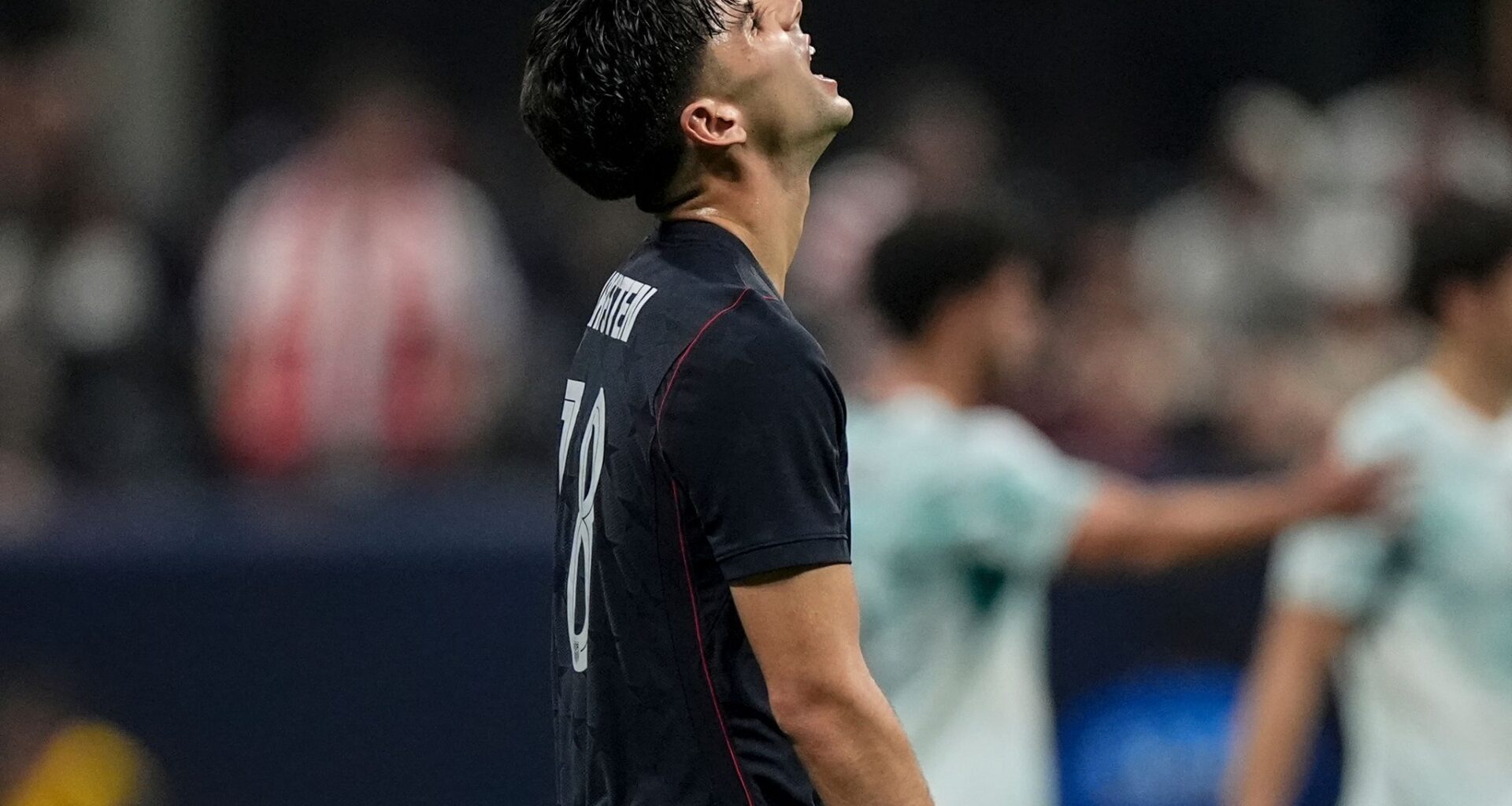
The U.S. national team’s Max Arfsten reacts to losing against Portugal in an international friendly soccer match Tuesday in Atlanta.
Mike Stewart/Associated Press
U.S. head coach Mauricio Pochettino prepares for play against Portugal during an international friendly soccer match Tuesday in Atlanta.
Mike Stewart/Associated Press
U.S. national team goalkeeper Matt Freese misses the ball as Portugal’s Francisco Trincao scores during the first half of an international friendly soccer match Tuesday in Atlanta. The U.S. lost 2-0.
Mike Stewart/Associated Press
The U.S. national team’s Christian Pulisic, left, and Portugal’s Francisco Trincao pursue the ball during the first half of an international friendly soccer match Tuesday in Atlanta.
Mike Stewart/Associated Press
Earlier this year, U.S. Men’s National Team coach Mauricio Pochettino said the 2026 World Cup would really begin in March.
“The idea is that the World Cup starts in March, when we’re all together,” he said. “With our identity, with our way we play, in the way we want to perform in the World Cup.”
Hoo boy. Pochettino better hope he is very, very wrong. Because if these late March games were a World Cup test, the American team just flunked.
Article continues below this ad
Facing a pair of European heavyweights in the span of four days, the results were ugly.
On Saturday, the U.S. players got their shorts handed to them by Belgium, losing 5-2. On Tuesday against Portugal, the group put up more of a fight, but still fell 2-0. Both games took place in Atlanta, home of U.S. Soccer’s new national training center and a site that was supposed to provide a partisan advantage.
In one way, Pochettino was correct, because these last few days of March have definitely felt like World Cup fever. On Tuesday, the final spots in the 48-team field were clinched, and there was joy and heartbreak around the world. Stunningly, Italy failed to advance, beaten by Bosnia and Herzegovina; despite the expanded field, the four-time World Cup winner will miss the sport’s biggest event for the third consecutive time.
One final spot was clinched by Turkey, which defeated Kosovo 1-0 and will be the fourth team in Group D, joining the United States, Paraguay and Australia. That means that the Americans’ group just got a lot harder. In the FIFA world rankings, Turkey is No. 22 (as opposed to 78th-ranked Kosovo) and will join the U.S. (an inflated No. 16), Paraguay (No. 40) and Australia (No. 27). In another set of rankings, the Elo ratings, Turkey (which will play Paraguay at Levi’s Stadium on June 19), is 14th while the U.S. comes in with the worst ranking of the group at 41.
Article continues below this ad
When the groups were first drawn, there were giddy predictions that the U.S. would win the group, or at least place second. Now, with the group more daunting and the Americans wobbling, that seems less sure.
But that hasn’t changed some people’s expectations.
“When I talk about this team, I talk about (making the) quarterfinals or it’s a failure; it’s not a good World Cup for us,” said former national team player Marcelo Balboa. “We’re tired of being OK. Of, ‘Yeah, we got out of the group, but we lost.’ No, no, no, no. No more.”
Balboa is working as a FIFA ambassador for the World Cup. He has a unique perspective, as a member of the 1994 U.S. team that also played in a home World Cup. But, as Balboa pointed out, that experience 32 years ago was vastly different from the current team’s.
“This team is not an underdog by any means,” Balboa said. “I think we’re selling ourselves short. We’re the favorite in this group and I think we’ve got to stop taking the pressure off these kids. This is their World Cup, an opportunity to do something special.
Article continues below this ad
“We were a bunch of college kids who didn’t have a club team. We trained together for two years because we didn’t have the opportunity to go to Europe and play. We were the underdogs in the ’94 World Cup. But we’re no longer the underdogs.”
In contrast to that 1994 team, many of the players on the current group play for the top clubs in Europe. They’ve been professionals since they were teenagers. They have a lot of experience and a lot of resources.
But with the newfound legitimacy and credentials, has something been lost?
“We’ve lost that American spirit that has kept us in games we had no business being in, for decades,” former U.S. caption Landon Donovan said on the “Unfiltered Soccer” podcast that he hosts with former USMNT goalie Tim Howard. “The irony is that from a talent and skill set, we’re as good as we’ve ever been.”
The United States is more talented than in the past but still has a knack for making things hard. The federation shortened the World Cup preparation schedule by changing coaches midway through the last cycle, firing Gregg Berhalter and hiring Pochettino, who arrived with little knowledge of the players he would inherit.
Article continues below this ad
The past 18 months have been a steep learning curve, made more challenging because — as one of the World Cup hosts — the U.S. didn’t have to go through qualifying. Sure, the Americans had the safety of an automatic berth, but the team had little opportunity to test itself and grow in meaningful games.
That was part of the impetus to schedule such a daunting pair of friendlies in this international window. But it’s a double-edged sword. Yes, the team gets to test itself against a tough opponent, but by being thoroughly beaten, the experience could shake confidence and any sense of momentum. The teams they played are among the best in the world, but that is exactly the kind of team they would face in the knockout round.
In Atlanta, the Americans were caught flat-footed. After the Belgium game, in particular, the Americans were criticized for a lack of aggression and fight, for atrocious defense, for an embarrassing result. On Tuesday night, former great DeMarcus Beasley called the effort “uninspiring.” These were the last games before Pochettino will announce his final roster on May 26.
Despite Pochettino’s earlier words, the World Cup really begins in 10 weeks. Will the U.S. team be ready?
Article continues below this ad