
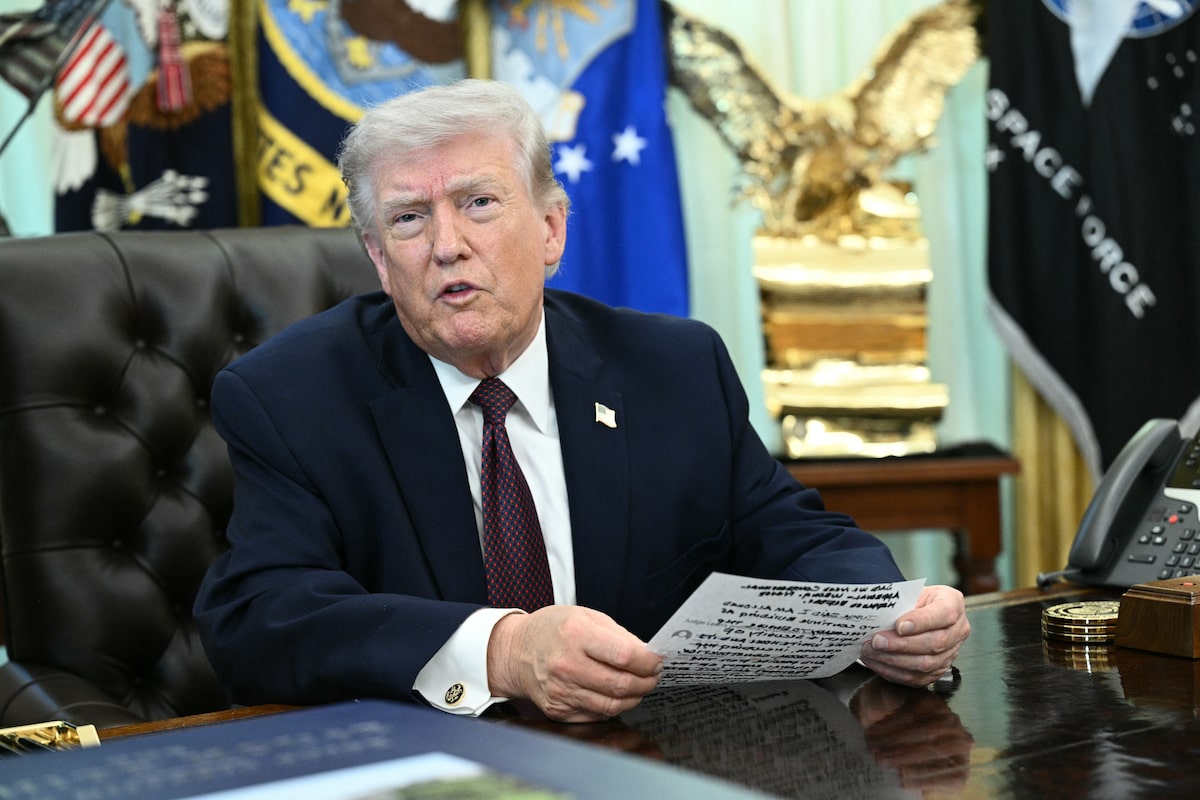
US President Donald Trump speaks to reporters after signing an executive order in the Oval Office, March 31.BRENDAN SMIALOWSKI/AFP/Getty Images
In public, Donald Trump still refers to Canada’s Prime Minister as “governor.” But in private, he acknowledges that Canadian annexation is beyond his reach, according to a royal biographer who dined at Mar-a-Lago with the U.S. President.
“I guess it’s not going to happen!” Mr. Trump, an open admirer of the British monarchy, told Robert Hardman in a conversation earlier this year.
The comments appear in Elizabeth II. In Private. In Public. The Inside Story, Mr. Hardman’s sixth book on the monarchy. Mr. Trump was the last state visitor to Queen Elizabeth II, capping a reign in which she met scores of national leaders.
Mr. Trump cited the long arc of Canadian sovereignty and this country’s continued ties to King Charles as reasons for Canada to hold on to its independence. Instead, the President described his repeated annexation threats as the result of personal pique.
A U.S. invasion of Canada is still far-fetched. Canadians are preparing anyway
Canada has “these terrible politicians. They’re nice to my face and then they say bad things behind my back,” he said, according to the new book, which is due to be released in Canada next month.
Mr. Trump has shown a long-standing affection for the monarchy, one partly grounded in his own family history, Mr. Hardman said in an interview.
“What we always have to remember is he is half British, and his mother was a MacLeod from the Isle of Lewis, who was a great fan of the late Queen herself. And I think that’s part of his heritage,” Mr. Hardman said.
Mary Anne MacLeod Trump was born in the village of Tong in the Outer Hebrides in Scotland and grew up speaking Scottish Gaelic before immigrating to the U.S. in her teens.
Queen Elizabeth II maintained deep ties with Scotland; she died in Balmoral Castle in Aberdeenshire.
Mr. Trump fashioned a “genuine connection with the late Queen,” said Mr. Hardman, who in his book recounts the President’s efforts to draw her into telling him which occupant of the White House she liked best.
“I kept asking her: ‘Who was your favourite president? Was it Reagan? Or Eisenhower?’ and she just said: ‘They were all very nice.’ That sort of thing,” Mr. Trump said.
His attempts to discern her favourite British prime minister were equally unsuccessful.
“So I realized: That’s why she lasted 70 years without a complaint – because she was so good at it. The rest of us would have said: ‘Oh, I liked so-and-so.’ But she was so clever,” Mr. Trump said.
“And I know she liked me because we talked a lot.”
Opinion: Trump is obsessed with Canada – and our rebuke of his advances is growing more dangerous
The Queen’s passing did little to dampen Mr. Trump’s enthusiasm for the monarchy.
“He’s as fulsome about the King as he was about the Queen,” said Mr. Hardman, who argues that the Royal Family’s influence on the President counts in favour of its value in modern times.
In January, after Mr. Trump offended American allies by saying they had “stayed a little back, a little off the front lines” in Afghanistan, British Prime Minister Keir Starmer demanded an apology for remarks he called “insulting” and “appalling.”
Trump criticized for downplaying NATO allies’ role in Afghan war
But it was only after “royal concerns” were sent the President’s way, Mr. Hardman wrote, that Mr. Trump called British forces “second to none,” writing on social media that their “GREAT and very BRAVE soldiers” will “always be with the United States of America.”
It is in part that royal connection, he adds, that has given Mr. Trump personal pause over his desire to annex his Commonwealth neighbour to the north. Charles is, after all, King of Canada, and travelled to Ottawa last year to open Parliament.
Mr. Hardman recounts telling Mr. Trump that any move toward annexation of Canada would displease the King.
“Do they still recognize the King? Or have they stopped that?” Mr. Trump responded.
He grumbled about the historical treaties that established the 49th parallel as the border, arguing that cold weather had caused Canadians to cluster close to that frontier.
“The problem is some guy drew that straight line to make a border. He should just have drawn it 50 miles further north and then there wouldn’t be a problem,” Mr. Trump said.
Still, he went on to acknowledge the durability of that very border.
“I suppose the Canadians have got 200 years of history and all that ’Oh, Canada’ thing,” he said. “You can’t deal with that in 3½ years.”