
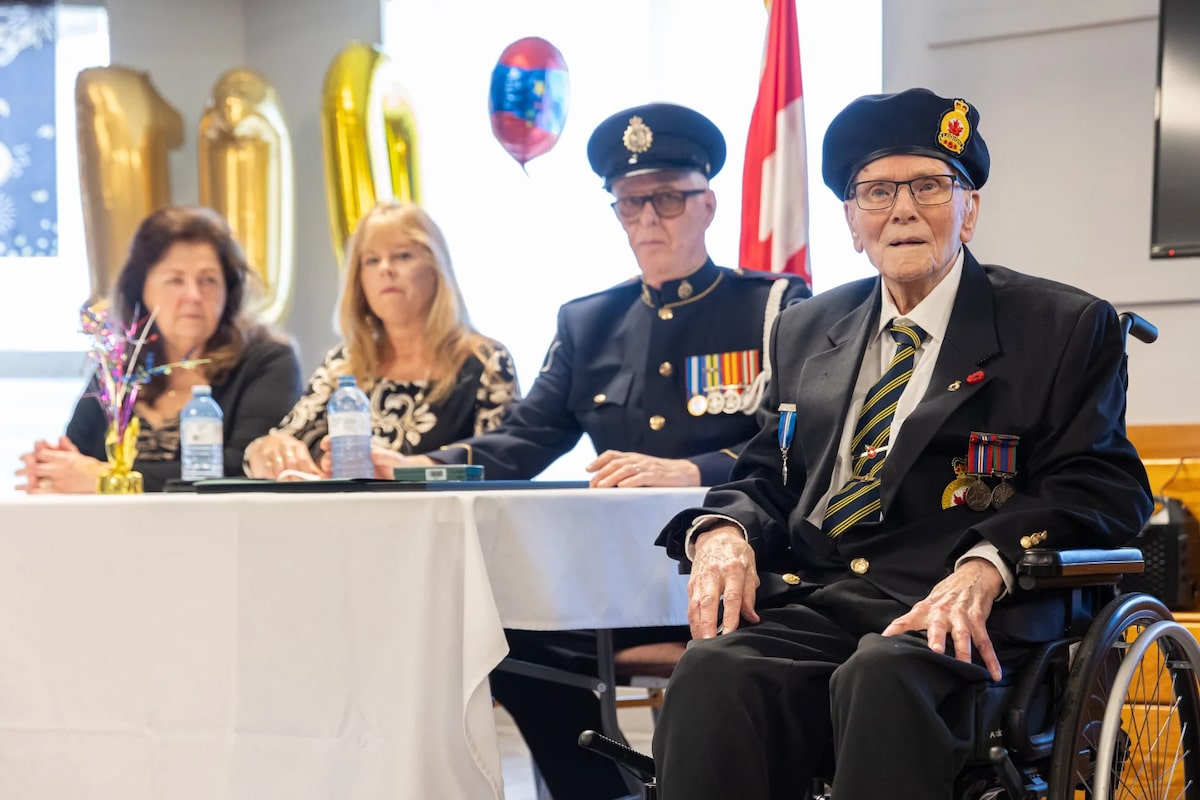
Burdett ‘Burd’ Thomas Sisler, centre, a 110-year-old veteran who served during the Second World War, at his birthday party at a Royal Canadian Legion in Fort Erie, Ont., in 2025.Alex Heidbuechel/The Canadian Press
For Burdett Sisler, being rejected by the Royal Canadian Air Force sparked a lifelong joy for tinkering with tech.
Turned down at the age of 28 because of poor sight in one eye, he instead enlisted with the army and became a telecommunications mechanic, helping deploy the top-secret radar technology used to shoot down German bombers in the Second World War.
When Mr. Sisler died on April 2 of natural causes, two weeks shy of his 111th birthday, he was believed to be Canada’s oldest person and the oldest surviving veteran.
His family said Mr. Sisler had adapted to some of the latest technological marvels. He used a smartphone and kept up with friends in France, Austria and Hungary through e-mail and social media until recently.
Through more than a century of change, the supercentenarian embraced kindness and helping others. He also stressed the importance of searching for the lighter side of life to his five children, dozen grandchildren, 23 great-grandchildren and 14 great-great-grandchildren, said his son Norm Sisler.
“That was his example: He was always joking around,” Norm told The Globe and Mail on Sunday.
Burdett Sisler, who served during the Second World War and is believed to be Canada’s oldest man, says there’s no real secret to longevity. (May 7, 2025)
The Canadian Press
Born in Akron, Ohio, in the spring of 1915, Burdett moved to Toronto as a three-year-old because his father took a job managing the Goodyear Tire rubber plant, which had begun ramping up production to meet North America’s exploding demand for cars.
Years later, Burdett started working in the company’s mailroom, his son said, and then married his wife, Mae.
“When he did enlist, my mother told him … ‘When you go overseas, I don’t expect you back, so you better give me something to remember you by.’ So they had a baby girl, Sharon,” Norm said.
Fortunately, he spent his military service training and operating in Canada. His brother Louis Sisler, who died in the 1960s, had a leg blown off while fighting in France when a nearby comrade stepped on a mine.
This weekend, Veterans Affairs Minister Jill McKnight heralded Burdett Sisler’s service and his inspiring legacy.
“Mr. Sisler was among the veterans whose sacrifice and resilience helped shape our country,” she said.
After the war ended, Burdett, or “Burd” as he was known, and Mae moved to Fort Erie and had two more daughters along with Norm and his twin brother.
Burdett set up a radio and TV repair shop, but with a growing family, he soon traded that in for a job with the federal customs and excise unit, the precursor to the Canada Border Services Agency.
From 1949 to 1979, he worked as a customs officer at the Peace Bridge border crossing. Norm, who followed in his footsteps with his own three-decade career in the same agency, said Burdett renounced his U.S. citizenship and became a Canadian citizen in 1952.
He loved travelling through the United States by motorhome, but the rapacious news reader was not happy with the direction President Donald Trump was taking his birth country, Norm said.
His retirement was ruptured by the death of his wife in 1985, but he continued finding meaning by travelling with friends, singing in a barbershop quartet and throwing himself into volunteering. Over the years, he enjoyed helping blind people bowl, teaching English to foreign students as well as advocating for Fort Erie’s oldest citizens through the municipality’s Senior Advisory Committee, Norm said.
The son of an alcoholic father, Burdett abstained from drinking and smoking his whole life and only ate during his three daily meals, his son added. He also “never took a pill until he was in his 90s,” according to Norm.
When the COVID-19 pandemic hit, Burdett’s children and their partners took turns sleeping over at his house so he wouldn’t have to be put in a nursing home, where the virus devastated residents in those crowded settings. He caught it anyway, Norm said, but felt better within three days.
He persisted as his mobility declined, but reluctantly agreed to use a walker after the pandemic‘s arrival to hedge against a bad fall. In 2022 he moved into the assisted-living facility where he spent his final days.
“It’s too bad he’s not around because if you talked to him, he would talk your head off,” Norm said.