
Breadcrumb Trail Links
SportsHockeyNHLVancouver Canucks
NHL teams use all kinds of big data in their analysis already; calling everything AI misunderstands what the technology actually is
Get the latest from Patrick Johnston straight to your inbox Sign Up
Published Apr 05, 2026 • 4 minute read
You can save this article by registering for free here. Or sign-in if you have an account.
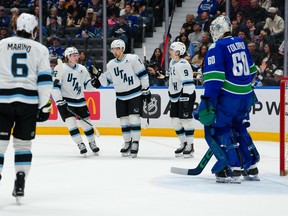 Dylan Guenther (#11) of the Utah Mammoth is congratulated after scoring a goal on Nikita Tolopilo of the Vancouver Canucks during the second period of their NHL game at Rogers Arena on April 4, 2026. Photo by Derek Cain /Getty ImagesArticle content
I chuckled a little when hearing declarations that NHL teams are looking more and more toward AI.
Advertisement 2
This advertisement has not loaded yet, but your article continues below.

THIS CONTENT IS RESERVED FOR SUBSCRIBERS ONLY
Subscribe now to read the latest news in your city and across Canada.
Exclusive articles by top sports columnists Patrick Johnston, Ben Kuzma, J.J. Abrams and others. Plus, Canucks Report, Sports and Headline News newsletters and events.Unlimited online access to The Province and 15 news sites with one account.The Province ePaper, an electronic replica of the print edition to view on any device, share and comment on.Daily puzzles and comics, including the New York Times Crossword.Support local journalism.
SUBSCRIBE TO UNLOCK MORE ARTICLES
Subscribe now to read the latest news in your city and across Canada.
Exclusive articles by top sports columnists Patrick Johnston, Ben Kuzma, J.J. Abrams and others. Plus, Canucks Report, Sports and Headline News newsletters and events.Unlimited online access to The Province and 15 news sites with one account.The Province ePaper, an electronic replica of the print edition to view on any device, share and comment on.Daily puzzles and comics, including the New York Times Crossword.Support local journalism.
REGISTER / SIGN IN TO UNLOCK MORE ARTICLES
Create an account or sign in to continue with your reading experience.
Access articles from across Canada with one account.Share your thoughts and join the conversation in the comments.Enjoy additional articles per month.Get email updates from your favourite authors.
THIS ARTICLE IS FREE TO READ REGISTER TO UNLOCK.
Create an account or sign in to continue with your reading experience.
Access articles from across Canada with one accountShare your thoughts and join the conversation in the commentsEnjoy additional articles per monthGet email updates from your favourite authorsSign In or Create an Account
or
Article content
It’s funny, because NHL teams have been using what we are now calling “AI” for a while now.
Article content
Article content
For instance, what do you think the computer boys were doing in Florida? They were using a data set comprising all the players who’d played hockey basically ever to find comparables to prospects and then projecting what they might become.
Do not forget what the tech bros are labelling “AI” is not really AI, rather it’s a deployment of large language models and databases to recreate things that already exist.
There are uses of this tech that are clearly practical, but they still require human direction.
It is what we used to call “big data” or “machine learning.” “AI” is just a different label. (Are you thinking about Anthony Bourdain explaining CDOs in The Big Short? I am. “It’s not old fish! It’s a whole new thing!”)
Lots of teams use projection models now that are built using supervised machine learning algorithms. Expected goals models are supervised machine learning algorithms. The contract projection models many teams use now are supervised machine learning algorithms.

Canucks Report
Thanks for signing up!
Article content
Advertisement 3
This advertisement has not loaded yet, but your article continues below.
Article content
“AI” is already here.
The Guenther thing
Dylan Guenther has 38 goals. Canucks fans need no reminding of this, of course.
The real question to ask today is, “Would you trade Dylan Guenther for OEL and Garland?”
And the answer is pretty clearly no.
Listen, Conor Garland was a quality Canuck. OEL in his first season was solid, but not spectacular.
Guenther is one of the top snipers in the NHL.
I do think it’s important to remember what the trade was about: Clearing out players who were overpaid and not contributing, while bringing in a defenceman who could play and a winger who could shore up your forward lines.
Jim Benning’s draft-day trade in 2021 accomplished this. But was it worth it?
Here’s the thing: Being a GM is about a willingness to take swings. It’s what you swing at, and with, that matters. When you are picking in the top 10, as the Canucks were set to do in 2021, you do need to think long and hard about what passing up that opportunity means. In Benning’s judgment, adding a defenceman who could play in the top four and a winger who could play on the second line, while disposing of three players who weren’t going to play a role, was worth it.
Advertisement 4
This advertisement has not loaded yet, but your article continues below.
Article content
And, on the surface, you can understand the concept.
But the problem was OEL was already 30 when Benning traded for him. He was a still a quality blueliner but was no longer at his peak. And the Canucks already had Quinn Hughes, so how he was going to fit into the lineup was a question. Was he a wise investment? He was being paid like a No. 1 defenceman but wasn’t going to fill such a role.
That was fundamentally the flaw here: Benning chased after the wrong kind of guy. He should have gone after a defenceman who could play on the second pair, not a guy who might be able to play on the first pair. (But how would he, when again, you already had Hughes?)
As a counter example: Nikita Zadorov was flipped for a third-round pick just five days later. Or Ethan Bear; he was traded straight up for Warren Foegele.
Obviously, the result from all this only underscores how big a gamble the trade was: OEL was bought out by the guys who replaced Benning, and Garland was shipped out last month after it became clear the Canucks were in a rebuild, something he hadn’t signed up for.
Advertisement 5
This advertisement has not loaded yet, but your article continues below.
Article content
You don’t win without taking cuts. It’s just that you need to recognize which swings to take and why you are taking them.
Most GMs miss this. The good ones — the few good ones, let’s be clear — recognize how to juice the chance at success with their roster moves.
The culture question
Elliotte Friedman said Friday on Kyper and Bourne in Toronto that from what he could tell, management here felt they’d done a pretty full reset of the culture inside the room, that they’re building who they are almost from scratch.
That tracks with something I wrote about almost a year ago, that management had in the back of their mind they may have to just blow everything up to fix the team’s culture.
Of course, they had this odd dream that somehow they could build something for Hughes, that somehow even though they knew he was going to leave sooner rather than later they could make a team that would do something before he left.
It didn’t work. To me, the lesson is don’t let things linger: Address them immediately and, if you can’t find an internal solution, move quickly and aggressively to change things up.
Read More

Canucks player grades: Rough defending in 7-4 loss to playoff-bound Utah

Canucks: Lessons from the past — and the Whitecaps — in how to set a culture
Article content
Share this article in your social network