
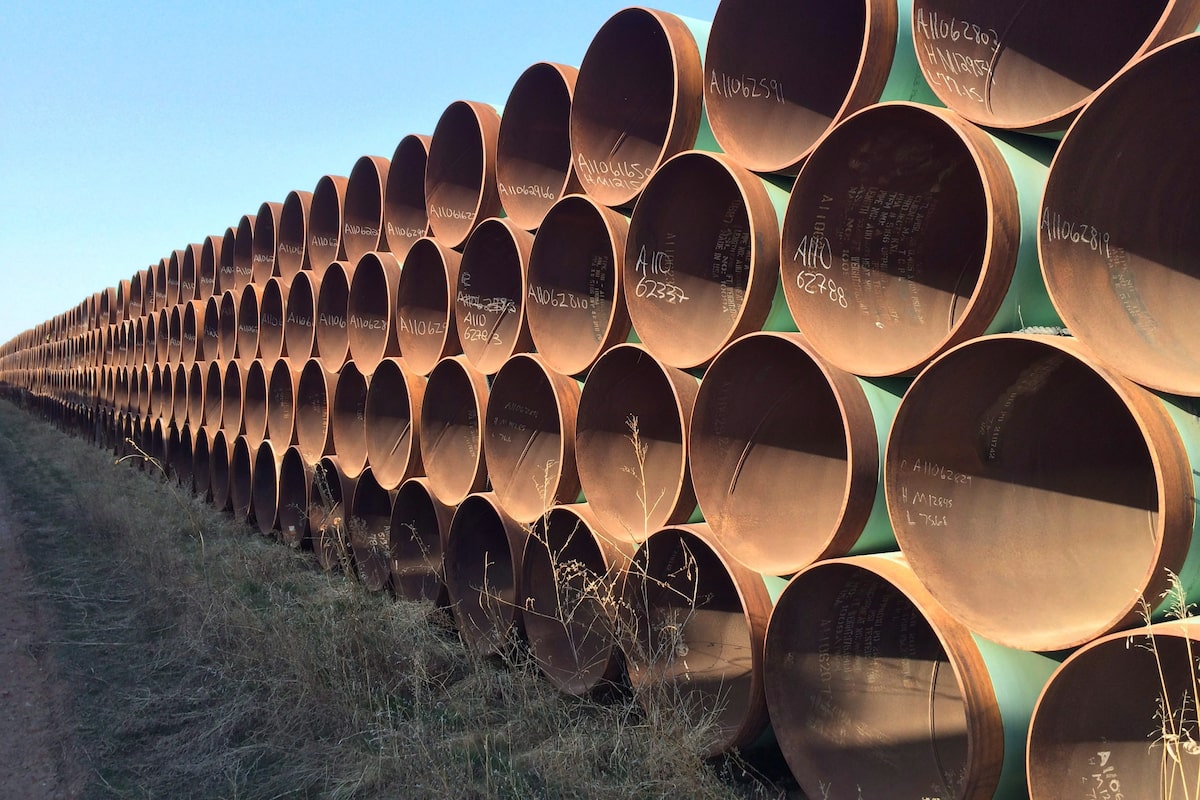
Pipes meant for the defunct Keystone XL project are stacked at a yard in Gascoyne, N.D., in 2015. Bridger Pipeline has proposed transporting crude from the Canada-U.S. border to Wyoming largely using existing pipeline corridors.Alex Panetta/The Canadian Press
Bridger Pipeline’s proposed project to transport Canadian crude from the U.S.-Canada border to Wyoming would cost about US$2-billion and have the capacity to transport more than 1 million barrels of oil per day, according to new details released by the company.
The company first outlined plans in January to the Montana Department of Environmental Quality for a pipeline capable of transporting 550,000 barrels per day of Canadian crude from near the U.S.-Canada border in Phillips County to travel south through eastern Montana before crossing into Wyoming and terminating near Guernsey.
However, filings submitted in late March show the proposed 36-inch pipeline would span nearly 1050 kilometres and ultimately have the capacity to deliver up to 1.13 million barrels per day to Guernsey, Wyoming. Bridger expects the pipeline to initially operate at about 550,000 barrels per day.
New U.S. proposal could revive Keystone XL pipeline assets, but would need Trump’s approval
The project, which the developers say would largely follow existing pipeline corridors to minimize new land disturbance, would cost about US$1.96-billion for the 700 km that will be laid within Montana.
Plainview Energy Analytics noted that batching light crude oil at maximum capacity could push volumes significantly beyond the 800,000 bpd ceiling typical for heavy oil service on a line this size.
Although the application specifically mentions moving Canadian oil, detailed maps in the application also show potential tie-ins at key points for the Bakken shale oil field, providing access to most of Bridger’s North Dakota gathering network, Plainview noted.
“This optionality positions the project for potential future expansion beyond 550,000 bpd and creates the possibility of a new competitive egress option for Bakken shippers,” Matthew Lewis, founder of Plainview said.
Bridger Pipeline is seen as a potential U.S. partner for Canadian company South Bow SOBO-T, which is working to revive portions of the cancelled Keystone XL oil pipeline.
Should that project receive approval from U.S. President Donald Trump and additional links to U.S. refining hubs be constructed, analysts say it could increase Canada’s crude exports to the U.S. by more than 12 per cent.
Those additional links would need to move oil to major refining hubs such as Cushing, Oklahoma; Patoka, Illinois; and the U.S. Gulf Coast. Analysts note that Guernsey is not considered an end market for crude oil, meaning further infrastructure would be required to connect the project to downstream demand centres.