
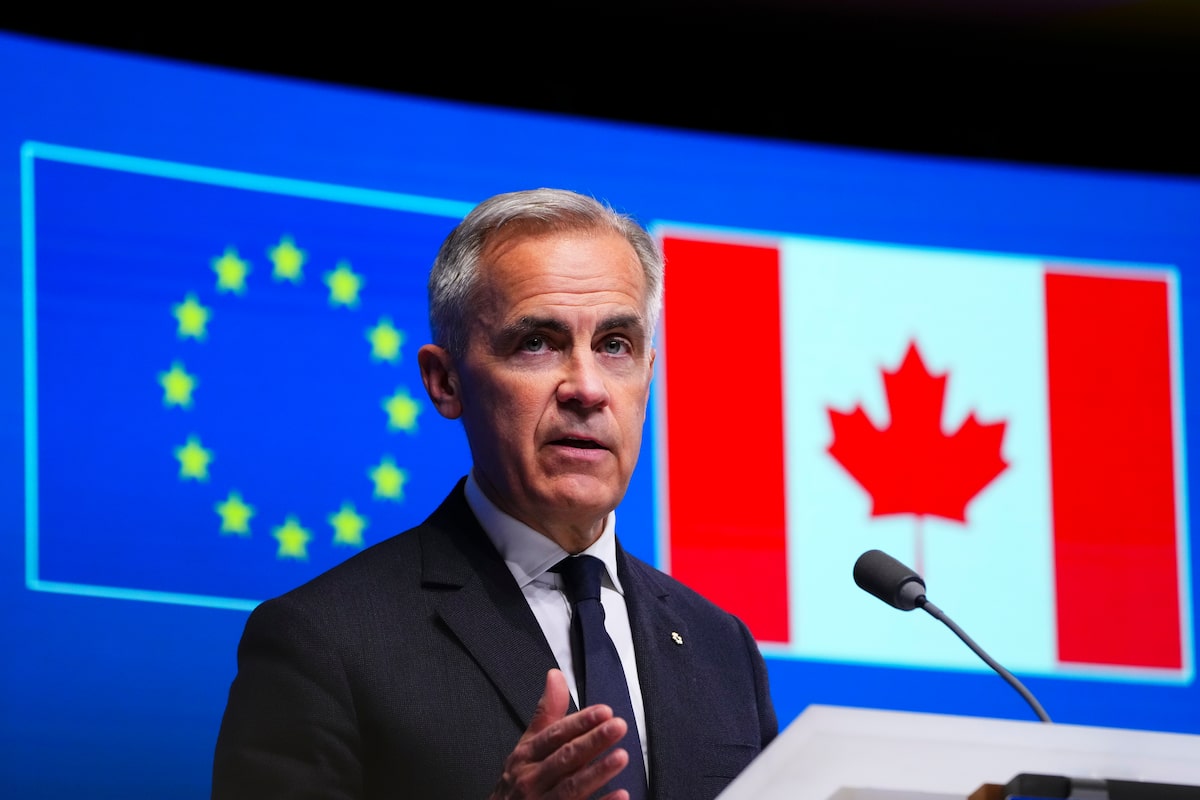
Prime Minister Mark Carney takes part in a news conference during the Canada-EU Summit in Brussels, Belgium in June, 2025.Sean Kilpatrick/The Canadian Press
New polling suggests a majority of Canadians think Canada should explore joining the European Union at a fraught time for geopolitical relations.
A survey of 4,000 people conducted by Spark Advocacy’s polling arm in March found that one in four respondents thought it would be a good idea for Canada to formally join the economic and political bloc of European nations.
A further 58 per cent indicated it was a proposal worth considering further, while the remainder said it was a bad idea.
The Spark poll cannot be assigned a margin of error because it was conducted online.
Spark’s chief strategy officer Bruce Anderson said the survey suggests Canadians are increasingly open to finding ways to buck Canada’s reliance on the United States after more than a year of tariffs under U.S. President Donald Trump’s second administration.
EU and Australia sign free trade pact and announce a new defense partnership
“What we’ve seen is obviously a real shock to Canadians’ sense of the status quo and whether or not it could endure,” he said.
“And alongside that, a real openness on the part of Canadians to say, ’Well, let’s find solutions to this problem of reliance on the U.S. when the U.S. isn’t as reliable.”
The prospect of Canada joining the European bloc – despite the obvious geographical barriers – has come up recently on both sides of the Atlantic Ocean.
Speaking at the Europe 2026 conference in Berlin in March, French Foreign Minister Jean-Noel Barrot said the European Union is attracting more candidate countries, such as Iceland, and suggested “maybe Canada at some point” will sign up.
Barrot smiled while mentioning Canada and his comments generated some laughter from a panel moderator and applause from the audience.
The European Parliament adopted a report last month calling on the EU to deepen ties with Canada. Members said in an accompanying statement that Canada is “perhaps the most European country outside Europe.”
That mimics a statement made by Prime Minister Mark Carney on his first trip to Europe after taking office in March 2025, on a trip designed in part to send a message about his pledge to expand Canada’s ties away from the U.S.
The idea of Canada joining the EU has been floated by some in Canada, including Alberta politician Thomas Lukaszuk, while others reject the idea of adding a layer of Brussels bureaucracy to existing federal and provincial rules.
Carney dismissed the idea last June, saying he wants clearer and broader ties with the continent but not as a member of the EU.
Support for exploring EU membership crossed party lines in Spark’s survey. At 33 per cent opposed, supporters of the federal Conservative party were the ones most likely to see it as a bad idea.
The survey also asked Canadians whether they thought the United Kingdom made a mistake leaving the EU in 2020. Nearly two-thirds of respondents said Brexit was a bad call.
Anderson said Canadians are more attentive to global developments since Trump started levying his tariffs last year. He said Carney’s speech at the World Economic Forum in Davos earlier this year – where he called on “middle powers” to band together – registered with the broader population.
Canadians are increasingly “pragmatic” about global affairs, Anderson said.
“I’m not saying everybody’s sitting around the dining room table at night talking about it, but there was an idea there that immediately made sense to a lot of Canadians, which is that, if you rely too much on superpowers, you might not end up having as much leverage as you need to have when the going gets tough,” he said.
Anderson, a longtime pollster, was a public supporter of Carney during last year’s Liberal leadership campaign and subsequent federal election.
Anderson said Carney is well-suited for this moment in geopolitics, given his experience on the global stage before taking the reins of the Liberal party.
But he added that no matter who was prime minister right now, Canadians would be looking for solutions beyond capitulating to Trump.
“This whole subject area is more at the heart of our politics than it has been, well, probably in my lifetime, to be honest – this whole idea of, how will we structure our economy for the future?” Anderson said.
The polling industry’s professional body, the Canadian Research Insights Council, says online surveys cannot be assigned a margin of error because they do not randomly sample the population.