


Summary
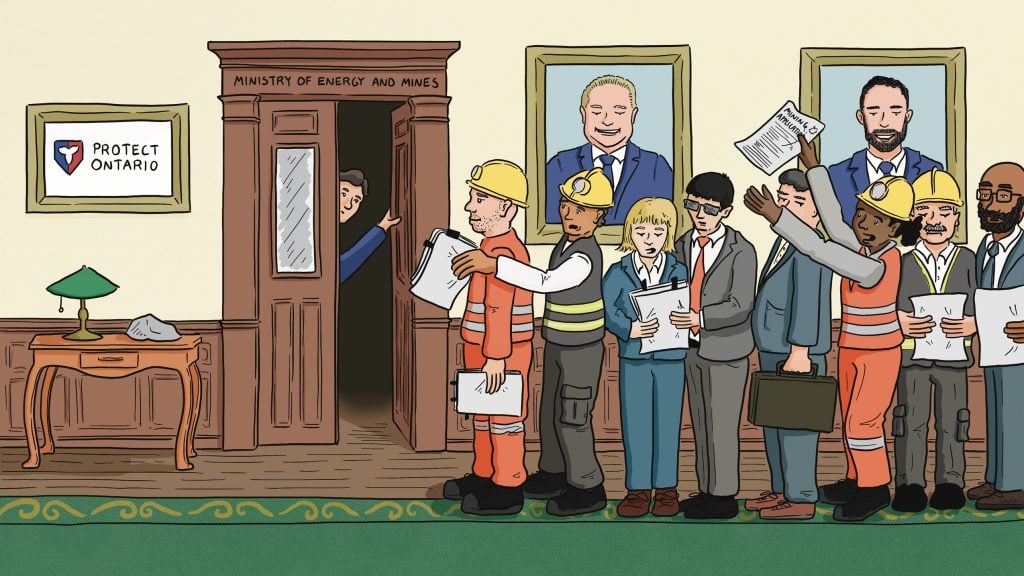
The Government of Ontario is overhauling the mine permitting process to funnel all stages through the relatively new Ministry of Energy and Mines, under the “one project, one process” system.
Many First Nations leaders have voiced concerns about how this will impact consultation, and the burden it places on Indigenous communities.
Some mining companies are already seeing how this fast-tracking could play out, and say no corners will be cut.
In early March, dozens of digital billboards across Toronto’s Union Station repeatedly flashed four words that have become synonymous with economic survival for the Doug Ford government: “one project, one process.”
The phrase welcomed people travelling through the central transit hub on their way to the world’s largest annual mining conference, held by the Prospectors and Developers Association of Canada. It was an overwhelming four-day affair, where more than 32,000 people talked deals, investments and pretty rocks in faraway places and how to get them out of the ground.
This year’s conference — the largest ever — began a day after the United States and Israel attacked Iran, setting in motion a crippling squeeze on oil supply that has raised gas prices to levels not seen in decades and killing thousands of people. But that didn’t hamper the very loud buzz at the conference. In some respects, it may have upped the volume.
 Ontario Premier Doug Ford touted his government’s new streamlined approach to reviewing mining proposals at an annual industry conference in Toronto in March. Photo: Chris Young / The Canadian Press
The urgency for a homemade solution to tackle global crises (mainly Donald Trump) had increased once more — and Ontario had a (four-word) plan that is still, for all the fanfare, an untested experience, unknown to many.
Though outward-facing, the plan is actually predicated on reshaping the way the government works internally, to guide and greenlight proposals for mining and development faster through the bureaucracy. The promise: one project ushered through one massive, clear and quicker process.
“It’s a huge shakeup,” one former Ministry of Mines official told The Narwhal. “It’s a huge disruption from how we would all typically work.”
The enormity of this internal shift was evident in the sprawling halls of the Metro Convention Centre. There, government ministers, led by Energy and Mines Minister Stephen Lecce, met seemingly every global delegation with the message of “one project, one process” — colloquially called “1P1P” — and how it would turn Ontario into “the world’s reliable partner.” Ministry staff answered questions in packed rooms about how to figure out if “1P1P was right for you.” The three companies that had already been accepted into the fast-tracking process were the stars of a crowded trade show, including one that talked at length with The Narwhal.
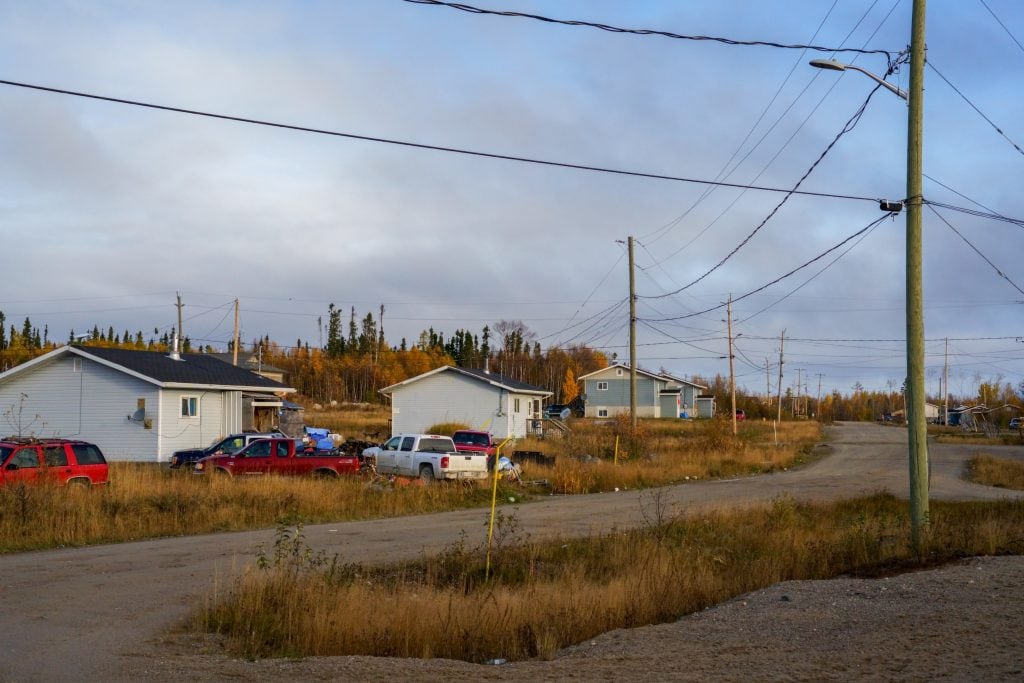
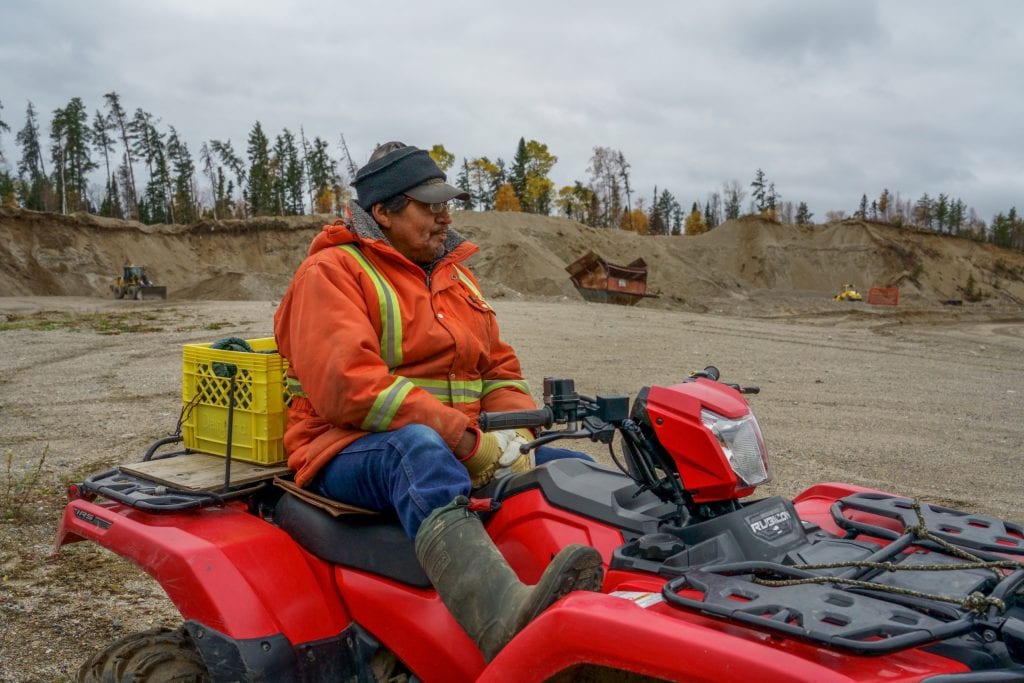
For some First Nations leaders attending the mining conference in Toronto, there was frustration that the many crises facing their communities back home, such as a lack of health-care services and housing, have not been tackled with the same urgency as mining projects are receiving. Photos: Sara Hylton / The Narwhal
While expediency might yield positive results for the mining industry, for some First Nation leaders who attended the conference, there is an obvious loss: important things, like consultation and consent, could also be fast-tracked, or missed completely. There was also frustration over the many crises that, for decades, have not been granted the same urgency: clean drinking water, basic health-care services, housing.
“We still don’t have any clarity on what fast-track or ‘one project, one process’ really means,” Ontario Regional Chief Abram Benedict told The Narwhal. “We’re all still kind of unsure.”
Four other First Nations leaders told The Narwhal the same thing: no one in government had talked to them yet about the process, let alone what it means for their communities, which are already on the frontlines of resource extraction and its aftermath.
The next 12 to 18 months, Benedict said, will “become the real test” of the government’s four-word fast-tracking policy, both provincially and nationally.
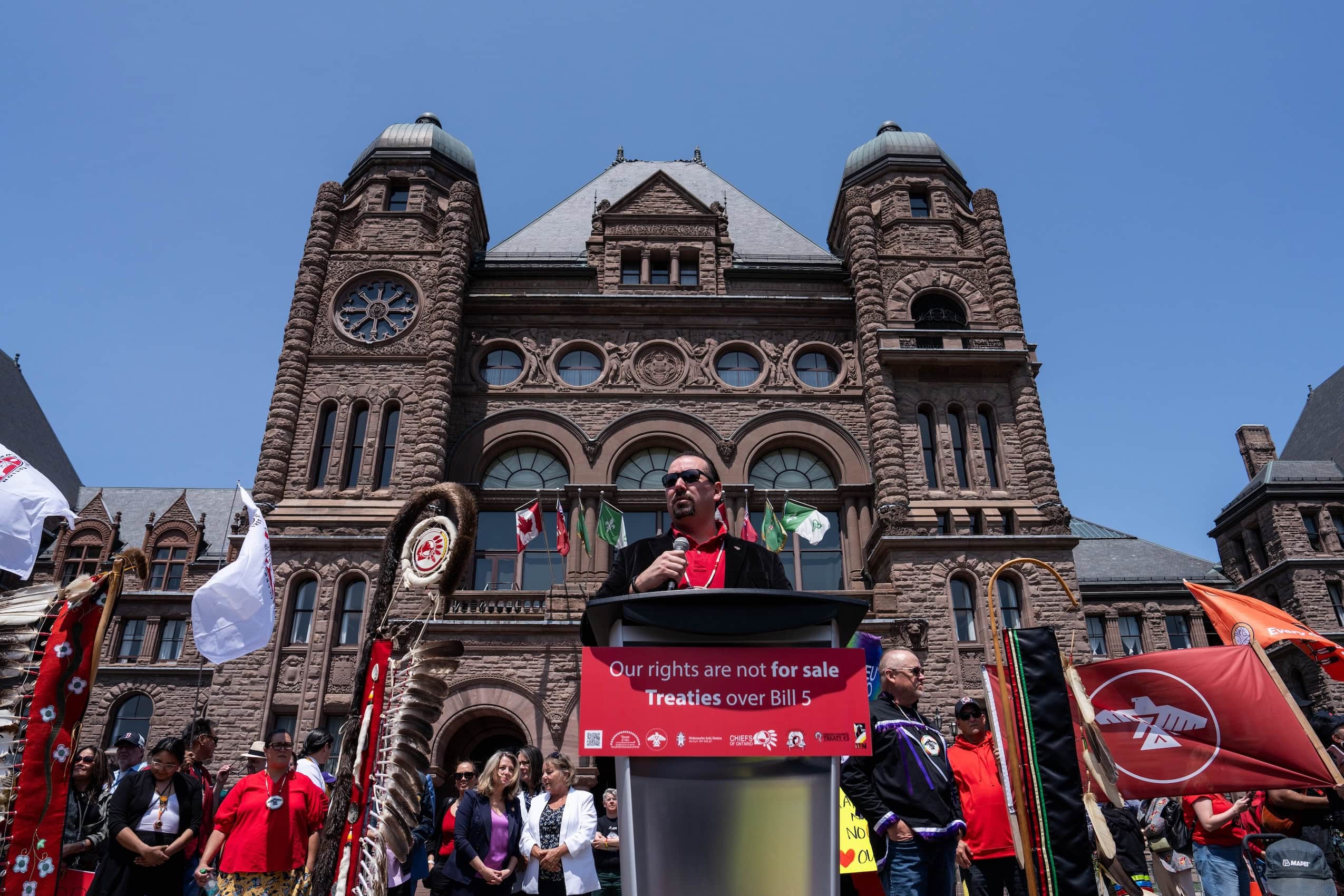 First Nations are seeking clarity on the details of Ontario’s push to fast-track mining developments in their territories, according to Ontario Regional Chief Abram Benedict, seen here speaking in opposition to the Ford government’s Bill 5 — the legislation that introduced the streamlined approval process. Photo: Sid Naidu / The Narwhal
‘A trailblazer or a guinea pig’
Just outside Red Lake, Ont., 100 kilometres east of the Ontario-Manitoba border, is the proposed site for the largest lithium mine in the province. The company hoping to build it, Frontier Lithium, says the mine could help supply electric-vehicle battery manufacturers. It was the first project to be designated on Ontario’s “one project, one process” list. The Sudbury-based mining company was assured a 24-month approval by the Ford government.
“We’re either a trailblazer or a guinea pig,” Clara Lauziere, Frontier Lithium’s director of sustainability, told The Narwhal.
Three years ago, Lauziere was working in the Ministry of Mines, navigating a process she described as inefficient and uncoordinated. “Had I known 1P1P was coming, I might have stayed,” she said.
As she explains it, the regulatory system in Ontario and Canada has some of the highest environmental standards, but it’s also one of the most complex globally. “There’s never been a real road map on how to permit a mine and how to do it effectively,” she said, because every project is different. Until last October, mining companies had to work with multiple ministries that didn’t communicate well, which she said resulted in a lot of repetition and confusion for both industry and Indigenous communities.
“Consultation fatigue was huge,” she said. Some of the communities she spoke to as a ministry official had received six or seven letters from several different ministries about the same project. In the same vein, companies were receiving multiple directives from different ministries about which Indigenous communities to consult about different parts of the project.
All of this inevitably resulted in delays for permits; 15 years of delay, according to the Ford government, though it hasn’t given examples of when bureaucracy alone tangled a mining project up for that long. With the new process, that will purportedly go down to two years. “Certainty is everything,” Lauziere said, “especially when you’ve never had it.”
That’s why she was bombarded with questions in every room she went to at the conference. “People want to know if they can really believe this is actually going to happen,” she said. The short answer appears to be yes, but it depends on a sustained commitment from industry to also be ready and committed with the right paperwork, detailed studies, accurate data and robust consultation plans. “I think the key is really just being willing to work with the government and communities,” she said.
In other words, as a government official told a packed room at the mining conference, “this is not a one-way street” but “a tremendous effort that requires everyone to be at the table.”
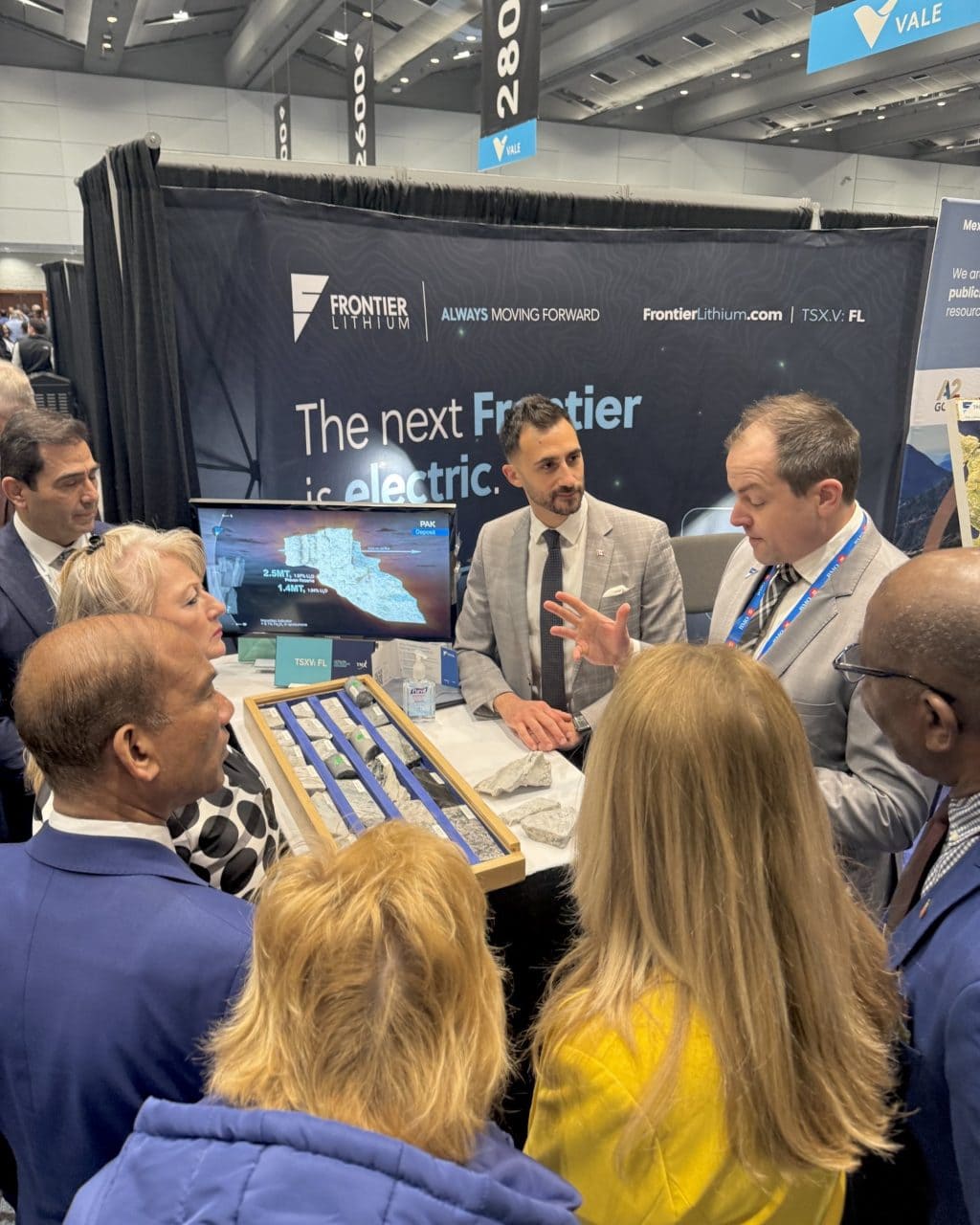 Ontario Minister of Energy and Mines Stephen Lecce, centre, visited the Frontier Lithium booth at the Prospectors and Developers Association of Canada’s 2026 conference. In October, a Frontier Lithium mine was announced as the first project to be fast-tracked under the Ford government’s new approach for reviewing mining proposals. Photo: Stephen Lecce / X
When Frontier Lithium was accepted into the new system, the company “had everything ready,” Lauziere said. In response, they were assigned a bureaucrat to be their main point of contact throughout the process, leading a team of officials across ministries. The company was provided a detailed 24-month timeline of steps this team would be completing in partnership with them.
In early March, the Independent Electricity System Operator, the Crown agency in charge of electricity supply and demand, proactively reached out to Frontier Lithium to discuss energy needs for their proposed mine after the company was selected for fast-tracking. “So there’s a lot of coordination and pressure there on priority projects,” Lauziere said, including from the mining minister himself.
In mid-March, Frontier Lithium received a single directive identifying all the communities that need to be consulted for the entire project. “Now, we can have confidence that we know who we need to talk to and what the potential impact on rights are going to be, so we can have meaningful conversations,” Lauziere said. “That level of detail and consolidation is incredibly valuable for communities and companies.”
Frontier Lithium is expecting a permit by the fall of 2027, so the new process does appear to be faster. Lauziere said if any concerns crop up with their proposal over this period, the company expects to resolve them with the government and communities.
“No corners are cut in the process,” she added. “And nothing changes on the consultation front.” What “one process, one project” does is make the consultation process clearer for every company.
“Yes, we want to build a mine,” Lauziere said, “but we also want a relationship that lasts 50 years.”
“As the first, we all kind of have to get it right.”
Fear of the fast track
Ontario’s push to fast-track mines, and promises it can happen without sacrificing free, prior and informed consent from First Nations, hasn’t landed with everyone.
“The idea of fast-tracking really scares me,” Natasha Martin, Deputy Grand Chief of Mushkegowuk Council, told an overflowing room of miners and government staffers at the March conference.
She repeated the same sentiment to The Narwhal in an interview later. “That means that it’s a very fast job — a rush job — and we’re taking something that has taken years prior down to six months. That scares me, because then there will be things that won’t be properly captured or looked at.”
Martin’s fear highlights a deep disconnect in the ways industry and First Nations understand “one project, one process.”
While companies are quickly gaining extensive knowledge of what it all means for them, many First Nations say they have been left in the dark. And they remain especially skeptical about the effectiveness of environmental and community risk assessments under the streamlined process. In no small part, because it was initially proposed in Bill 5, a controversial legislation that allows for “special economic zones” where “designated projects” can evade provincial laws.
Bill 5 was written without the government holding a single consultation with Indigenous communities, although many would be significantly impacted by an increase in mining and development activity — and have historically not reaped the financial or social rewards of such industry. Nine First Nations have challenged the law in court, arguing that it is unconstitutional.
Dive deeper on this topic
Complicating matters further is that just as Ontario speeds up development approvals, the federal government has created its own office with a similar mandate. The Crawford Nickel project, outside Timmins, is being considered for fast-tracking at both levels. And recently, Frontier Lithium has been named to another list of projects for “federal permitting coordination.”
On the one hand, Lauziere credits the “one project, one process” system for setting them up perfectly for federal fast-tracking. On the other hand, early signs show choppy collaboration between levels of government could be a new drag on momentum, even as First Nations around Red Lake appear ready to work with both.
Dive deeper on this topic
Lauziere agreed that if things are going to be sped up, there will inherently be added pressure on First Nations. She called it “an unintended consequence” that will require Ontario to actively work on better informing and communicating with Indigenous communities.
“We really haven’t seen much of a difference on the ground yet,” Jason Batise, the executive director of the Wabun Tribal Council, told The Narwhal. The regional council for five First Nations around Timmins has honed a consultation framework to manage the deluge of mine consultations over the last two decades. That includes Crawford Nickel, with whom Batise says the First Nation has a good relationship.
Dive deeper on this topic
Batise is clear: “Consultation has never been a bottleneck to responsible development.”
“We don’t really yet see any sort of distinct acceleration of 1P1P, but we know it’s coming,” he said. “And if I had one concern, it would be the expectation from developers to fast-track consultation.”
“Because at that point, 1P1P is going to get challenged by the nations.” Historically, mining projects have been delayed by protests or legal challenges from nations that feel their constitutional rights were not properly met.
Batise isn’t the only one watching the fast-tracking process carefully. Many Indigenous leaders came to the mining conference with messages of vigilance, reminding attendees that First Nations were not “carbon copies,” and neither are their territories.
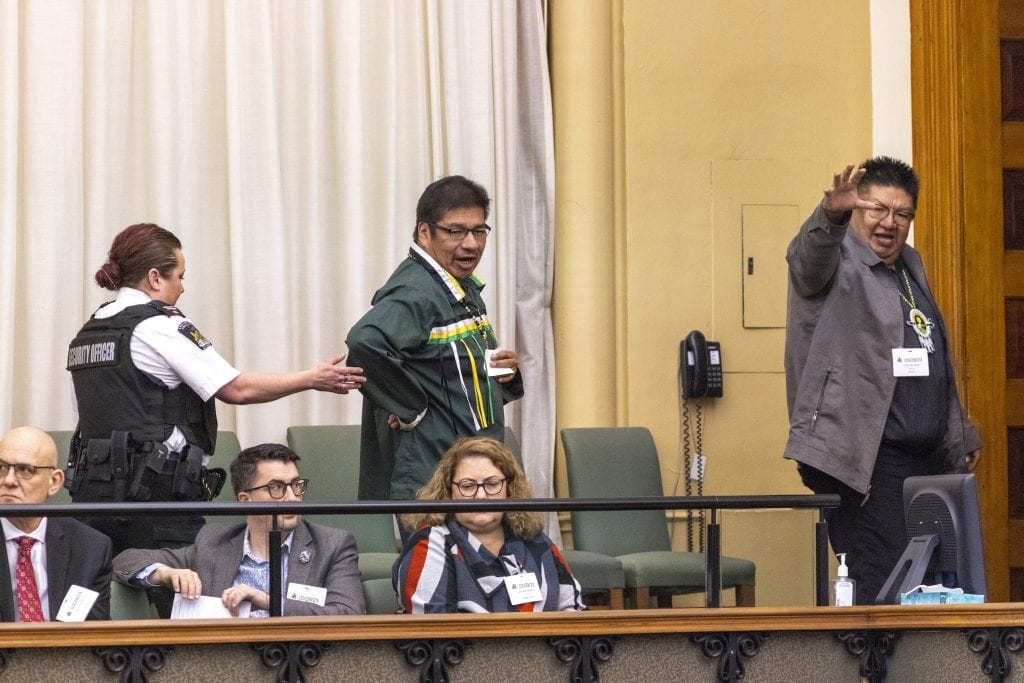

Members of Neskantaga First Nation have been speaking out about the impacts of industry on their community for years, including during a 2023 visit to Queen’s Park, when they were escorted from the legislature during question period after shouting their concerns with the Ford government’s mining agenda. Photos: Carlos Osorio / The Narwhal
Even as the process to approve mining projects speeds up, communities like Neskantaga First Nation, in the Ring of Fire region, are dealing with simultaneous crises. When Bill 5 passed, the nation’s only health-care centre was flooded and inoperational. There continues to be a chronic housing shortage; those that are standing are plagued by mould. There is a 31-year boil advisory in effect, the longest in the region.
“It’s hard to understand. It’s moving so fast,” Chief Gary Quisses told The Narwhal at the mining conference. He fears that despite its moniker, the “one project, one process” system will open the doors to multiple projects in their communities that all bypass First Nations consent, and needs.
“I don’t even have 9-1-1, I can’t even use that number. I don’t have a fire truck. I don’t have an ambulance, paramedics, anything,” he said. “And here, the government is trying to push and take our resources away.”
Batise is cautiously hopeful, noting that industry has lately had its “come-to-Jesus moment with First Nations,” developing meaningful partnerships based in equity. But he too worries the fast-tracking process may become a catalyst for companies to prioritize their bottom line.
“The government is telling industry 1P1P will be better for them. They’re also telling nations that faster is better for them,” he said. “The difference is that industry is getting what they want, but communities are not.”