

Listen to this article
Estimated 5 minutes
The audio version of this article is generated by AI-based technology. Mispronunciations can occur. We are working with our partners to continually review and improve the results.
A new report on the proposed data centre near Regina contains more details about its intended design, but nearby resident Doug McKell wants to see those intentions turn into reality.
The Rural Municipality of Sherwood has published online an executive summary of a consultant’s report on the $1.7-billion “artificial intelligence data centre campus” that Bell Canada is proposing to build just south of Regina.
The report addresses issues such as noise mitigation, water usage, road upgrades and storm water management, which are among the concerns that residents have been voicing.
The RM has not responded to requests for comment.
McKell lives within a mile of the proposed site, as the crow flies. He said he’s not opposed to the development.
“All that we’ve been asking, throughout this whole process, is that commitments made through, like this executive summary, appear in writing as binding, enforceable clauses in the development agreement, not as statements of intent,” he said in an interview.
McKell said he is also looking for more details on many of the items included in the executive summary, which was authored by Doug Randell of Fusion Consulting Ltd.
One of the concerns is about how much water the data centre will need and where it will come from. Other data centres use large amounts of water for their cooling systems, but the one in the RM of Sherwood will use an “air-cooled, closed-loop chilling technology,” the report says.
It will require a one-time fill and then remain sealed, and the facility will be hooked up to the City of Regina’s municipal grid, according to the plans.
There’s still a lot of unanswered questions about that system, though, said Simon Enoch, a Regina-based senior researcher with the Canadian Centre for Policy Alternatives.
He said it may be the “wave of the future” that data centres recognize the public opposition to their high level of water usage, but Enoch questioned how much more energy would be needed for that “closed-loop” type of cooling system.
“Usually these systems also require more energy, because it’s sort of a trade-off. You either use more water or use more energy,” Enoch said in an interview.
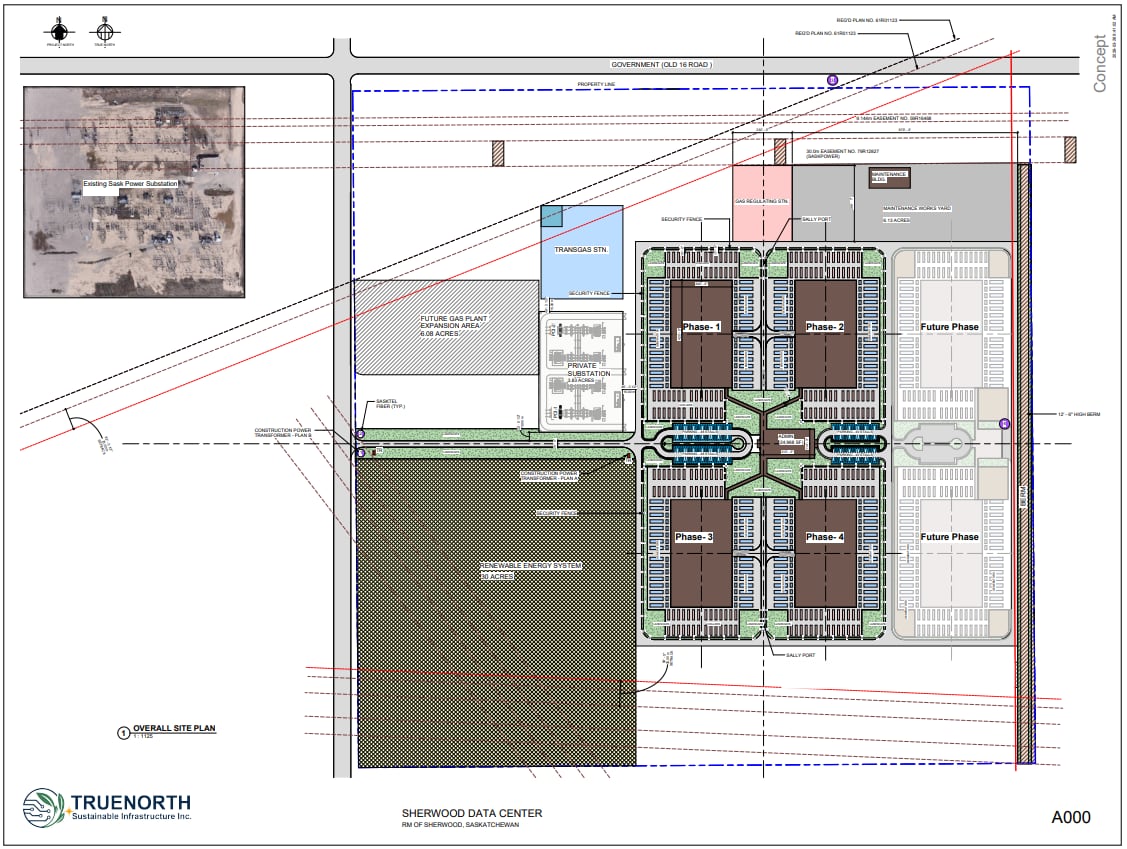 The RM of Sherwood posted this conceptual site plan for the AI data centre on its website. (RM of Sherwood)
The report says the site will host a “dedicated energy generation zone [with] a renewable energy system, a private SaskPower-linked electrical substation and a future natural gas plant.”
Both McKell and Enoch want to see more details on that.
“We’re still in the dark as far as things that are going to happen down the road,” McKell said.
Regina resident questions wisdom of development
One of the reasons Premier Scott Moe has given for supporting the data centre is that it will contribute to data sovereignty, which the federal government defines as “Canada’s right to control access to and disclosure of its digital information subject only to Canadian laws.”
“This is one of the few provinces where we do have available power to build, at scale, the data sovereignty that we very much require as Canadians,” Moe said last month.
WATCH | Premier touts data centre as economic boon for Saskatchewan:
Premier Scott Moe touts ‘Canada’s largest AI data centre’ as economic boon for Sask.
Bell Canada and Premier Scott Moe announced Monday that Saskatchewan will be home to Canada’s largest AI data centre — a 300 MW facility in the rural municipality of Sherwood, just outside Regina. Moe says this is a ‘historic investment’ in the province’s technology sector that will create jobs and partnerships.
However, Enoch noted Bell has said it has long-term tenancy agreements contracted with American artificial intelligence companies Cerebras and CoreWeave. He questioned whether they would still be vulnerable to a seizure of data by the U.S. government.
Regina resident Jay-Jay Bigsky, who initiated a letter-writing campaign after learning of the proposed data centre, echoed that concern.
After reading the consultant’s report summary, he’s looking for more details about many of the promises it makes.
But Bigsky also wants the community and the province to grapple with the overarching question of whether we should be building and investing in generative AI to begin with.
“What will a generative AI data centre actually produce for its community?” he asked. “We are seeing the answers to this. It is producing stolen content. It is producing false information. It is not producing anything of quality.”
Council needs quorum
The report is set to be considered at the RM of Sherwood’s next council meeting on April 20.
The council, however, does not have quorum after four of its seven members resigned on March 18. Under Saskatchewan’s Municipalities Act, councils need a majority of their members to be present at meetings for proceedings to be valid.
The provincial Ministry of Government Relations said in a statement Tuesday that it has “initiated the process to appoint individuals to serve as council members on an interim basis until elections are held in the fall” and it is working toward making those appointments before April 20.