
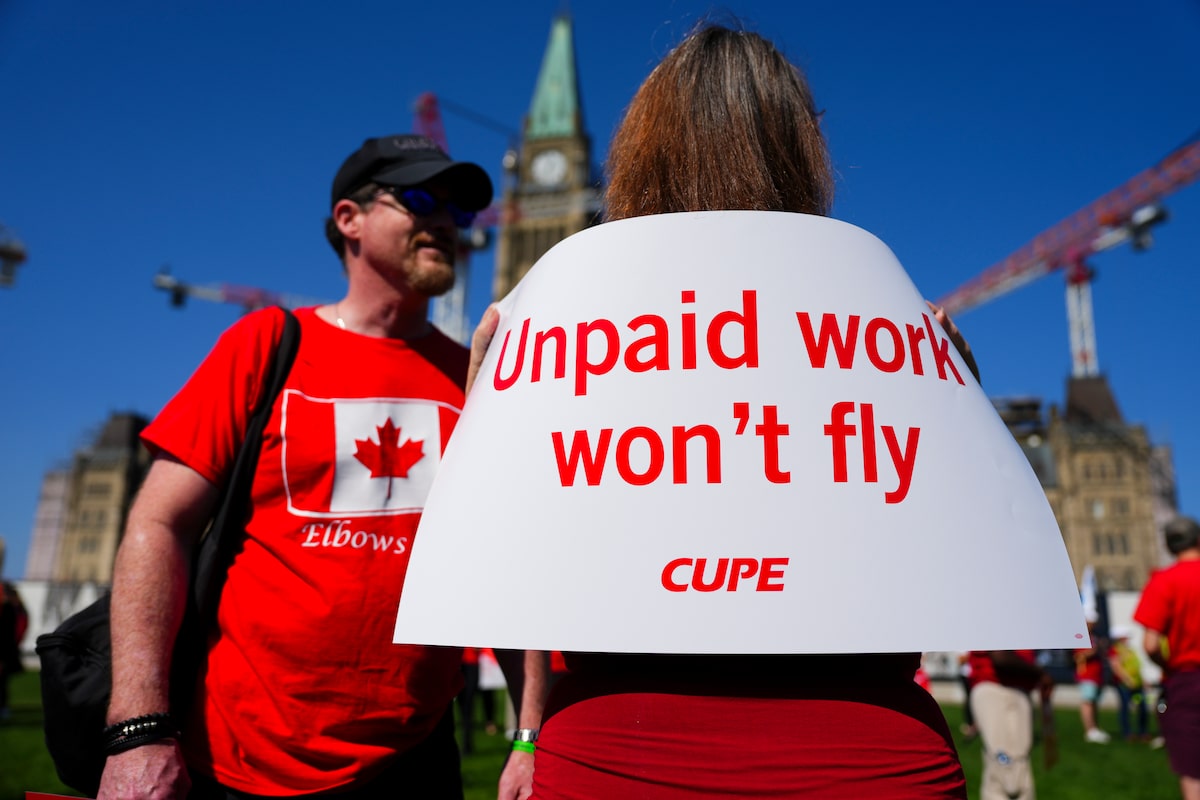
Unionized employees and supporters take part in a rally for Air Canada flight attendants on Parliament Hill in Ottawa, on Sept. 16, 2025.Sean Kilpatrick/The Canadian Press
The Canadian Union of Public Employees says the federal government’s probe into allegations of unpaid work in the airline sector is not taking workers’ arguments seriously.
Ottawa launched an investigation into the sector in August, 2025, when negotiations between Air Canada AC-T and the union representing its flight attendants boiled over into a strike that saw planes grounded as workers took to the picket lines.
Central to that work stoppage were allegations from the union that flight attendants are regularly subjected to unpaid work when aircraft are grounded.
In response, Jobs Minister Patty Hajdu asked her department to look into whether workers in the sector were being paid below a standard set by the federal minimum wage.
Findings from the first phase of that probe published in February found little evidence that unpaid work was widespread in the industry, though investigators flagged some issues with part-time and entry-level flight attendants to get a closer look.
Hajdu said at the time that the federal government needs more data to fully settle the issue.
Wesley Lesosky, president of CUPE’s Airline Division, said those initial findings were “a little frustrating” for the union and its members.
“There are copious amounts of times where we are unpaid, based on our schedules, based on how we’re paid,” he said.
Hajdu has said in the past the credit-based compensation model that’s standard in the Canadian airline sector has been established over the course of decades of collective bargaining.
Lesosky called the credit-based system “convoluted.”
The pay formula is largely based on time flight attendants spend in the air, combined with other factors as well as daily or monthly minimums for wages. But Lesosky said that approach fails to accurately take into account when delays and unforeseen circumstances keep cabin crew grounded, but still on duty.
“None of that’s compensated because you didn’t fly. You’re not credited,” he said. “So the whole idea of this formula pay doesn’t take into account the actual conditions of a flight attendant today.”
Much of the second phase of the federal government’s probe relies on the airlines conducting self-audits of their pay records to determine whether there are instances of crew members performing work below the federal minimum wage.
A WestJet spokesperson said in a statement to The Canadian Press the airline is supporting the federal government’s “collaborative approach” in the probe. WestJet values the work of its cabin crew and “remains committed to transparent and constructive dialogue,” the spokesperson said.
Air Canada did not respond to requests for comment on this story.
CUPE said in a release last week that it appears the airline industry is “flying the plane” in the probe.
Lesosky said the audit parameters allow airlines to select as few as 40 workers to track to determine whether they’re underpaid, with no requirement for random sampling. CUPE also said that the probe is happening outside of peak travel seasons when packed flight schedules make instances of alleged unpaid work more common.
CUPE argues the federal government hasn’t established a definition of work for flight attendants in the first place – whether a shift starts when they’re in uniform at the airport, if it extends when they’re part of a delay or have additional duties that crop up after a plane hits tarmac.
Lesosky argued that, without a definition of work specific to airline employees set out in Canada’s labour code, it is impossible for the probe to determine whether workers are falling below the federal pay standards.
Without that definition, the union is also bargaining at a disadvantage, he said.
“It is completely unfair that I have to sit at a bargaining table and bargain a minimum standard. That doesn’t make sense,” Lesosky said.
Hajdu’s office said in a statement to The Canadian Press that the second phase of her department’s probe is expected to give the details needed to determine whether unpaid and unfair working conditions exist in the airline sector.
“Any time the government identifies non-compliance with the (Labour) Code, it will act to ensure federally regulated workers’ rights are upheld. The government will compel parties to provide the necessary information, if they are not provided, as part of this process,” she said in a statement.
Hajdu’s office also said any employees who believe they are not being compensated properly should file grievances with their unions or a formal complaint with the federal labour program.
“Our inspections will remain rigorous and uncompromising. Compliance with the law is not a suggestion,” the statement reads.
Lesosky said if the union feels its examples of unpaid work were not accurately represented in the probe, members will continue to make their cases directly to the public to demonstrate unfair conditions in the sector.
“Do I think that we’ll be represented equally? I don’t, but I think we’ll force the issue – so we have to be,” he said.
Air Canada and CUPE announced in February they had settled outstanding issues on wages in arbitration.
The agreement, which runs until March 2029, means flight attendants at Air Canada now receive half their hourly wage rate for 60 minutes of ground time on narrow-body aircraft and 70 minutes on wide-body planes. That is to rise to 60 per cent of the hourly wage rate in April, 65 per cent in 2027 and 70 per cent in 2028.