
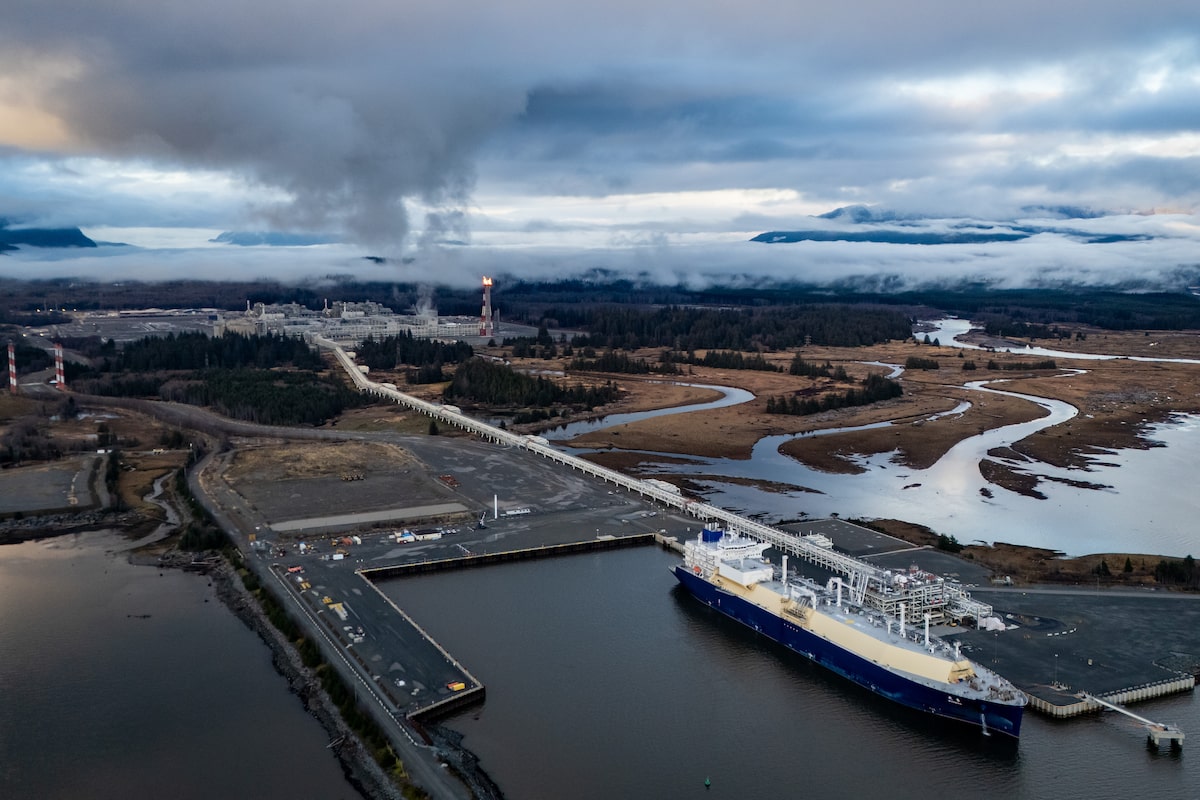
A liquefied natural gas tanker fills up at an LNG Canada facility in Kitimat, B.C.ETHAN CAIRNS/The Canadian Press
It might be a busy market for mergers and acquisitions in Canada’s oil patch later this year, provided the geopolitical mayhem eases enough for buyers and sellers to find common ground on price, says a partner at consulting firm Deloitte.
In a report published Wednesday, Deloitte said deal activity seemed to be on the upswing heading into this year after a decade-long lull. But with the U.S.-Israel war on Iran shaking global oil markets, the outlook now is much more hazy.
Oil tumbles below $100 after Trump announces two-week ceasefire
“It’s really hard for a deal to get done” with the West Texas Intermediate price hovering around US$115 per barrel, said Andrew Botterill, partner for energy, resources and industrials at Deloitte Canada.
“Buyers and sellers are just too far apart.”
The current crude price is about 70 per cent higher than where it was trading before the conflict began in late February, spilling over to several countries in the region and choking off 20 per cent of the world’s oil and liquefied natural gas supplies.
But if the volatility blows over – as futures market trading seems to suggest might happen later this year – Canada’s energy sector would be ripe for an acceleration in merger and acquisition activity.
“People are starting to really come to the recognition that Canada is very investable right now and it’s a place to deploy capital and we should expect to see more deals,” said Botterill.
The oilsands are already dominated by a handful of big players, so there are few opportunities in that space, he said. But the Montney and Duvernay areas of northeastern B.C. and northwestern Alberta are some of “the world’s highest-quality assets out there” and are likely to see more consolidation. Those rocks are rich in natural gas liquids, whose prices tend to track those of crude oil.
“The repeatability economics are so strong, the technology is so consistent and Canadian producers have just done such a great job at managing costs alongside that and continuing to make large swaths of resource highly profitable,” said Botterill.
In its latest forecast, Deloitte predicted an average 2026 WTI price of US$85 per barrel. The ongoing closure of the Strait of Hormuz is currently driving prices significantly higher than that, but oil traders seem to be betting on a more mellow market in the latter half of this year. Contracts for October, November and December delivery, for instance, have been sinking below US$80 per barrel.
For 2027, Deloitte is forecasting a drop in WTI to US$76.50. For 2028, it sees a return to the pre-war level of US$67.65.
Meanwhile, the benchmark for Alberta natural gas is forecast to average $2.15 per mmBTU in 2026, climbing to $3.20 in 2028. A balmy winter in much of Canada coupled with a slower-than-expected ramp-up of the LNG Canada export terminal on the B.C. coast put pressure on the price of the home-heating fuel, Botterill said.
He’s never felt so positively about the prospects for Canada’s liquefied natural gas export ambitions. The war has knocked out LNG production from Qatar, one of the world’s biggest players, sending Asian and European power prices soaring and highlighting Canada as a relatively stable global supplier.
“These are hard projects to get approved and it’s a lot of money, so I think there’s still a lot of work to get done to move particular projects forward,” Botterill said.
“But at the end of the day … Canada is seen as a real safe place for capital and it’s seen as even more investable now than it was a few years ago … We’re going to be talking about one or two or three more projects off the West Coast over the coming years.”