
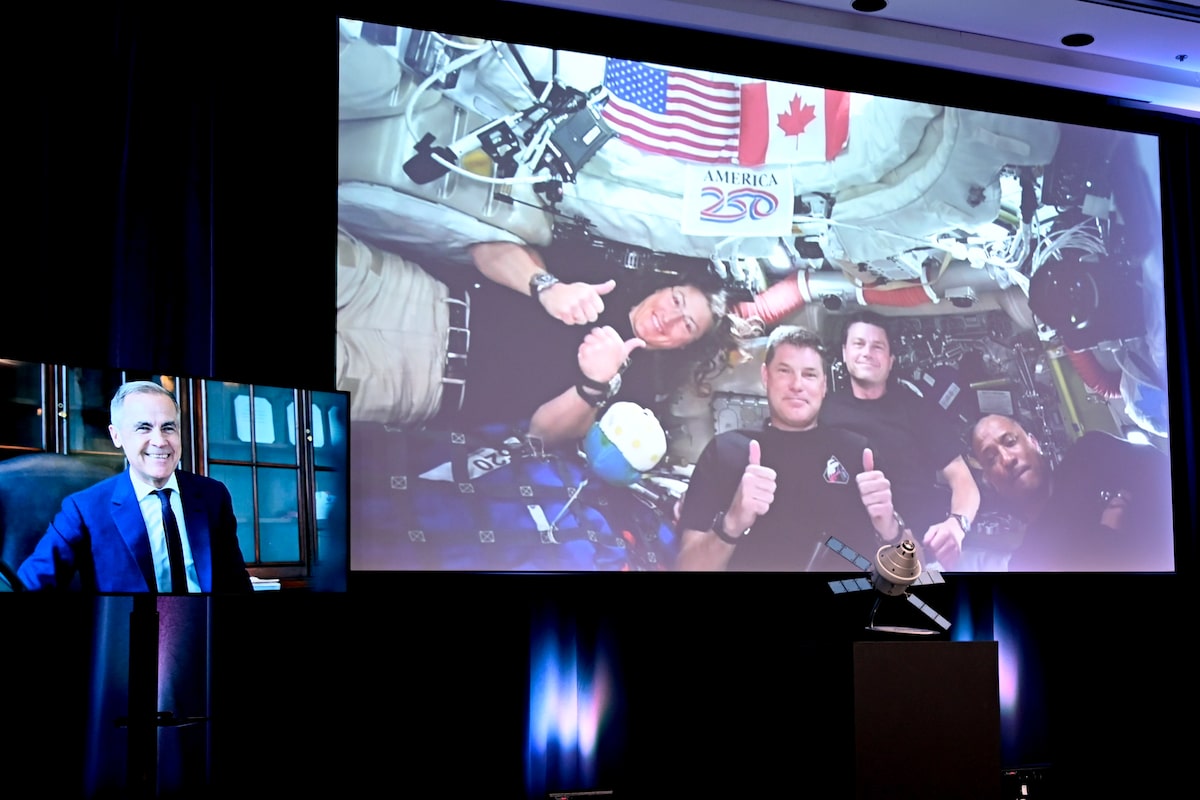
Prime Minister Mark Carney, left, speaks to Artemis II mission astronauts, left to right, Christina Koch, Jeremy Hansen, Reid Wiseman and Victor Glover during a live feed at the Canadian Space Agency headquarters in Longueuil, Que., on Wednesday.Graham Hughes/The Canadian Press
With two days left in his historic flight around the moon, Canadian astronaut Jeremy Hansen took time out to chat with Prime Minister Mark Carney during a live link up on Wednesday evening.
“We’ve all been watching and inspired by what you’re doing,” Mr. Carney said after greeting Col. Hansen in both French and English.
In a 10-minute conversation that was occasionally derailed by a long signal delay, Mr. Carney’s comments and questions to Col. Hansen ranged from lighter matters – including the conspicuous presence of maple syrup on the spacecraft – to topics that are likely to be front of mind for the Prime Minister, such as building a successful international collaboration and the need to manage risk.
“You can see we’ve got our flags here together,” Col. Hansen said at one point, gesturing to the Canadian and U.S. flags decorating the capsule’s interior. “We’re better together.”
Mr. Carney also heard from Col. Hansen’s U.S. crewmates: commander Reid Wiseman, pilot Victor Glover and mission specialist Christina Koch.
The four astronauts lifted off from the Kennedy Space Center in Florida one week ago. After flying around the moon’s far side on Monday, they are on a return trajectory and rapidly approaching Earth. Their capsule, dubbed Integrity, is set to re-enter the planet’s atmosphere shortly before 8 p.m. ET on Friday and splash down in the Pacific Ocean about 13 minutes later.
Prime Minister Mark Carney had a video call with the astronauts on Artemis II, and as he quickly learned, the lag is real when you’re talking to space.
At an update briefing held earlier on Wednesday at the Johnson Space Center in Houston, officials said they were still aiming to make the most of the crew’s time during what has been the first human flight into deep space in more than half a century.
“Because this is a development flight, we are thinking about what we can still learn in the remaining days to better understand the systems and to inform future missions,” said Lakiesha Hawkins, acting deputy associate administrator for NASA’s exploration systems.
A key part of the final stretch of the mission is the gathering of medical data that show how the crew is faring in a space environment far less sheltered than astronauts experience on the International Space Station, which orbits well inside the protective envelope of Earth’s magnetic field.
Such experiments, which were not conducted by Apollo astronauts during the 1960s and 70s, “are going to give us data that we need to be able to live on the moon longer,” Ms. Hawkins said.
Later into Wednesday night, the itinerary included a manual piloting test, to demonstrate that a crew can orient the spacecraft on their own to put sunlight on the capsule’s solar panels and generate power as needed.
Crew members also practised donning orthostatic intolerance garments, which apply compression and which they will wear on the day they return to Earth to promote blood flow when they are back under the influence of normal gravity.
What we learned from the Artemis II mission and what comes next
The briefing provided additional information on what the crew will be experiencing during the final minutes of their journey back to Earth, as Integrity separates from its service module and then rotates to put its heat shield forward as it plunges through the atmosphere at speeds approaching 40,000 kilometres an hour.
Once the capsule has been slowed by air drag, it will deploy a series of parachutes that should bring it down just off the coast of California, near San Diego.
During the re-entry, several aircraft will be on hand to observe the capsule at different points during its arrival, as it traces a path more than 3,000 km long over the Pacific.
Meanwhile, on Wednesday, the crew also continued to radio back some of the images they have captured while looking out of their viewports.
Among the most striking was a photograph of the central region of the Milky Way, offering a surprisingly rich view of the starry expanse.
It is very unlike photos of Earth and the moon, which contain very few stars because of the relatively short exposure times of those images.
“The crew could see the glowing ribbon of stars and filaments, a clear view of our home galaxy,” Ms. Hawkins said.
Almost since its creation, NASA has helped to revolutionize astronomy with orbiting observatories, famously including the Hubble and James Webb space telescopes, which have probed the universe far beyond our solar system.
In their sightseeing, the Artemis crew offered an unexpected reminder that the space agency’s mandate is not just limited to the moon.
As another astronaut once said: To infinity and beyond.