
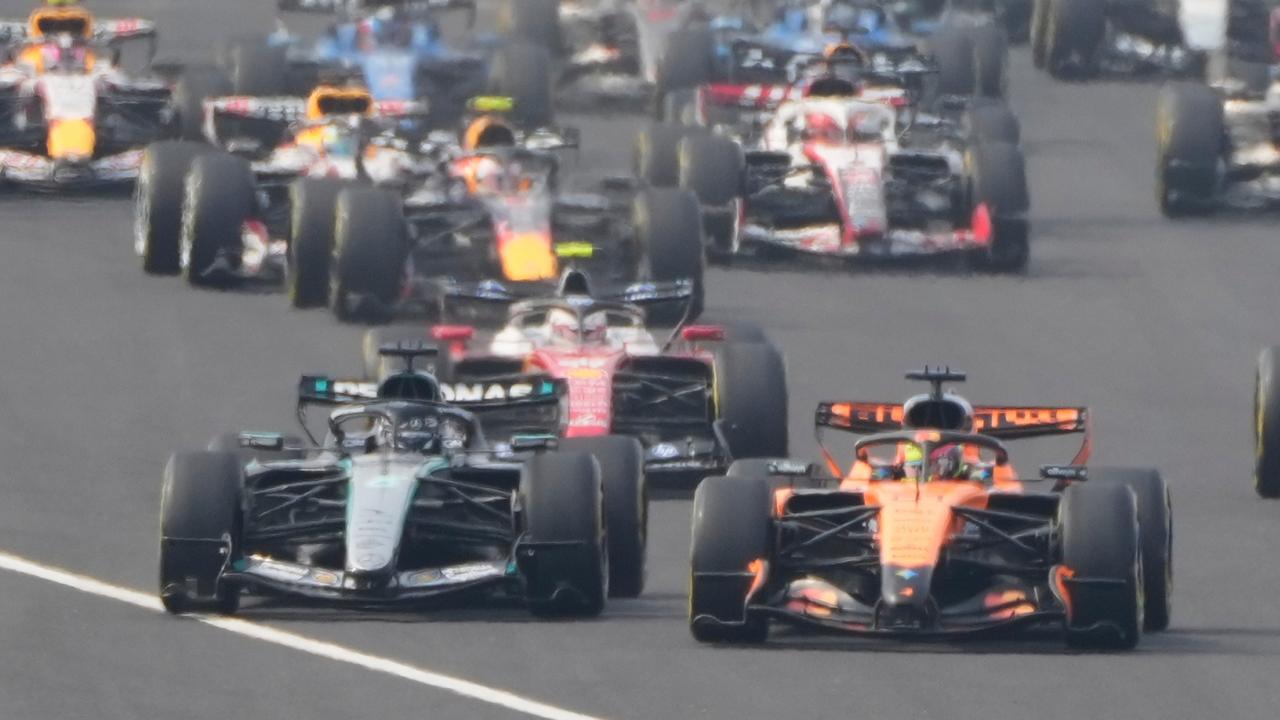
Formula 1 will meet today in the first of several crunch confabs to decide on the direction of its controversial 2026 regulations.
The sport’s sweeping 2026 rule changes have been met with mixed reviews at best. Though the new chassis regulations have been generally praised for moving away from ground-effect aerodynamics to a more conventional philosophy, the more heavily hybridised engines have been widely panned.
The headline near 50-50 split between combustion and electrical energy has altered the sport so dramatically that four-time world champion Max Verstappen has threatened to quit Formula 1 at the end of the season if drastic changes aren’t made.

Fox Sports, available on Kayo Sports, is the only place to watch every practice, qualifying session and race in the 2026 FIA Formula One World Championship™ LIVE in 4K. New to Kayo? Join now and get your first month for just $1.
The sport had been due to review the rules after the second-round Chinese Grand Prix, but the cancellation of the Bahrain and Saudi Arabian grand prix has gifted Formula 1 a wide-open window to consider what it’s learned so far this year and weigh up its alternatives with three rounds in the books.
It’s also, crucially, given some teams an opportunity to get their heads above the water of these sweeping rules and reset in time for the Miami Grand Prix in May — though not ever constructor has welcomed the untimely break.
BAD FOR: F1’S BRAVE NEW ERA
The hype was significant. The sell was ambitious. But ultimately Formula 1 has fumbled its bold new era.
The flop hasn’t been total. The chassis changes have been well received, and even the engines have some positive elements — they’re the most powerful ever built, with an eye-popping acceleration profile, and even with extreme battery management they’re delivering lap times comparable to last year.
But even as some drivers have tried to pluck out the positives from the new regulations, after three rounds opinions among the stars of the show have become clearly and increasingly hardened against the formula.
The challenge of qualifying has been obliterated. The need to regularly redirect combustion power to the battery means the cars are alarmingly far from the limit of grip through high-speed corners, and the sensation of the car topping out and then decelerating down the straights is extremely counterintuitive.
The racing spectacle is more polarising. While some have praised the general formula for boosting overtaking chances, other deride today’s passing as artificial for its dependence on battery usage, while others — most notably reigning champion Lando Norris — have described the car forcing a driver to execute an overtake even when it’s tactically disadvantageous to do so, taking them even further away from the absolute control they’re used to.
Then there are the safety concerns demonstrated so viscerally in Japan when Oliver Bearman came close to disastrously rear-ending Franco Colapinto with massive overspeed. There was as much as 50 kilometres per hour difference between them when Bearman left the road. That difference wasn’t down to the driver per se; it was as the rules envisaged.
It’s taken just three rounds, but the significant problems with the rules have been laid bare.
Red Bull ready for Green light in NZ | 01:09
GOOD FOR: FORMULA 1 POLITICS
It’s unclear how quickly the rules can be changed to make a significant difference, but the one positive Formula 1 can pull from this moment is that the sport is united over most of the problems.
That’s extremely rare in Formula 1, where self-interest rules.
Of course having an entire sport lined up to whack the rules is tough to sell as a positive, but it means that the process of change need not be drawn out over politics. Change can be achieved rapidly, perhaps even this season.
The covenants governing rule changes for the engines are complex.
All 11 teams get a vote, with the FIA and Formula 1 also getting 11 votes apiece to match, creating three power blocs. According to Autosport, arrangements put in place at the end of last year require six of the 11 teams — plus both the FIA and Formula 1 — to agree on rule changes for the current season. Long-term changes require only four teams with the FIA and F1 onside.
A stricter structure is in place for engine regulations, with four of the five manufacturers — again, along with the FIA and F1 — needing to agree to in-season changes, as was achieved with the impending changes to compression ratio rules set in motion before the start of the season.
There appears, on the face of things, to be enough agreement for these ratios not to come into play.
That said, the devil is always in the detail, and just because there’s agreement that something must be done doesn’t mean everyone will agree on what those changes must be.
Denyer hospitalised after ugly crash | 00:28
BAD FOR: MERCEDES DOMINATION
If there’s one team that would be truly regretting the lack of racing in April, it’s Mercedes.
After plenty of obfuscation and misdirection during the pre-season, Mercedes has started the campaign with clearly the fastest car-engine package.
It’s won all three of the opening grands prix. It narrowest victory margin so far is 13.722 seconds — and that was in Japan, where a safety car bunched up the field around halfway through the race.
Mercedes doesn’t expect to keep this sort of advantage all season, however.
The development race is expected to be ferocious as rival teams come to understand their packages and get the most from them — consider just how much McLaren closed the gap in three rounds through understanding alone, even without any significant upgrades.
McLaren in particular but potentially Ferrari could yet give the German marque a run for its money — and if Andrea Kimi Antonelli and George Russell continue taking points and wins off each other, it could be that neither has built an unassailable advantage when that happens.
Losing two races, then, deprives Mercedes of the opportunity to make hay while the sun shines.
‘F*** our luck!’ – Russell CRACKS it | 00:30
GOOD FOR: MCLAREN’S HOPES FOR A REVIVAL
McLaren’s scenario is precisely the opposite of the one facing Mercedes.
It knew and was braced to start 2026 on the back foot — albeit it surely didn’t expect the first two rounds to go quite so badly — but it knew too that it could develop its way forward and into title contention, just as it did over the last two seasons.
Its first big upgrade is scheduled for Miami, as has also been the case in recent years. Effectively this April break has hit fast-forward on the team’s development plans by skipping over two races at which it almost certainly would have shipped potentially major points to Mercedes.
On average it’s lost almost 30 points per grand prix to Mercedes. Notwithstanding the team’s double failure to start in Shanghai weighs that down considerably, if that trajectory were to have continued in Bahrain and Saudi Arabia, McLaren could have been looking at a deficit well in excess of 100 points before the sport made it back to Europe.
Instead, when the form guide resets in May, it will still by 89 points down in the championship — but it will be no more than 89 points down in the championship.
Some of that should be weighed against Piastri not being able to build momentum from his outstanding weekend in Japan, but the long-term outlook will be much healthier if McLaren hits the ground in Miami with a car that can genuinely challenge Mercedes in every session.
Safety car costs Piastri in Japan | 02:18
BAD FOR: ASTON MARTIN TROUBLESHOOTING
The same McLaren principal might have applied to Aston Martin had its season to date been less abysmal, but realistically the team is so far adrift and has so much work to do that more races at the back of the pack cannot have been considered detrimental.
Instead the loss of two races is the loss of precious troubleshooting time.
Aston Martin is still feeling the effects of turning up to testing late and then completing few laps in the time it had remaining, but even if it had used its full allocation of days, the trouble at the intersection of the engine and chassis would unlikely have been much improved by now. It’s too intractable to be the work of a couple of days on the track.
That’s clear because even after three grands prix neither Honda nor Aston Martin appears to know why the car is shaking so violently that the drivers have openly wondered whether they can finish races without suffering permanent nerve damage.
The blame for the vibrations was originally pinned on Honda, but the Japanese marque has since clarified that its engine doesn’t shake on the test bench, only when it’s bolted into the Aston Martin car, suggesting the race team is at least equally culpable.
The only way to identify the problem is with track time, something Aston Martin now has considerably less of.
Antonelli becomes youngest F1 leader | 01:25
GOOD FOR: RED BULL RACING PREVENTING VERSTAPPEN FROM RAGE QUITTING
Max Verstappen moved beyond anger to resignation and acceptance of his hatred of the new rules during the first three rounds of the season. Unfortunately for Red Bull Racing, the acceptance stage is the Dutchman canvassing his options to walk out on the sport at the end of the season.
Undoubtedly not helping is that, on the evidence of the opening three rounds, the RB22 is a thoroughly midfield car. In China and Japan it was on average the fifth-quickest car, 1.3 seconds off the pace and behind even the Alpine machine.
Things, in other words, can’t get much worse.
That also means things can only get better.
Two fewer races in an uncompetitive car built to a rule set he despises can only be good for Verstappen’s odds of sticking around — which is good for Red Bull Racing.
That the sport will consider changes to the rules for both this season and for 2027 during the break is also a good thing in this regard.
Perhaps Verstappen has already made up his mind on quitting. Perhaps the threat was only to shock the sport into action on changing the regulations.
Whatever the case, this break can only be a good thing for F1’s troubled champion.
Supercars exploring wildcard for F1 star | 02:49
BAD FOR: CADILLAC’S EXPERIENCE TRAJECTORY
The only team Aston Martin is currently battling with at the back of the pack is newcomer Cadillac. While the American-owned team’s 2026 potential is unclear, what is certain is the only thing that will get it close to its ceiling is track time.
Cadillac has impressed with how smoothly it’s hit the ground running in its first campaign. Some had feared it would struggle to even qualify for races, and while it is well off the pace, it’s been comfortably in the ballpark to start races, and it’s recorded only one fail to finish for the season to date.
It’s a testament to the depth of its preparation program during 2025 — but off-track preparation can get you only so far.
What Cadillac needs is experience, and lots of it. It needs to bed in practices and process in the heat of a real race weekend. It needs its team to continue gelling together. It needs its drivers to continue shaking off the rust after a year out of the sport.
A two-week break is by no means disastrous for Cadillac, and the team will undoubtedly draw some positives from having the chance to digest its three-round baptism of fire.
But after having spent all of last season watching from afar, being confined again to its factory will do it no favours as it seeks to establish itself in Formula 1.