

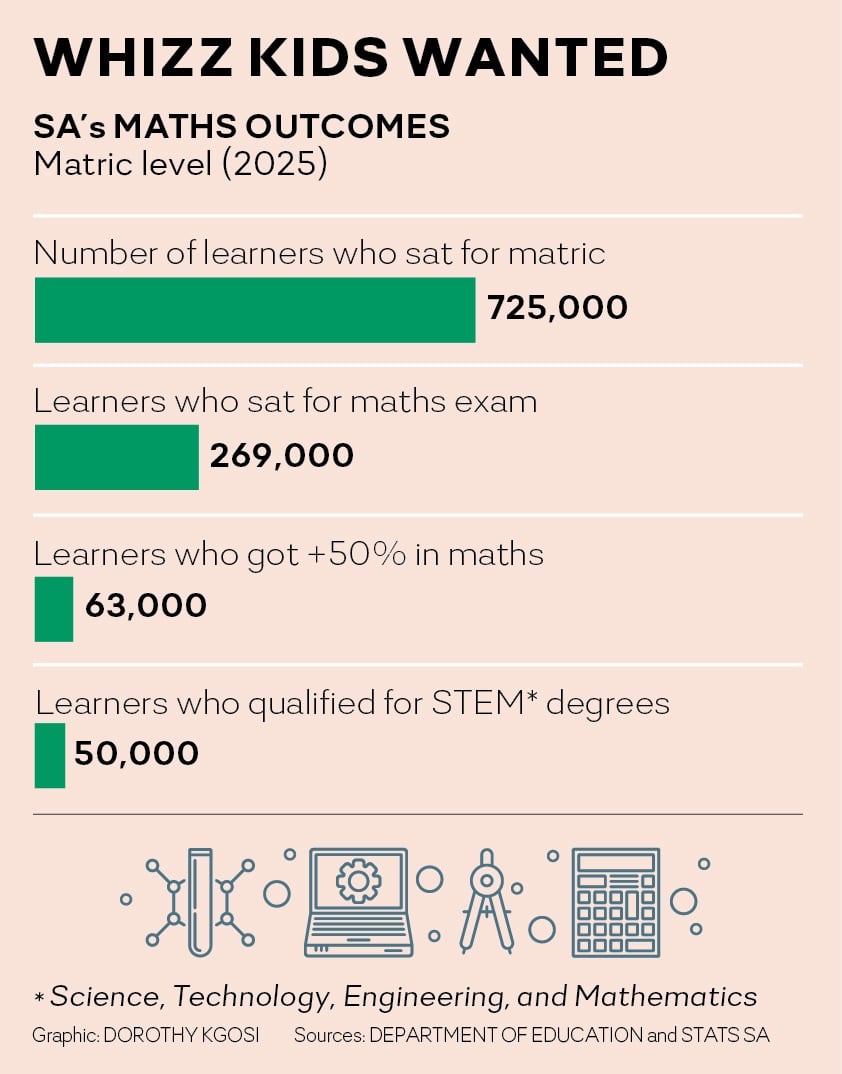
Alexforbes head of research Premal Ranchod has pulled no punches in dissecting the challenges the finance and asset management industry is facing in diversifying the workplace, blaming this on weak mathematics and science outcomes at school level, which he said significantly limit the number of students able to pursue quantitatively demanding degrees.
“If the pipeline is structurally constrained upstream, the industry must ask whether redistributing opportunities within a limited pool is sufficient or whether the more sustainable solution lies in expanding the pipeline itself and investing in capability development much earlier,” Ranchod said in the group’s latest Manager Watch Survey.
 (Dorothy Kgosi)
“For the asset management industry, the implications are profound: the talent pipeline that feeds analysts, portfolio managers and investment leaders is constrained by upstream gaps in schooling, Stem [science, technology, engineering and mathematics] achievement and workplace readiness.
“If firms and regulators simply persist with performative criteria — hiring for optics rather than capability — the industry risks stagnating. The result is a capital flight or emigration phenomenon (across race or gender).”
Gender parity
The lack of gender parity in the asset management industry has been a source of debate for several years, with women’s ability to progress to investment leadership roles depending on the talent pipeline.
An 80/20 male-female split of CFA (chartered financial analyst) charter holders suggests that the industry still has a long way to go.
Managers in the industry have often decried the lack of a diverse talent pool, which makes it difficult to hire female investment professionals. This has a direct correlation to the low proportion of female CFA charter holders and candidates.
The CFA designation is considered the apex for professional development in investment management and is highly valued by employers for roles in the finance industry, including portfolio management, analysis, private wealth and consulting.
Ranchod said South Africa’s demographic challenges — ranging from educational disparities to gender and race gaps in Stem and workforce readiness — are “real and persistent”.
He added that these challenges are rooted in systemic learning issues and cannot be solved through mechanised scorecards.
“When one reflects on this plight, it becomes necessary to frame the issue and ask whose responsibility it is to fight social policy or address social risks? Surely making moral judgments is not the domain of the asset management industry,” he said.
“One could argue the spectrum of morals is as long as a piece of string, and therefore whose standard is the correct one to measure progress by?”