
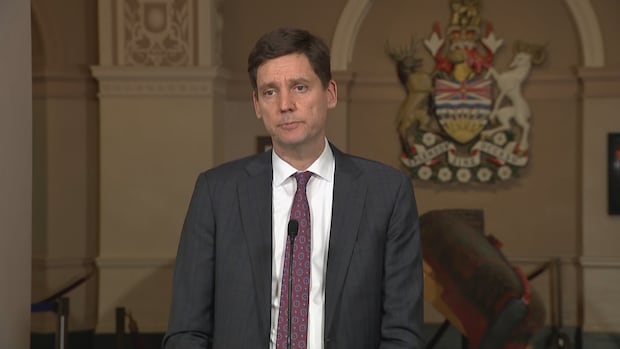
Premier David Eby says more than 20 lawsuits against the province have been amended to reflect a key B.C. Court of Appeal ruling that has been the basis of his government’s push to overhaul the Declaration on the Rights of Indigenous Peoples Act, known as DRIPA.
Eby says that’s why the B.C. NDP government must act quickly to suspend sections of DRIPA that relate to last year’s Gitxaała ruling last year on mining rules.
One of the key sections being suspended is Section 3, which says “the government must take all measures necessary to ensure the laws of British Columbia are consistent with the Declaration.”
That’s according to a leaked copy of the proposed changes obtained by CBC News.
WATCH | British Columbia plans to pause certain sections of DRIPA:
British Columbia plans to pause certain sections of DRIPA
B.C. Premier David Eby says he will temporarily pause certain sections of the Declaration on the Rights of Indigenous Peoples Act. As the CBC’s Katie DeRosa reports, it comes after a tense meeting with First Nations leaders, who say the proposed changes are unacceptable.
“It’s a very real and manifesting challenge that we face otherwise we wouldn’t be taking these steps,” Eby said during an unrelated press conference in Kelowna. “It’s not something we’re making up. It’s something that we have to do.”
Eby was responding to backlash following his announcement last week that he will seek to temporarily pause certain sections of DRIPA for up to three years or until the Supreme Court of Canada rules on the Gitxaała case.
The provincial DRIPA legislation, which was intended to incorporate the United Nations Declaration on the Rights of Indigenous Peoples (UNDRIP), was adopted by the province with unanimous support from all parties in the B.C. legislature in 2019.
Eby said the Gitxaała ruling, which the government is appealing, opened the door for any law to be challenged if it does not align with DRIPA. The country’s highest court has not yet decided if it will hear the appeal.
The premier doubled down on this message in a letter sent Wednesday to First Nations leaders, a copy of which was obtained by CBC News.
“We are already seeing multiple pieces of litigation dealing with the extent to which laws are consistent with the UN Declaration, and we expect that to continue even if they have been through a consultation and cooperation process,” he wrote.
Eby also expressed “regret that the timeline and the legislative calendar do not allow for further opportunity to engage before legislation creating the suspension is introduced.”
Eby said suspending some sections of DRIPA does not stop the work of reconciliation or First Nations consultation.
Eby faces backlash
Eby’s latest plan is facing criticism from First Nations leaders and some legal experts.
“The premier has cornered himself,” says Robert Phillips, who sits on the First Nations Leadership Council political executive. “You can’t put a pause on Aboriginal rights and title.”
Phillips says the leadership council has not ruled out litigation or mass protests.
WATCH | Critics say B.C. premier’s DRIPA ‘flip-flop’ has caused more uncertainty:
Critics say B.C. premier’s DRIPA ‘flip-flop’ has caused more uncertainty
B.C. Premier David Eby is facing criticism over his intention to temporarily pause certain sections of the Declaration on the Rights of Indigenous Peoples Act, or DRIPA. As CBC’s Katie DeRosa reports, critics say it will essentially put the province’s approach to reconciliation in limbo.
Thomas Isaac, a partner with Cassels Brock and Blackwell who specializes in Aboriginal law, says Eby has only created more uncertainty and confusion for the legal community when it comes to major resource projects.
“To essentially do a flip-flop in less than 24 hours on something as critical as this. It’s disappointing and it’s negligent,” said Isaac. “It’s not serving reconciliation at all. And it’s certainly not serving our economy at all.”
Eby has said DRIPA must be amended in response to two landmark court decisions the government is appealing.
The court case that directly relates to DRIPA is the Gitxaała decision, which found that the province’s system of granting mineral rights was inconsistent with DRIPA.
The other is the Cowichan decision. A B.C. Supreme court judge awarded Aboriginal title over a swath of property in south Richmond. The decision has raised questions about how Aboriginal title impacts private property, although both Eby and the Cowichan Nation have said private property will not be used as a bargaining chip.
WATCH | Why this B.C. land claim is such a big deal: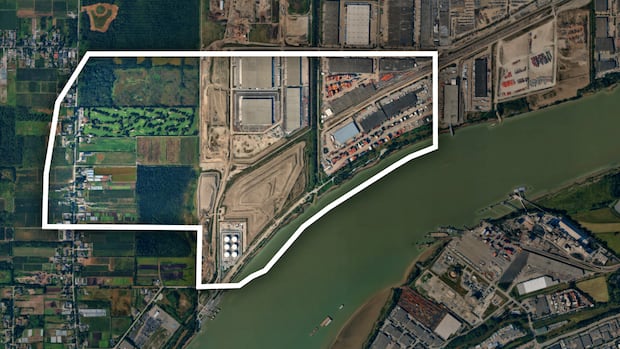
Why this B.C. land claim is such a big deal
A landmark B.C. Supreme Court decision to recognize Aboriginal title over privately held land in Richmond, B.C. last year has ignited debate about ownership and reconciliation. For The National, CBC’s Georgie Smyth explains the significance of the Cowichan ruling and why the legal fight is far from over.
That lawsuit was launched in 2014, five years before DRIPA was passed unanimously in the legislature.
It was litigated over 11 years and hinges on Section 35 of Canada’s Constitution Act, 1982, which recognizes and protects Aboriginal rights and title.
Both Isaac and former B.C. Green MLA Adam Olsen say in his justification for making changes to DRIPA, Eby has conflated the two court cases.
“It’s really on our government to be very clearly explaining that to British Columbians rather than having the premier seemingly intentionally winding those up into the same ball and saying it’s all one big problem,” Olsen said.
WATCH | Indigenous leaders weigh in on whether DRIPA should be amended: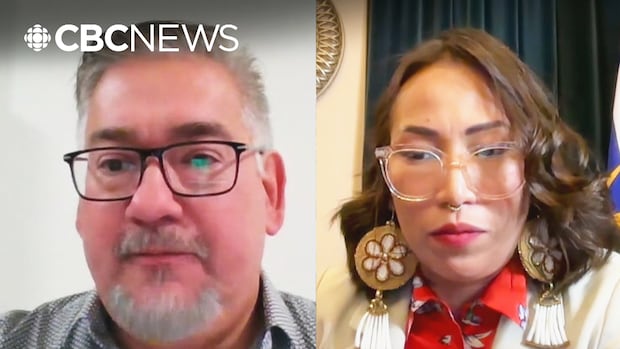
Indigenous leaders weigh in on whether DRIPA should be amended
Premier David Eby has announced plans to amend DRIPA to scale back the power courts have in shaping reconciliation efforts in B.C. For insight on where First Nations stand, CBC’s Stephen Quinn spoke with Á’a:líya Warbus, the Conservative MLA for Chilliwack-Cultus Lake and a member of the Sto:lo Nation in favour of amending the act, and Canim Lake Band member and First Nations Summit political executive Robert Phillips, who opposes changing it.
The B.C. Conservatives have called for DRIPA to be scrapped entirely and the issue has dominated the party’s leadership race. Interim leader Trevor Halford has said Eby has hit the “panic button” and has not shown the leadership needed to reassure those who are worried about property rights.
Scott Fraser, who was the B.C. NDP’s Indigenous relations minister when the law was passed unanimously in 2019, says repealing DRIPA would bring the province back to a time of endless litigation over land rights.
“It’s very very dangerous to turn back the table, to turn back the clock on history, on this legislation,” he said.
Fraser’s advice to the premier: “Stick with it. Make sure that the public knows why.”
Eby has not laid out a timeline for when he’ll introduce the bill to suspend those sections of DRIPA. He told reporters it will be a confidence motion, which means if the bill fails, the government will fall.
Despite a one-seat majority, Eby insists he has the votes to pass the legislation, which could be introduced as early as next week.