
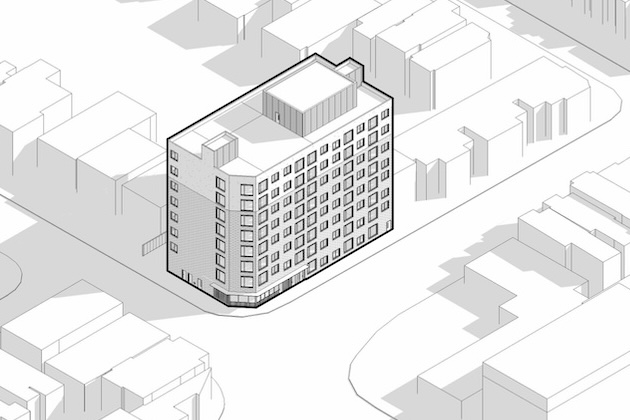
A proposal for mid-rise mass timber residential rental building has taken shape for 1280 through 1286 College Street in Toronto’s Dufferin Grove area. The 8-storey building planned for the northeast corner of College Street and Lansdowne Avenue is designed by Batay-Csorba Architects for Collecdev-Markee Developments. The project forms part of a five-site “Missing Middle” initiative backed by the Canada Mortgage and Housing Corporation, advancing a model of prefabricated modular mass timber construction for purpose-built rental housing.
Looking northeast to 1280-1286 College Street, designed by Batay-Csorba Architects for Collecdev-Markee Developments
The site occupies a rectangular parcel that is currently vacant, having previously housed a single-storey coin-operated car wash surrounded by extensive pavement. Neighbourhood amenities include Dufferin Mall to the northeast and the Sterling Road employment area and Museum of Contemporary Art to the northwest.
Looking northwest to the current site, image by UrbanToronto Forum contributor milkycontent
A Zoning By-law Amendment application has been submitted to facilitate the redevelopment of the site. The proposal calls for an 8-storey mid-rise building rising to 32.5m, occupying the full extent of the corner site and establishing a continuous street-wall along both College Street and Lansdowne Avenue. With a Gross Floor Area of 5,281m² and a Floor Space Index of 5.01 times coverage of the 1,054m² lot, the design is organized in a compact massing. At grade, the layout prioritizes a pedestrian-oriented frontage, with the main residential entrance and a live-work unit positioned along College Street.
Site plan, designed by Batay-Csorba Architects for Collecdev-Markee Developments
A total of 77 purpose-built rental units are proposed, comprising 48 one-bedroom and 29 two-bedroom suites, with the latter accounting for 38% of the unit mix. The development would include a minimum of 10% affordable rental units as part of the broader CMHC-backed Missing Middle initiative. Amenity space is concentrated at the rooftop level, where 161m² of outdoor space is planned for residents, with no indoor amenity area proposed. Vertical circulation would be supported by two elevators, resulting in an approximate ratio of one elevator per 39 units, indicating rapid service response times.
Ground floor plan, designed by Batay-Csorba Architects for Collecdev-Markee Developments
No vehicular parking is proposed, while one level of underground space would accommodate building services and long-term bicycle storage. A total of 91 bicycle parking spaces would be provided, including 75 long-term spaces located below grade and 16 short-term spaces at grade for visitors.
Massing perspectives for 1280-1286 College Street, designed by Batay-Csorba Architects for Collecdev-Markee Developments
The site is positioned within both the Protected Major Transit Station Areas (PMTSAs) of both Lansdowne subway station on Bloor Line 2, and the future Bloor-Lansdowne GO on the Barrie Line, now under construction. Lansdowne station is located roughly 900m to the north, while the future Bloor-Lansdowne GO station will be about 700m away. Surface transit is readily available at the doorstep, with the 506/306 Carlton streetcar operating along College Street and the 47 Lansdowne bus route running north-south, supplemented by the 505/305 Dundas streetcar within a short walk to the south. Bloor GO on the Kitchener Line and UP Express services are approximately 1km to the northwest. The area is also supported by bike lanes and shared routes along College, Lansdowne, and Dundas, as well as proximity to the West Toronto Railpath, roughly 250m away.
An aerial view of the site and surrounding area, image from submission to City of Toronto
Development activity in the surrounding area reflects a shift toward mid-rise and higher-density forms. To the south, 1744 Dundas West is proposed at 7 storeys, while to the east, the Fauna and Flora Condos developments are each planned at 8 storeys. Further northwest, the Sterling Master Plan introduces a more intensive cluster, with three towers at 221 Sterling Road ranging from 21 to 27 storeys, alongside 150 Sterling at 28 storeys and 158 Sterling at 31 storeys.
UrbanToronto will continue to follow progress on this development, but in the meantime, you can learn more about it from our Database file, linked below. If you’d like, you can join in on the conversation in the associated Project Forum thread or leave a comment in the space provided on this page.
* * *
UrbanToronto’s research and data service, UTPro, provides comprehensive data on construction projects in the Greater Golden Horseshoe—from proposal through to completion. Other services include Instant Reports, downloadable snapshots based on location, and a daily subscription newsletter, New Development Insider, that tracks projects from initial application.
Related Companies: