
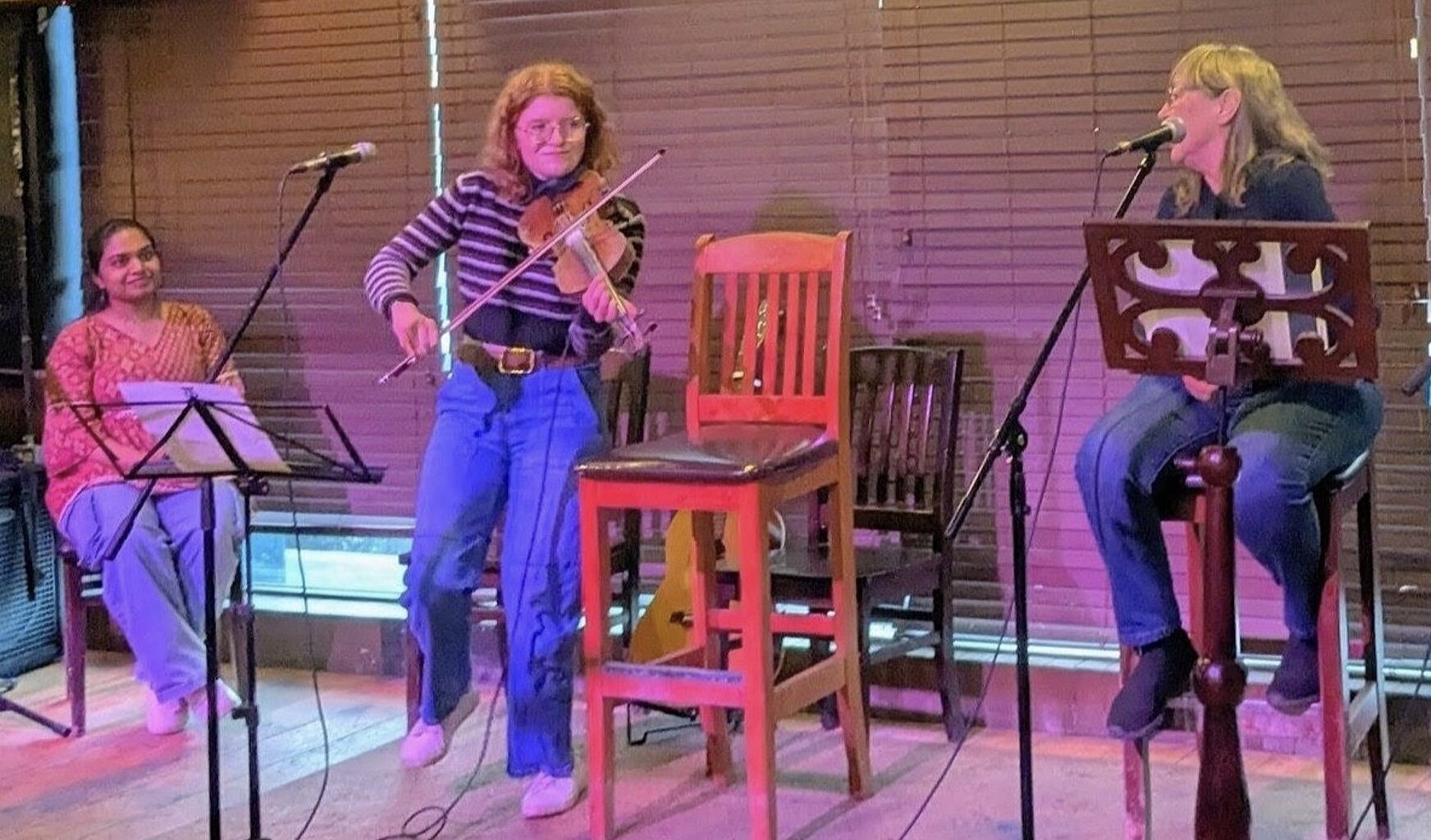
Organizers of an annual music event that’s been held in Ottawa for more than 30 years have issued a statement to local songwriters prohibiting the use of artificial intelligence in composing their tunes.
The Great Canadian Song-Along, which is taking place April 9-12 this year at Moose McGuire’s pub in south-end Ottawa’s Hunt Club neighbourhood, is a songwriting challenge in which performers produce new compositions that must incorporate one of a handful of pre-set phrases in the lyrics.
The topics and phrases for this year’s Song-Along, which is also being streamed for free on YouTube, include “you can’t go back, you can only go forward,” “a suitcase,” “find my way,” and “stand behind the …”
The Song-Along is not a competition and there are no prizes to be won. It exists as an exercise in creative writing and musicianship — which is why co-organizer Peter Rutherford said it was time to put in guardrails for the 2026 version of the event to discourage the use of AI in the songwriting process.
In a statement titled “A Note About the Use of Artificial Intelligence (AI) and the Spirit of the Song-Along,” Rutherford wrote to the dozens of local participants: “It is in a spirit of respect for art and our community that we ask that all songs written for Song-Along 2026 be crafted by the composers themselves without the aid of AI in the creation of either the music or the lyrics.”
Although the rule is enforced on an honour-based system, Rutherford said that the presentation of AI-assisted works at the Song-Along would detract from the purpose of the event.
“I won’t go to ask AI to write my song, because then it won’t be me doing it,” Rutherford said. “Have pride in what you do, and do your best.”
Song-Along host and songwriter Chris White, who has participated in every Ottawa Song-Along since 1994, echoed Rutherford’s view on the issue.
White said using AI for the competition wouldn’t make sense, and that it is antithetical to the goals of the challenge.
‘I won’t go to ask AI to write my song, because then it won’t be me doing it. Have pride in what you do, and do your best.’
— Peter Rutherford, Ottawa co-organizer, Great Canadian Song-Along
“The idea of the tormented artist is a true thing,” White said. “You didn’t go through the important part, which was all of the experience that an artist goes through in bringing their vision to the world. It challenges you and sometimes it’s painful. It’s not necessarily easy.”
White called the use of AI an “ethical issue” in songwriting since generative AI draws from pre-existing creative works and copyrighted materials to produce melodies and lyrics.
“We’re not impressed by how AI works, which is to take creations that other people have made that are out there and without anybody’s permission and with no compensation,” said White.
The Summer Song-Along, later re-named to the Great Canadian Song-Along, was conceived as a free event in 1993 in Toronto by musician Karen Leslie Hall.
“It’s always been … a mixture of people from novices to seasoned professionals, all sharing the same stage and the same night,” said Hall, “just… a wonderful sense of community and shared purpose.”
The Song-Along has since been expanded into a national event, with Song-Alongs happening in cities such as Almonte, Gananoque, Vancouver and Ottawa in 2026. A total of 54 acts have signed up to perform at the Ottawa Song-Along over the course of four days.
The Song-Along event isn’t the only corner of the Canadian music world wrestling with the potential use of AI in songwriting.
In February, SOCAN — Canada’s national association and advocacy group for songwriters — announced a campaign aimed at blunting the impact of AI on the Canadian music industry.
“SOCAN is launching a national campaign calling on its members, the entire music industry, and the public to urge the Government of Canada to stand behind Canada’s creative industries by ruling out any new copyright exceptions that would permit free unauthorized use of copyright-protected works for AI training,” the organization stated.
White said he agreed that 2026 was the right year for Song-Along to put in the guardrails because determining which songs have or have not been AI-assisted is becoming increasingly difficult.
‘We’re not impressed by how AI works, which is to take creations that other people have made that are out there, and without anybody’s permission and with no compensation.’
— Chris White, Ottawa host, Great Canadian Song-Along
“When we had a just a planning meeting, (Rutherford) was the one that suggested to put that statement in there,” White said. “It’s so powerful now that if we didn’t ask people not to use AI, it’s not like you could really tell if they had done so or not at this point.”
When Rutherford moved to Ottawa four years ago, he said he never expected to find such a vast and eclectic songwriting community.
“The music community here is unreal,” Rutherford said. “It’s probably bigger than Montreal even though … it’s a quarter of the population.”
Rutherford runs a songwriting group called Second Sunday Songwriters, one of at least two such groups in the region where musicians gather on a monthly basis to share and workshop their latest compositions.
“It’s fun to do,” said Rutherford, and “it makes it feel like you’re part of a group.”