
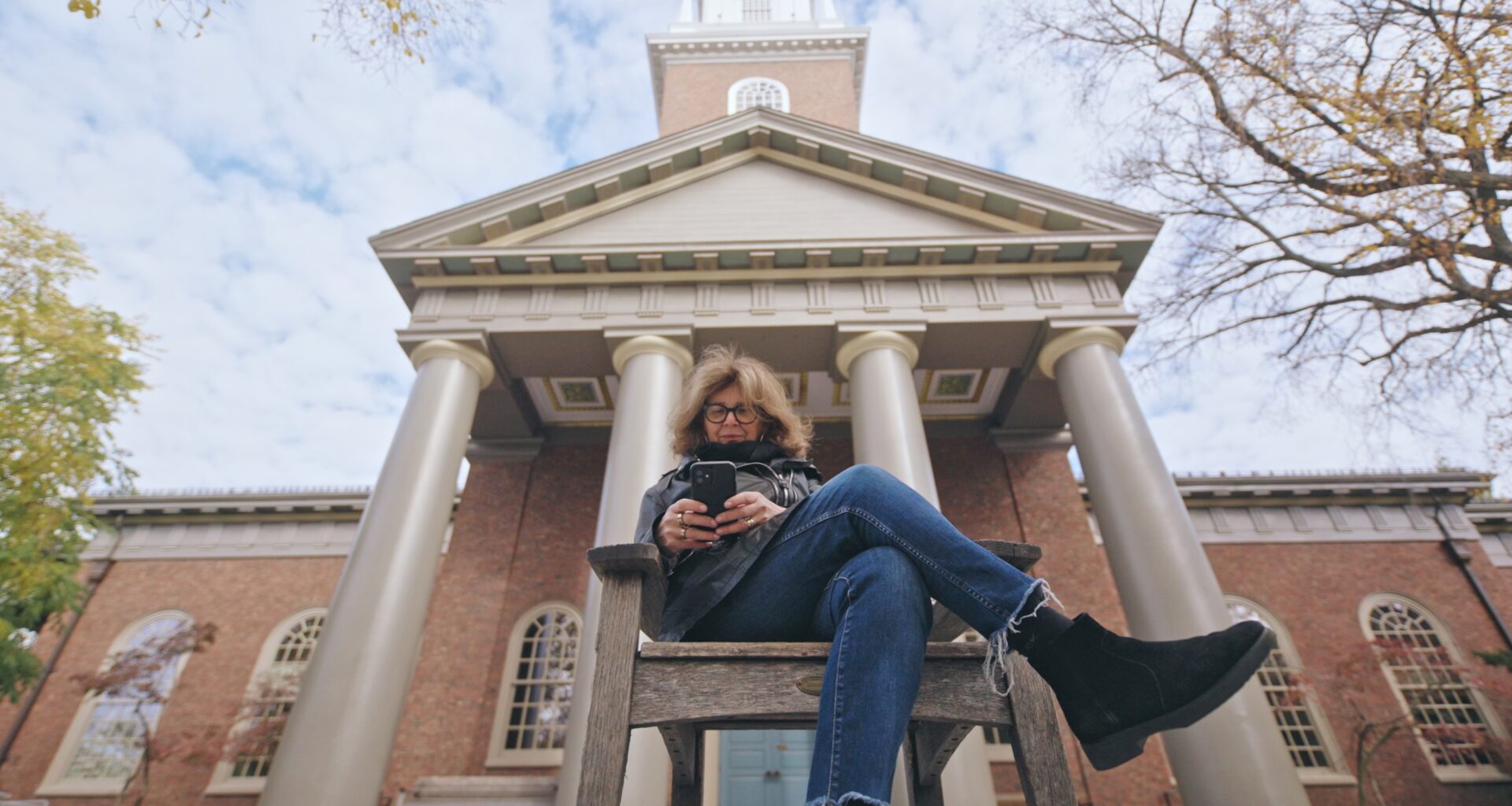
As titles go, a documentary called Speechless — dealing with battles over free speech, among other hot-button issues raging on college campuses — couldn’t be more apt.
Speechless, directed/produced by Ric Esther Bienstock, will touch nerves and will provoke no matter where people stand on these issues. It will also make for compelling yet frightening viewing. And it will indeed leave many speechless.
The three-hour documentary will be presented in two commercial-free, 90-minute segments on CBC Television, Tuesday and Wednesday at 8 p.m. It will also be available for streaming on CBC Gem as of Tuesday at 9 a.m.
Bienstock is without doubt one of the most respected doc filmmakers on this continent. The Montreal native’s works have been screened at just about every film festival and just about on every TV network imaginable and have earned her a mantle full of awards, including a 2024 Silver Circle Emmy Award, recognizing 25 years of significant and impactful contributions to the industry. She was also appointed an Officer of the Order of Canada for raising awareness of global events and conflicts through film.
Bienstock has navigated some mighty turbulent waters over the course of her career. She has been at the epicentre of the Ebola outbreak, has gone undercover in Turkey to find a trafficked woman, has exposed corruption in the boxing universe and has tracked down Dr. Frankenstein, the world’s most notorious organ dealer. But Speechless is in a class all its own.
“I’m making what might be the most dangerous film of my career … I’m going back to school,” Bienstock notes as the film commences.
The project started over a decade back. Her two kids were set to start university and she was concerned how they might fare in light of the fact that “clashes over speech and identity had put universities in the crosshairs of a political backlash.”
The “left-leaning” Bienstock recalls in a phone interview undergoing protest times as a student at McGill several decades back, but she is quick to point out that there was a semblance of civility even in disagreement with others back then.
Nor did Bienstock go to just one school for research purposes. She essentially embedded herself at about a dozen universities: Harvard, Yale, Cornell, Stanford, the liberal-arts school Evergreen State College and the University of Sussex in the U.K. She deliberately picked institutions where some of the most divisive ideological conflicts reshaping higher education were taking place. She tracked students, professors and administrators from all corners of the ideological spectrum. And she has emerged with a disturbing picture of polarization where every utterance can carry consequences with careers hanging in the balance.
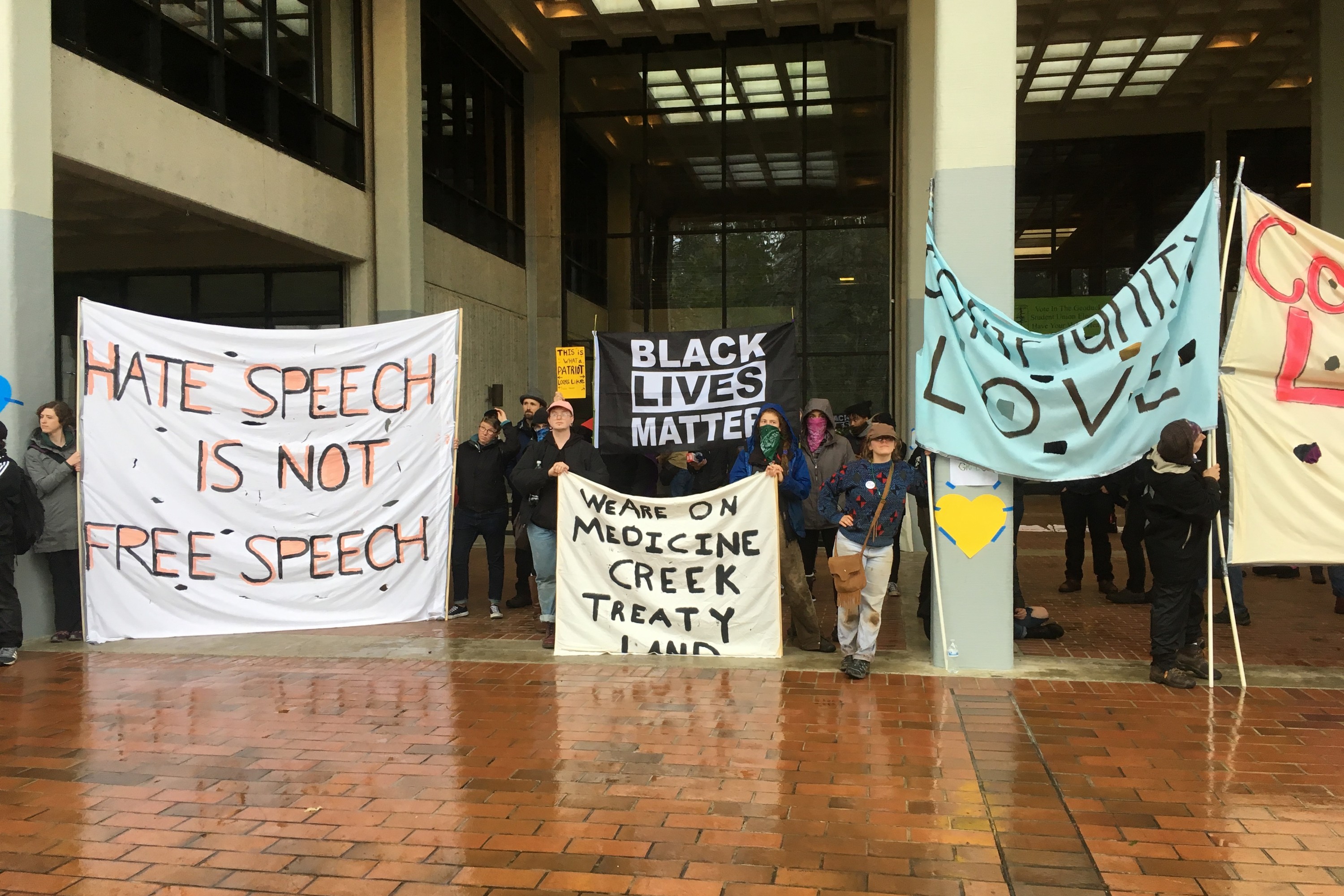 Evergreen State College students protest a Patriot Prayer rally on their campus in a scene from the film Speechless. Ric Esther Bienstock / Good Soup Productions
“How did we get here? Just asking that can get you cancelled,” Bienstock says. “We spoke to hundreds of people, many off the record, and some were so petrified about losing their jobs or being cancelled — students, professors, administrators alike. Because if you didn’t toe the line, you ran the risk of being vilified by friends or being socially ostracized. It was quite emotional. Many of them broke down into tears, because they had been living through such stress.” She talks about a professor of anthropology who’s digging up bones and who runs risks simply by trying to figure out first if the bones are male or female.
“Now gender is on the line, and professors became some sort of target in a gender war and most weren’t trying to be political about it at all. There was a new sensitivity about certain things, but there’s also a little bit of truth, too. And it’s true that science has done some terrible things. What was worrying me was that this was curtailing peoples’ ability to teach, to learn and to speak freely. Even in trying to avoid any kind of controversy, there’s no limit to what might offend.”
Bienstock’s mission was to listen to all points of view no matter how extreme. Regardless, she faced some hairy situations on campus where even she was considered suspect.
Talk about lighting up a powder keg.
“It really was the most dangerous movie I’ve ever done,” Bienstock states. “And it started off being dangerous for one reason and then it ended up being dangerous for reasons that I never could have anticipated.
“It’s a very generational thing and (the issues) were not carried very much in mainstream media when I started this. Though this was new to me trying to understand issues like safe spaces and trigger warnings and microaggressions back then, I was wondering how this was affecting education and our ability to talk across differences and to speak to each other.”
The situation was volatile and fluid back then and remains even more so today. What started off as a probe into what constitutes free speech at universities and the halls of government morphed into gender-identity terrain and then into an overall battle for power exacerbated by events in the Middle East, which had turned some college campuses into war zones.
“I had no idea the film was going to unfold in this way,” she says. “I was ready to end the film after dealing with the identity issues. But then the Hamas attack happened and everything changed again. I didn’t want to litigate the war. The Middle East is very complicated, but what I did want to explore was the ideology that campuses have been infused with over the years.”
Bienstock concedes the project has been quite the learning experience for her.
“At the beginning, what I was feeling and witnessing was vaguely uncomfortable, but I didn’t totally understand it. It’s just mind-boggling when you put it all into perspective. We had to expand the canon. And I’m all for that as people fought for more representation. Those are all positive changes.”
But what was particularly troubling to her was dealing with the reality that too many refused to engage with those whose ideas offended them.
And that’s precisely what Bienstock encountered. Essentially, that free speech is fine as long as it’s their free speech not that of their adversaries.
“But both sides do have something in common: using power to (silence) what they can’t tolerate,” Bienstock says.
“Everyone says this is a generational struggle, and it’s true. But principles have to apply, otherwise we end up with a pendulum going back and forth. Where is the middle? Not everybody is out for a fight. Some students say they don’t make comments in class. They keep their heads down. They need the degree, and that is literally antithetical to the reason for being in higher ed.”
But Bienstock believes there is hope:
“We have to start talking to one another. Institutions need to revisit teaching students to engage in ideas they don’t agree with. Most of us are in the middle who want and enjoy dialogue. That doesn’t mean you insult people. But you have to be able to discuss things like race and gender.
“I remember at a certain point I had a lot of colleagues saying: ‘Why are you doing this film? It’s a career-ender!’ I would say it’s about race, gender and the (Middle East) events of Oct. 7 and free speech. What could possibly go wrong?”
At a glance
Speechless will be broadcast commercial-free on CBC Television in two 90-minute segments, Tuesday and Wednesday at 8 p.m. There will be an interview with director Ric Esther Bienstock following the first-night broadcast and, following the second night, there will be a panel discussion. The documentary will also be available for streaming on CBC Gem as of Tuesday at 9 a.m.
Editor’s Picks