
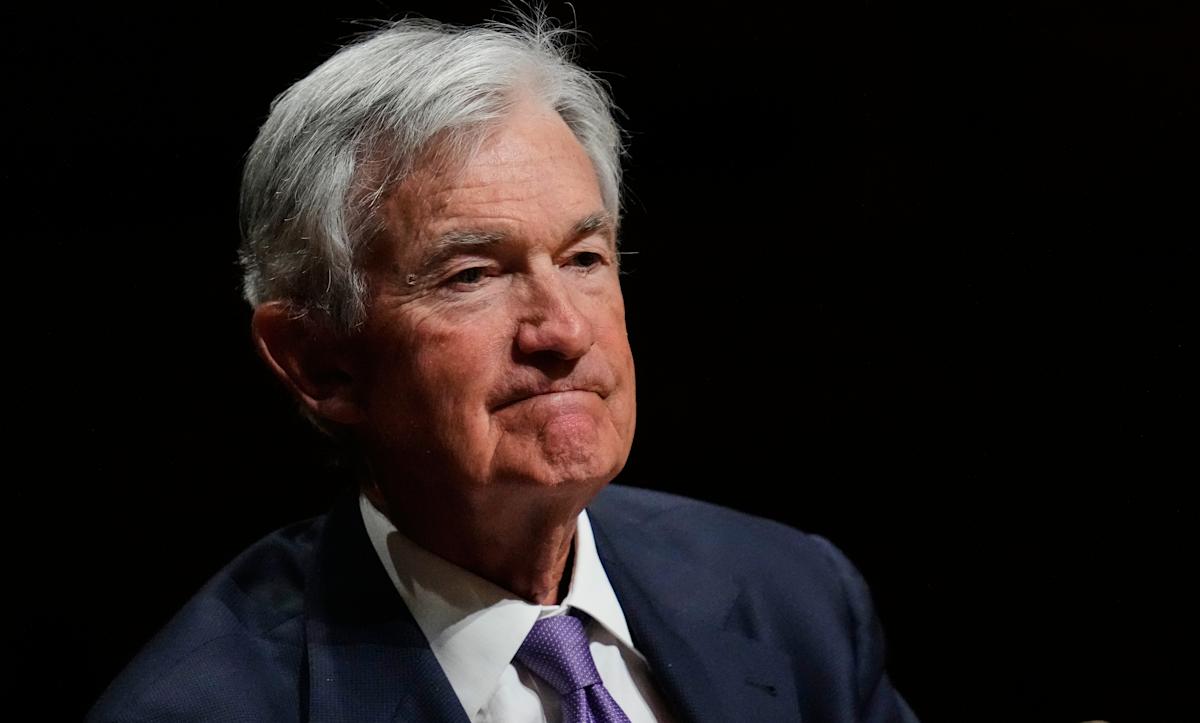
While the readings were in line with expectations, they also reinforced the widespread belief that the central bank will continue to hold rates steady.
On a “core” basis, which strips out volatile food and energy prices, inflation came in at 3%, well above the Fed’s 2% target. And even worse, the past three months of readings have been stuck at roughly 3%.
The war in Iran complicated the picture because central bankers believe inflation from tariffs is still working its way through the economy and won’t fully pass through until later this year. But just as those lagged impacts finally wind down, another shock is waiting to do its work.
That all amounts to a cautious Fed, one that won’t attempt to cut rates until it can better understand the economic consequences of the Iran war. Traders now see the Fed holding steady through the end of the year, according to the CME FedWatch tool.
We’ll get March’s Consumer Price Index today at 8:30 a.m. ET, giving us a more recent update on how things stand. Economists expect a very large jump of 0.9% from February’s prices.
 Amazon CEO Andy Jassy speaks during a keynote address at AWS re:Invent 2024 conference at the Venetian Las Vegas on Dec. 3, 2024, in Las Vegas. (Noah Berger/Getty Images for Amazon Web Services) · Noah Berger via Getty Images
Investing in the hardware piece of the AI trade just got more validation.
For all the roundabout, sideways, and downstream ways for investors to get in on the AI transformation, the straightforward path still has some juice to it. Sure, investing in picks and shovels at the start of a gold rush is one way to get rich, but so is striking gold.
For the tech set, that means owning actual etched silicon.
Bank of America analyst Vivek Arya upgraded the global semiconductor 2026 outlook to a revenue target of $1.3 trillion, powered by the advancement and growth of firms like Nvidia, Broadcom, and Marvell.
“We continue to view AI/data center to drive the majority of gains (via compute, networking, memory),” Arya said.
In just four years, analysts expect the semiconductor market to hit $2 trillion, implying a compound annual growth rate of 20%.
Earlier this week, Gartner came out with its own bullish semiconductor forecast, echoing the $1.3 trillion figure for the year, which would give the industry its third consecutive year of double-digit growth, highlighting just how important the industry is to the AI boom.
As well as the contrast between these infrastructure investment trades and the evolving implementation of the actual AI functions they provide.
But contemplating the risks to chipmakers and networking firms is also a useful way of thinking through how the AI hype train might stall or even disintegrate.
(Sameer Al-Doumy/AFP via Getty Images) · SAMEER AL-DOUMY via Getty Images
Just as AI hardware heats up, the software trade is in trouble again.
The ceasefire between the US and Iran has meant that investors can return to their other anxieties and hangups, namely the potential end of software’s reign.
Software names fell on Thursday after the AI lab Anthropic unveiled another head-turning update to its models and announced a cybersecurity partnership with tech firms.
Anthropic’s new Claude Mythos Preview is so powerful that the AI startup is making it available to only a few dozen companies to help them secure their own software.
Cybersecurity names Cloudflare, Okta, and CrowdStrike were among the tickers that lost ground.
The latest move downward underscores how skittish Wall Street is about AI’s capacity to overtake entire swaths of the software world.
While cybersecurity was the latest worry of the week, Anthropic’s prior updates have rattled segments and business units like HR, graphic design, legal, and cloud sales on the belief that clients can integrate advanced AI models to do that kind of work, replacing the software firms that specialize in them.
“We’re enhancing our KitKat recipe to deliver a creamier chocolate, transitioning our sweets portfolio to colors from natural sources and ensuring that all Hershey’s and Reese’s offerings are consistent with their brands, classic milk and dark chocolate recipes.”
—Hershey chief growth and marketing officer Stacy Taffet, at a New York City investor day on Tuesday.
First of all, this quote from a head of Big Food corporate PR is pure poetry. Silk-screen it in a three-color triptych and call it a Warhol.
But the whole story is very interesting and was prompted by a Reese’s heir who was unhappy with the ingredients in the contemporary product.
Michael Burry attends “The Big Short” New York screening at Ziegfeld Theater on Nov. 23, 2015, in New York City. (Astrid Stawiarz/Getty Images) · Astrid Stawiarz via Getty Images
Michael Burry, the Christian Bale-played main character from “The Big Short,” has long been a Palantir critic.
That company’s stock has become another of Burry’s big shorts.
But the investor’s specific criticism of the company, blogged on his Substack this week, sent the stock over 7% into the red.
Anthropic, Burry said, is essentially “eating Palantir’s lunch” with its impressive reasoning services that can upend what he sees as Palantir’s low-margin government consulting business that relies on human labor instead of tech prowess.
Compared to embedding employees in government, Anthropic’s Claude is plug-and-play.
Markets may have responded to his now-deleted remarks, but Wall Street is divided on whether it’s reasonable.
$2.5 billion and $100 billion: The amount of ad revenue OpenAI thinks it’ll pull in next year and in 2030, Axios reported.
That’s based on the assumption that 2.75 billion people will be using the platform by the end of the decade.
Economic data: CPI, month-on-month, March (+1% expected, +0.3% previously); Core CPI, month-on-month, March (+0.3% expected, +0.2% previously); CPI, year-on-year, March (+3.4% expected, +2.4% previously); Core CPI, year-on-year, March (+2.7% expected, +2.5% previously); Real average hourly earnings, year-on-year, March (+1.3% previously); Real average weekly earnings, year-on-year, March (+1.6% previously); Factory orders, February (-0.2% expected, +0.1% previously); University of Michigan sentiment, April preliminary reading (52 expected, 53.3 previously); U. Mich. current conditions, April preliminary reading (55.8 previously); U. Mich. expectations, April preliminary reading (51.7 previously); U. Mich. 1-year inflation, April preliminary reading (+3.8% previously); U. Mich. 5-10year inflation, April preliminary reading (+3.2% previously); Durable goods orders, February final reading (+0.0% previously)
Earnings calendar: Lotus Technology (LOT)
Hamza Shaban is a reporter for Yahoo Finance covering markets and the economy. Follow Hamza on X @hshaban.
Ethan Wolff-Mann is a Senior Editor at Yahoo Finance, running newsletters. Follow him on X @ewolffmann.
Click here for in-depth analysis of the latest stock market news and events moving stock prices
Read the latest financial and business news from Yahoo Finance