
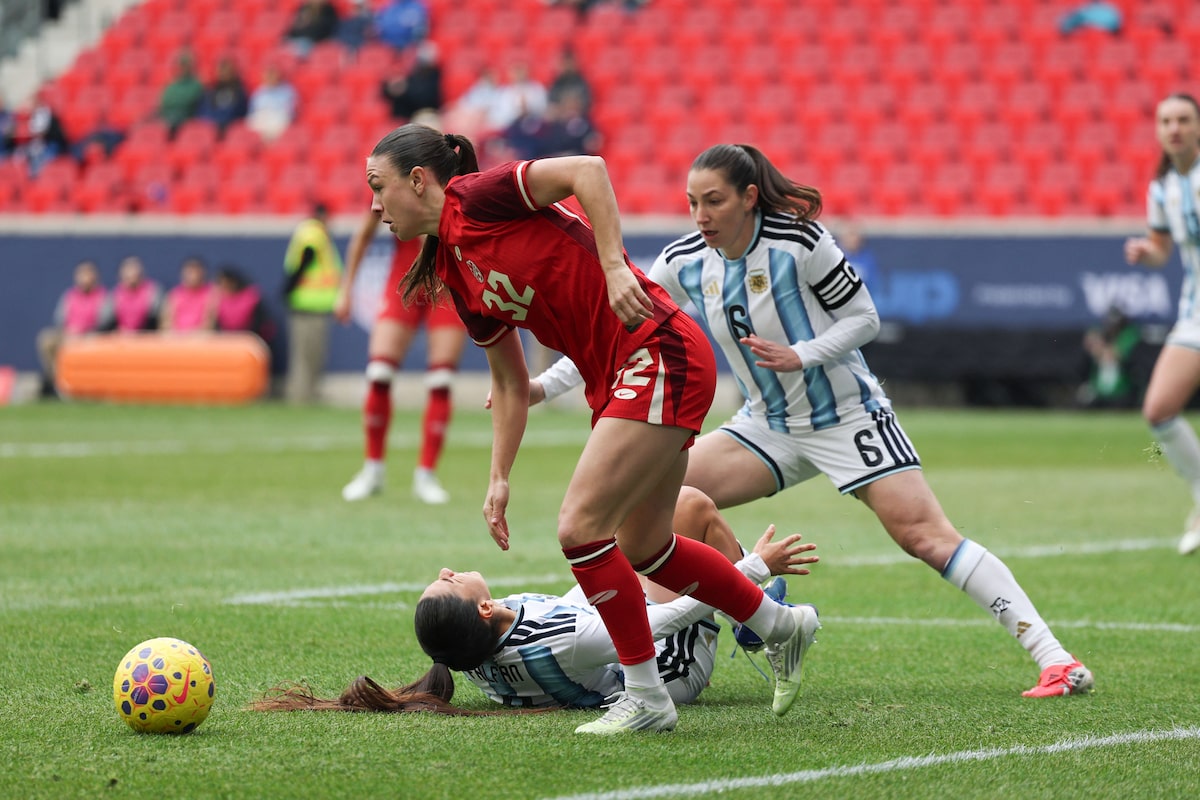
Canada’s DB Pridham (centre) who plays for the Ottawa Rapid of the Northern Super League, landed a spot on the senior women’s national team thanks to a strong season in the NSL that saw her named the league’s player of the year.ANGELA WEISS/AFP/Getty Images
For too many years, the opportunity to play professional women’s soccer in this country – a dream held by many young girls taking their first steps in the world’s most popular sport – was always out of reach.
Last year’s arrival of the Northern Super League finally made that a reality, but for some of the stars lighting up the new venture, playing pro was only part of that dream.
“I never gave up on my dream,” said Ottawa Rapid forward Delaney Baie (DB) Pridham. “My dream has always been to play on the Canadian national team.”
After turning the inaugural season of the NSL into her personal showcase, Pridham, who was named player of the year after a league-leading 20 goals in 27 games, finally arrived at her stated aim earlier this year. The 28-year-old made her international debut at the SheBelieves Cup last month, starting in a 4-1 win over Colombia. She quickly earned another two caps in the tournament as Canada finished second behind the country of Pridham’s birth, the United States.
Canada Soccer forecasts smaller-than-expected deficit in 2025 and surplus of $6.5-million in 2026
Qualifying for Canada through her parents, Pridham could have made her national-team debut last November in Japan, but her Canadian passport didn’t come through in time. But patience has been a hallmark of Pridham’s journey to the top, having had to play college soccer in the NCAA, and then professionally in Iceland and Sweden, to earn the chance to wear the Maple Leaf.
She feels that the arrival of the NSL will help others in a similar fashion.
“I think in the Northern Super League, this is the beginning of many more players to come that are going to be in this league to go to the Canadian national team,” she said. “Because this is a part and a big reason of why this league was made, to connect the youth players to the professional level, to the national team level, so that you don’t have to go overseas, and you can stay domestic.”
Of all the metrics that defined the inaugural season of the NSL – such as the third-highest average attendance for a domestic women’s soccer league anywhere in the world – one of the most impactful for the sport’s future in this country is the number of Canadian national-team call-ups.
While some of the seven summoned to Casey Stoney’s team in 2025 had international experience that predates the NSL, others, such as Pridham, Kaylee Hunter and Holly Ward, used the league as a springboard to the national team.
Canada’s Kaylee Hunter showed what she could do with AFC Toronto in the NSL last year. She made her senior debut last month against Argentina in the final game of the SheBelieves Cup.ANGELA WEISS/AFP/Getty Images
With next year’s World Cup and the Los Angeles Olympics of 2028 appearing as career-defining carrots dangling on the horizon, the timing couldn’t have been more perfect.
“There’s just so much talent in Canada that has kind of gone unseen just because we didn’t have a professional league,” the 18-year-old Hunter said. “So I think it’s really good that this league came around in our day. Some of our players can get called up to the national team, and it’s only going to get bigger as you just go on.”
Hunter, who placed second in the NSL’s golden boot race behind Pridham with 16 goals in 25 games, is no stranger to the international scene, having played for Canada’s under-17 and under-20 teams. She made her senior debut last month, starting alongside Pridham against Argentina in the final game of the SheBelieves Cup.
“The league is creating a pathway to integrate more players that weren’t necessarily looked at before just because of where they were playing abroad,” Hunter said.
“This league, it’s really just making a good pathway to slowly integrate new faces and get more players into the national team. And that’s exactly what we need, because truth is, the players who are there now, they won’t play there forever and then there needs to be new up and coming players.”
Stoney, the Canadian women’s national team coach, included both players in her squad for the upcoming three-game series in Brazil, which will play host to the 2027 World Cup. Canada will face Zambia on Saturday, before playing South Korea on Tuesday and Brazil, the 2024 Olympic silver medalist, next Saturday.
Documentary goes behind-the-scenes on the birth of Northern Super League
Staying with the NSL, Stoney also called up Ottawa Rapid goalkeeper Melissa Dagenais, who rooms with Pridham for both club and country and is still looking for her first international cap. There was also another call-up for Emma Regan, who played alongside Hunter last year with AFC Toronto before getting transferred to the Denver Summit of the National Women’s Soccer League in January.
While Stoney said Pridham had “played herself into the starting 11,” she said that Hunter’s involvement with the national team setup has been done with one eye on the future, although Canada still has to qualify for next year’s World Cup at the CONCACAF W Championship in November.
“With her being so young, she’s across both programs into terms of 20s and seniors,” Stoney said. “But having her experience Brazil, if we are going to consider her in a year’s time, it’s important and a vital experience for her.”
Holly Ward (right) spent 2025 with the Vancouver Rise in the NSL and has since joined the Seattle Reign in the NWSL. Canada’s national team can evaluate players like the 22-year-old Ward as it keeps an eye to its future.Joseph Maiorana/Reuters
Away from the national team, another year of seasoning and experience will only help players like Hunter, and maybe others. In a world where other domestic leagues have restrictions on overseas players – NWSL teams get seven international roster spots, for example – the NSL allows Canadians to get vital playing time.
“We all have heard Casey Stoney say that minutes matter, and playing matters and experience matters,” said NSL president Christina Litz. “And so, there is a limitation on Canadians on rosters for other leagues around the world. So you’re taking a big gamble if you’re going to choose to go there and potentially sit on the bench, versus being one of the top talents and actually getting on the pitch in your first year with us.”
The NSL hierarchy is well aware of the power of Canadian national-team call-ups as a calling card for the league and its future growth.
When Pridham got called up to last November’s camp in Japan, the league sent her flowers to mark the occasion. And all four of the league’s call-ups to last month’s SheBelieves Cup, which included Ward, formerly of the Vancouver Rise before her transfer to the NWSL, were the proud recipients of customized Ugg slippers, with a note that said: ‘Rest those talented feet.’
“That is Christina for sure,” laughed league co-founder and former national-team midfielder Diana Matheson of the gifts. “I’m not taking credit for that, I’m not that thoughtful, I think. But yeah, that’s the league we’re trying to be.”
Getting more serious, Matheson says that the league is on track with regards to the timing of how many of its players it could funnel into the national team by this point. As someone that had to follow much the same path as Pridham did before the NSL came along, the former Olympian is only too happy to grease the wheels for future generations.
“We were just losing so many players because they weren’t able to get those international spots abroad, or you couldn’t even see it at home, so you weren’t dreaming about it,” she said. “So either we were losing them in general to the game, or we just weren’t developing them professionally.”
Matheson says the early vision was to have up to a quarter or a third of the Canadian women’s national team playing in the NSL after the first Olympic and World Cup cycle. However, she now envisions an inflection point somewhere beyond the first four seasons.
“I think there’ll be a tipping point where we get even more of the women’s national team back here, because I think we have, again, the player pool that comes up and feeds this league is so strong that’s going to keep raising the level of play,” she said, adding that the international players that want to come to the NSL will only raise that standard.
“Ten years from now I think that’s going to be a different percentage.”