
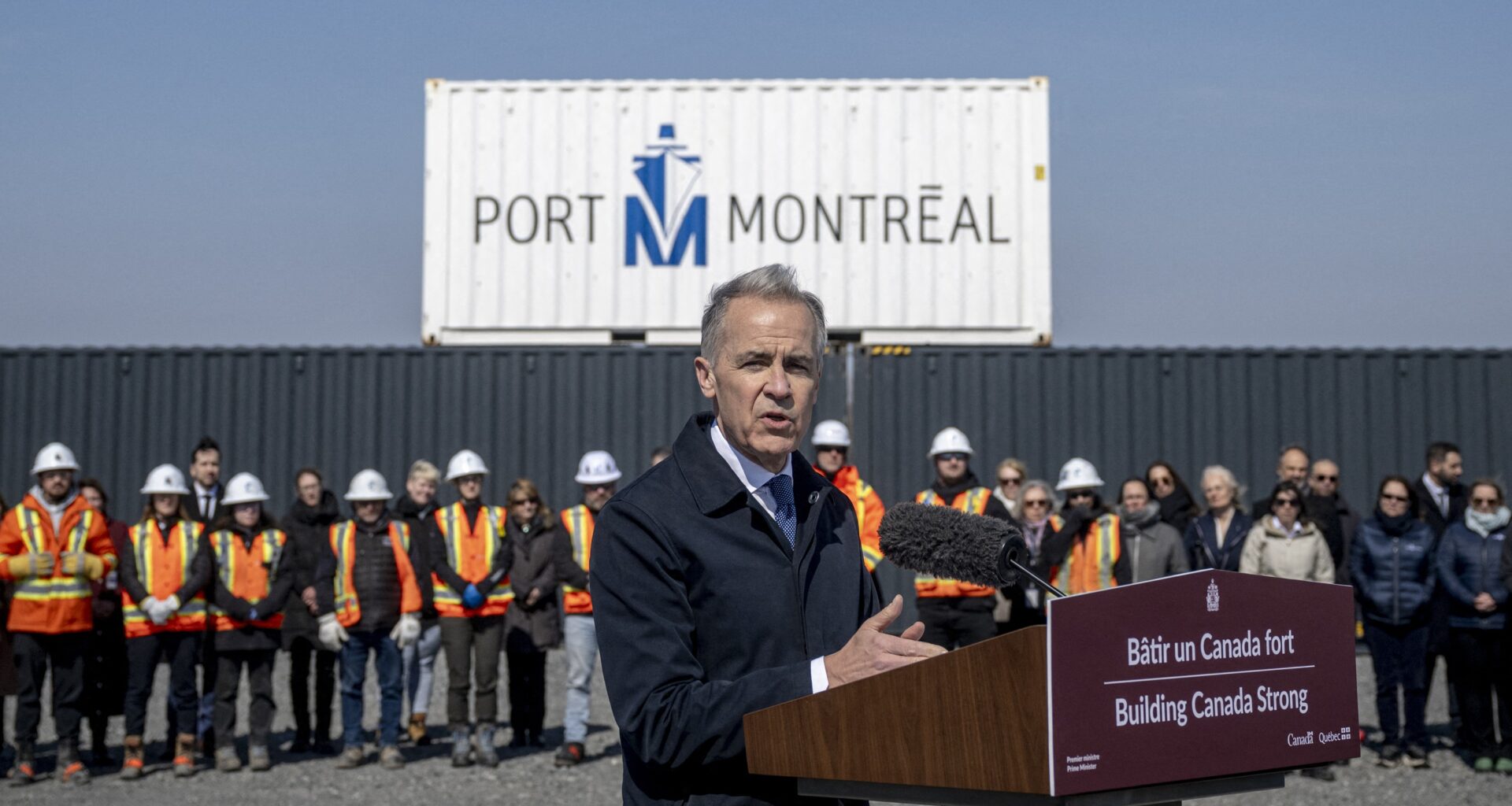
After nearly four decades of planning, major construction will begin this summer on a new Port of Montreal terminal, Prime Minister Mark Carney announced Thursday, backed by $1.16 billion in federal financing.
The $2.3-billion terminal in Contrecoeur, 40 kilometres northeast of Montreal, will handle up to 1.15 million containers per year, increasing the port’s capacity by 60 per cent.
“War in the Middle East, Russia’s illegal invasion of Ukraine, and the new trade regimes are reshaping the global economy in real time,” Carney told reporters in Contrecoeur.
“Some of these effects are immediate and profound: closing markets, disrupting supply chains, halting investments.”
In response, he said, “Canada is focused on what we can control — building a stronger, more independent, more resilient economy.”
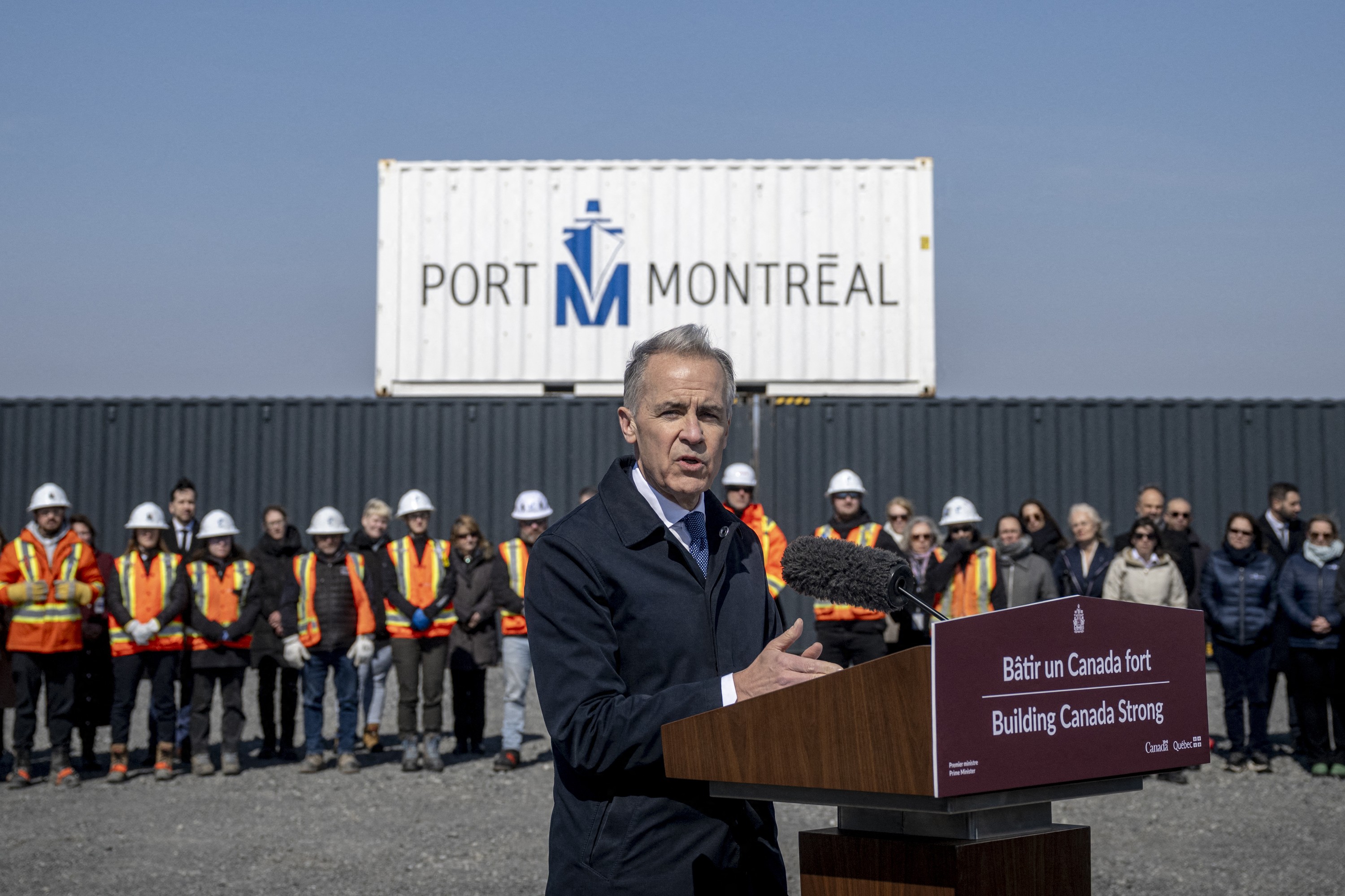 Prime Minister Mark Carney makes an announcement about the expansion of the Port of Montreal in Contrecoeur, Que., on Thursday, April 9, 2026. ANDREJ IVANOV / AFP via Getty Images
The federal government says it has committed $1.16 billion in financing through the Canada Infrastructure Bank “to ensure investors had the certainty they needed to advance the terminal expansion quickly.”
Carney said the new terminal shows his government’s more nimble approach to major projects.
“The vision for the terminal expansion was first proposed in 1988 — almost 40 years ago,” he said.
“Since then, it’s been subject to delay after delay, extensive and duplicative regulations and approval processes.”
Carney said that for too long, “when the federal government examined a new project, the immediate question was: Why? Today, our new government starts by asking: How? How can we build it bigger? How can we build it faster? How can we build it now?”
He said Contrecoeur is “an example of a confident Canada — a country that’s building again, that’s connecting to the world. With each shovel in the ground, with every new trade deal, we are building a stronger, more independent, more resilient country.”
Contrecoeur was one of 15 initiatives referred to the Major Projects Office, created by the federal government last year to fast-track “nation-building” projects. Contrecoeur will be the first to start construction.
Preparatory work began at the site last fall.
The new facility is expected to open in 2030. Last fall, the port signed a deal with DP World under which the Dubai-based logistics company will build the terminal and operate it for 40 years.
Carney made the announcement as the Liberal Party of Canada began a three-day national convention at Montreal’s Palais des congrès, where about 4,000 delegates are gathering to debate party policy.
Speaking in Contrecoeur, Quebec Economy Minister Jean Boulet said ongoing turbulence in supply chains and logistics networks highlights why it’s important for Quebec to become more competitive and to diversify export markets.
He said the new terminal will boost exports and make Quebec more resilient.
“This is what will make Quebec and Canada succeed despite the international conditions we constantly face.”
Boulet said the project “demonstrates once again that through collaboration, we are capable of achieving great things.”
Last year, the Quebec government said it would provide $130 million in financial assistance for the project.
Contrecoeur will support 4,000 jobs per year during construction, and once fully operational will support 10,000 jobs annually, Ottawa says.
The port says it needs the new terminal because it expects to soon run out of space at its main facility, a sprawling complex along the St. Lawrence River in Montreal’s east end.
The terminal’s construction has been the focus of years of environmental opposition because it will take place in the habitat of an endangered fish.
At the centre of the dispute is the copper redhorse — referred to as a “pure laine” fish by the Fédération québécoise des chasseurs et pêcheurs, a hunting and fishing association, because it’s found nowhere else in the world.
The port has said it will protect the species through an ecological project approved by the federal Department of Fisheries and Oceans. It will involve creating a dike and breakwater and planting aquatic vegetation to restore feeding habitat for the copper redhorse.
But the environmental group Société pour la nature et les parcs (SNAP Québec) has cast doubt on the mitigation measures, saying in January that it has concerns about their “scientific legitimacy, legal compliance and environmental effectiveness.”
Editor’s Picks