
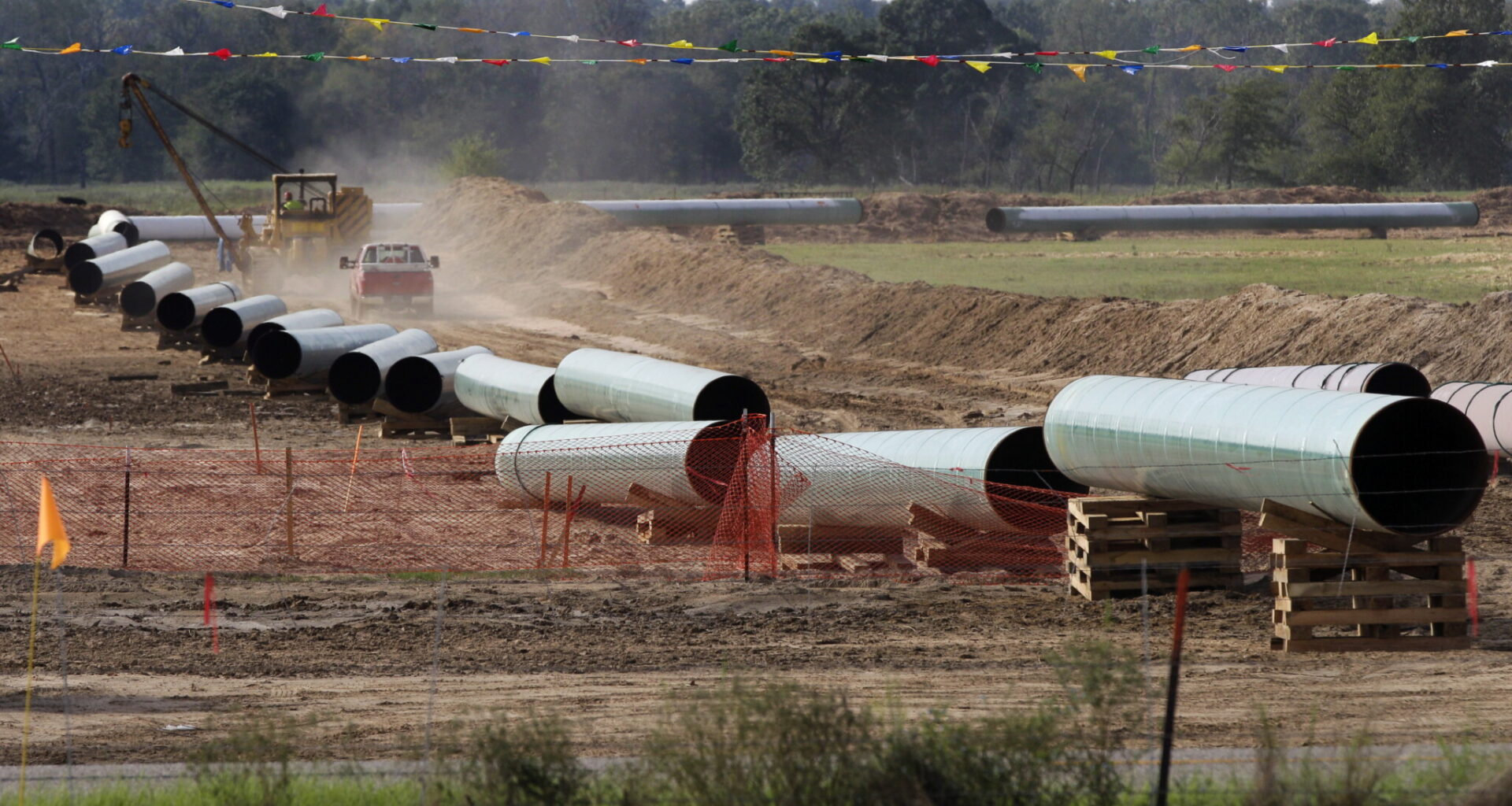
If energy is Canada’s superpower, complacency is its kryptonite. This reality has been exposed again this past month as it’s become increasingly clear that new pipeline egress will primarily head south to the U.S., not west to Asia, in the coming years.
Our inability to leverage our world-class oil reserves in our foreign policy by building pipelines to global markets has been a perennial weakness. It is still bewildering that we are doing it again.
Hello, Keystone, my old friend
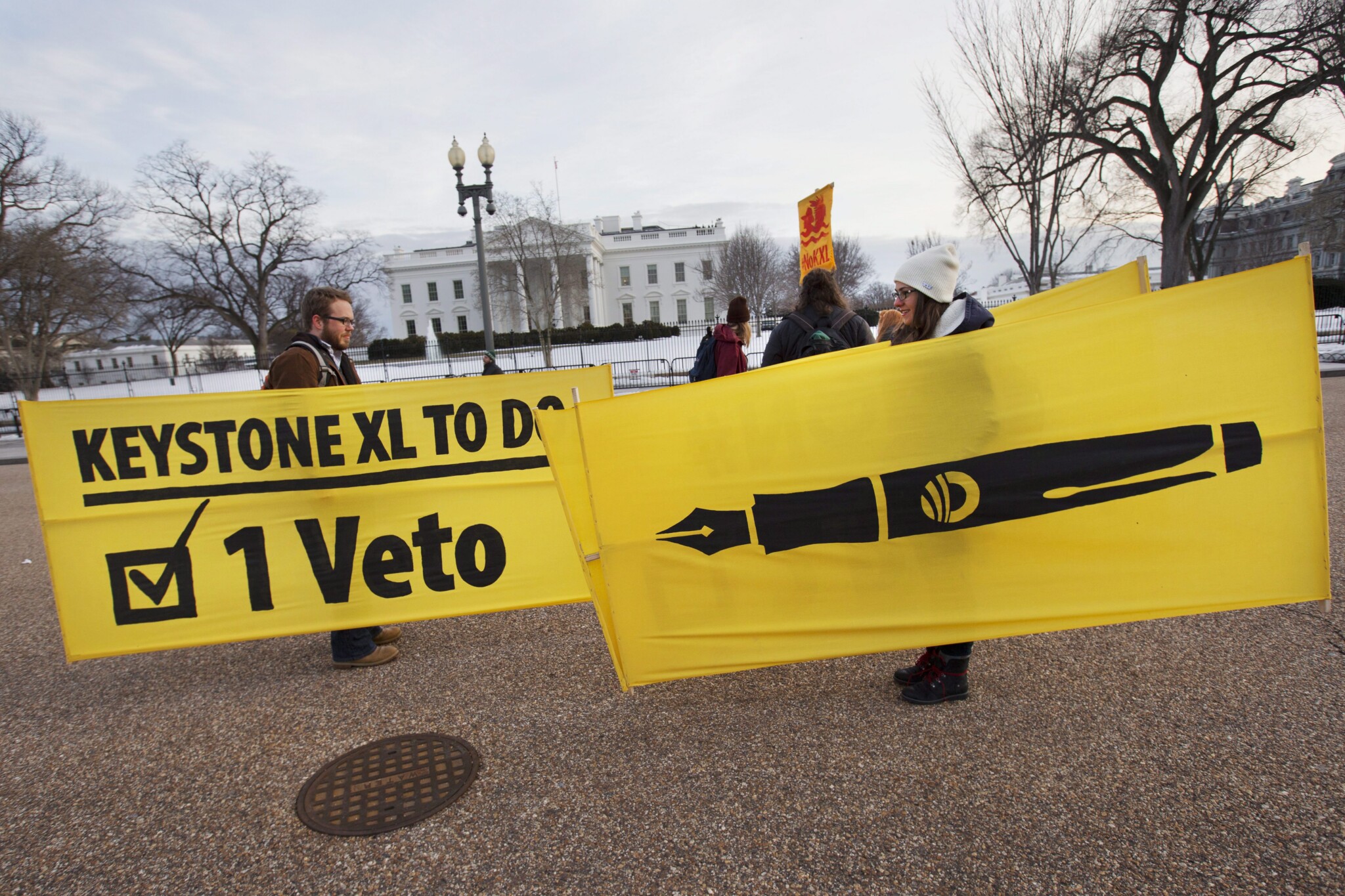
The words “Keystone XL”—the million-barrel pipeline from Alberta to the United States that was cancelled by President Joe Biden on his first day in office in January 2021—were uttered a few times by President Donald Trump in early 2025, a nod to the fact that the cancellation was unpopular with pro-oil Republicans.
But any chance the pipeline would be part of a grand bargain between Canada and the U.S.—a plank in a North American energy dominance strategy—became remote as Trump ramped up his rhetoric about Canada, a potential “51st state” from which the U.S. needed nothing.
i
Protestors pick up their signs after attending a celebration gathering with other opponents of Keystone XL oil pipeline, Tuesday, Feb. 24, 2015, outside the White House in Washington. Jacquelyn Martin/AP Photo.
This triggered a natural, even overdue, reaction from Canadians to seek other trade partners and diversify exports. The fastest and most impactful way to do that would be to increase oil and gas shipments to Asia, with its energy-hungry and enormous population. The prospect of a Northern Gateway 2.0, to bring heavy oil from Alberta’s prolific oil sands to B.C.’s West Coast and off to eager customers in Japan, South Korea, China, Hong Kong, Singapore, and India, was thus revived.
Poll after poll confirmed majority public support for such an endeavour, and the pipeline became the centrepiece of another grand bargain, the November MOU between Canada and Alberta. The MOU endeavoured to create a path to unleash that province’s economic and resource might in a way that could also appease the environmental sensibilities of the Liberal base in Toronto, Ottawa, and Montreal.
The result was a quid pro quo of a northwest coast bitumen pipeline to access Asian markets in exchange for the massive Pathways carbon capture, utilization, and storage (CCUS) project.
It has turned into a poison pill.

To be fair, the exchange seemed like an elegant solution at the time: the major oilsands companies themselves are proponents of the project, Alberta Premier Danielle Smith championed it, and the Carney/Hodgson Liberals were happy to jump on board. The multi-billion-dollar question was who would pay for it.
But the world changed in the meantime, and the idea of putting $20 billion into a project that was pure cost with zero economic return, for markets unwilling to pay any kind of premium for a lower emissions barrel, and with “ESG” having left the lexicon of investors, started to look unnecessary.
Adding insult to the injury of requiring the world’s most expensive CCUS project as a condition to moving ahead, the political path for a northwest coast oil pipeline remained narrow. It was vociferously rejected by B.C.’s Premier David Eby, who publicly diminished the essential trade infrastructure as a “fictional pipeline” that makes no “financial or economic sense.”
Coordinated opposition from some B.C. coastal First Nations, which Prime Minister Carney, Energy Minister Hodgson, and other Liberal MPs implied would need to “consent” to the project for it to move forward (a prerequisite not required by Canadian law), added more headwinds, on top of a literal ban on oil tankers across B.C.’s northwest coast.

The spice must flow
Faced with the option of an approximately $30 billion pipeline, tied to a $20 billion carbon capture project, with entrenched political opposition, and a ban on oil tankers, rational economic actors did what anyone could have predicted they would do, which was to find cheaper and easier sources of egress.
They were successful. In November, Enbridge announced an “optimization” of its Mainline, the massive pipeline system that carries a majority of Canadian crude to American markets, which would allow it to transport an additional 400,000 barrels per day of oil south by 2028. That same month, Transmountain announced a series of projects that would add a combined 360,000 barrels per day of output from its assets.
This was already a new pipeline’s worth of equivalent capacity. But then came the icing on the cake: Keystone XL was back on the table, revealed by filings in February from Bridger Pipeline to the Montana Department of Environmental Quality for a 36-inch pipeline to carry oil from the U.S.-Canada border through Montana and into Wyoming, initially carrying 550,000 barrels per day but with the ability to expand to one million later on.

For its part, South Bow, the oil pipeline company spun off from TC Energy in 2024, commenced an open season to confirm 450,000 barrels per day of binding commitments for a new pipeline on the northern side of the border dubbed the Prairie Connector, carrying oil from Hardisty, Alberta to the U.S. using still-valid permits issued for Keystone XL and going through about 150 kilometres of pipe already in the ground.
With approximately 1.3 million barrels of economically and politically palatable pipeline egress now likely to be unlocked this decade, the private sector’s enthusiasm to build a northwest coast oil pipeline has greatly diminished. The market is desperately calling for more barrels of Canadian crude oil, and those barrels can’t wait on Ottawa or Victoria to flow.
Energy superpower or energy colony?
So what about our ambition to be an energy superpower? To diversify trading partners? To double non-U.S. exports? What about the overtures to China, India, and Japan to be an essential partner in their energy security?
What about—and here, I could quote Carney’s entire Davos speech, but let me just choose a handful of invocations—“reducing the leverage that enables coercion,” “prioritizing broad engagement to maximize our influence,” and especially the assertion that “diversification internationally is not just economic prudence, it’s a material foundation for honest foreign policy, because countries earn the right to principled stands by reducing their vulnerability to retaliation”?
View reader comments (22)
There is no doubt in my mind that Canada’s strategic interests would be best served by enhancing the ability to ship crude oil to new trade partners in Asia with a northwest pipeline ending in Prince Rupert or thereabouts. We should have prioritized this pipeline.
What we did instead was make the pipeline to the coast of B.C. the most expensive, contentious, and risky, creating incentives for Alberta oil producers to ship more of their barrels to the U.S. at a fraction of the cost.
This time should’ve been different. The cancellation of Northern Gateway, Keystone XL and Energy East looks catastrophic in hindsight. They’ve cost Canadians tens of thousands of good jobs and over a hundred billion dollars in lost investment. They’ve left us with precious few options to alleviate the global energy crisis that 8.5 billion people are suffering from today.
But to make the same kind of choice in 2026? To double down on U.S. oil exports because we’ve made it too hard to build in our own country?
This is no longer just complacency, Canada. It looks a lot like carelessness. Costly carelessness, at that.

Heather Exner-Pirot is the director of energy, natural resources and environment at the Macdonald-Laurier Institute.
Canada’s energy strategy is flawed by its continued reliance on exporting oil to the United States instead of diversifying to Asian markets. The failure to build pipelines to the West Coast, due to obstacles such as political opposition, environmental concerns, and financial burdens, is lamentable. The revival of Keystone XL and other pipeline projects that primarily serve the U.S. market is seen as a missed opportunity for Canada to assert itself as an energy superpower with a more independent foreign policy. Canada’s complacency and internal obstacles are hindering its potential and leading to costly carelessness.