
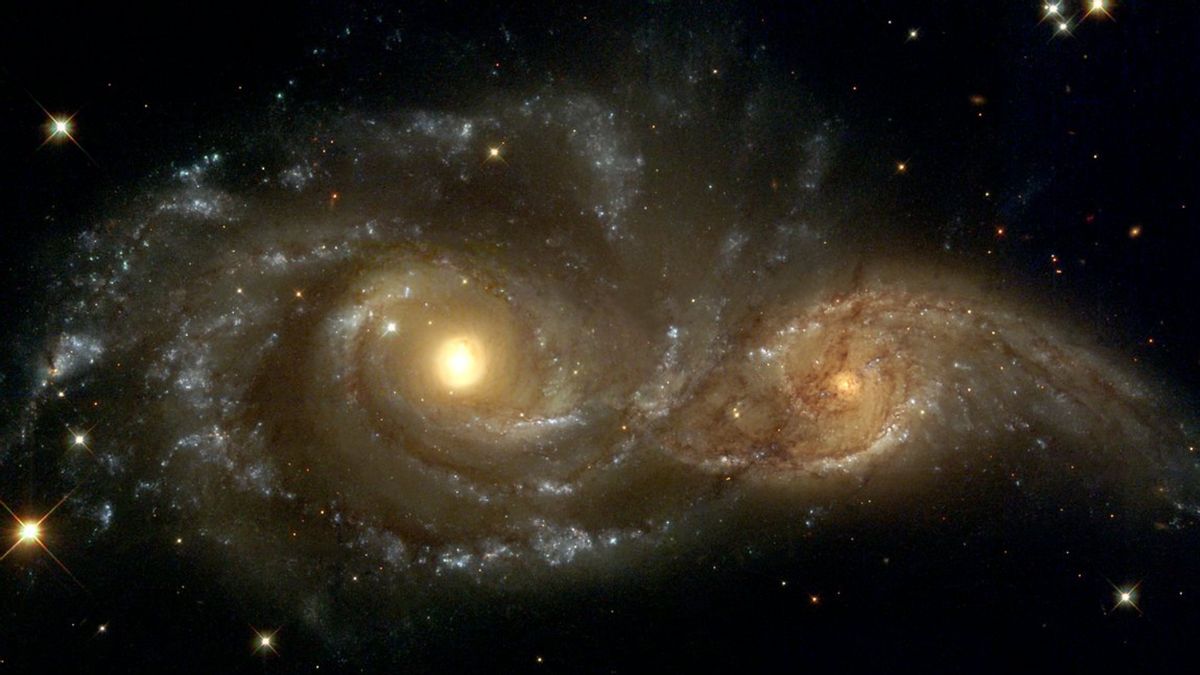
In early 2026, a rumor circulated online that a set of images showed that human ashes under a microscope resemble galaxies.
The photos stemmed from the work of Gabriela Reyes Fuchs, an artist who uses a patented microscopy method to create prints of pictures of human and animal ashes. Her work, sold through the company Innerstela, produces a wide range of images with a space-like feel.
Given Fuchs markets her creations as a form of art and because it’s subjective whether one item resembles another, we have left this claim unrated.
Snopes will update this report if, or when, additional information surfaces. We contacted Fuchs for more context about her art and await a reply.
In early 2026, social media users claimed that a set of images circulating online showed that human ashes resemble galaxies when looked at through a microscope.
For example, one Facebook user posted a video featuring the colorful pictures in January (archived). The caption read: “Under a microscope, human ashes look like galaxies. So much Light. Color. Motion. A quiet reminder that energy is never destroyed, only transformed.”
The photos also circulated in Instagram (archived) and Threads (archived) posts.
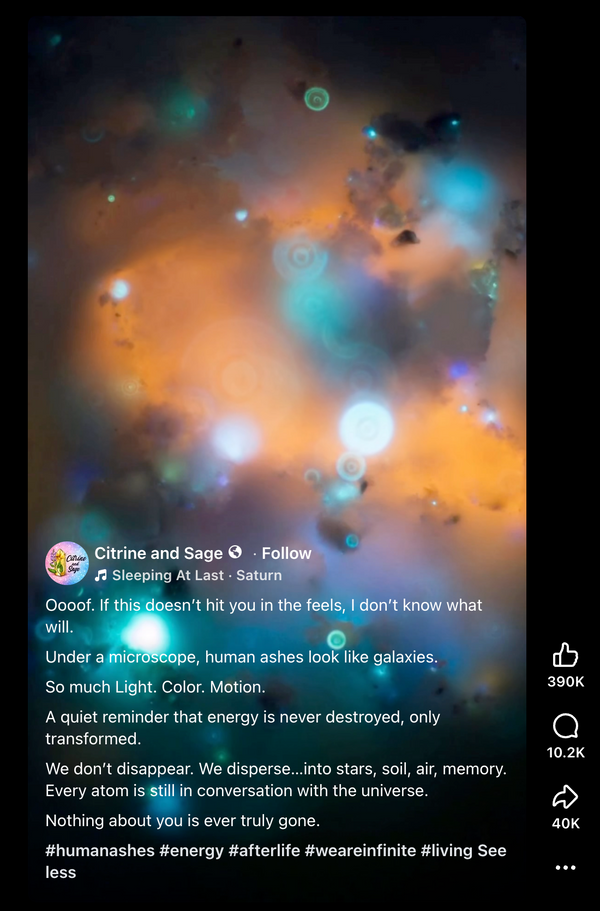
(Image courtesy of Citrine and Sage, accessed via Facebook)
The images are authentic. They originate from posts by Innerstela (archived, archived, archived), a memorial art company run by Gabriela Reyes Fuchs. The business uses a patented microscopy method to create prints of photos showing human and animal ashes.
On a separate Instagram page — for Fuchs’ 2018 “Dead Soon” art exhibition that led to the creation of Innerstela — the artist described (archived) her work as a “trademarked and patented artistic process which allows me to produce art from a small pinch of human or non human ashes.” According to her U.S. patent, Fuchs creates her images using epifluorescence microscopy, a technology that captures the energy emitted from certain materials as light.
Given Fuchs markets her creations as a form of art, which is created in a specific and esoteric manner, and because it is a subjective opinion that one item resembles another (some readers may not believe the ashes pictured resemble galaxies), we have left this claim unrated. Snopes contacted Fuchs for more context about her art and await a reply.
A patented method
In a 2018 TED Talk (archived), Fuchs explained that the inspiration for “Dead Soon” and Innerstela came from her father’s death and cremation. Left with her father’s ashes, Fuchs said she asked a university for access to its laboratory to look at the ashes under a microscope, but they told her that would only produce “black, white and gray” images.
Instead, Fuchs said (detail in brackets ours), “I discovered multicolored nebulae that resembled the images taken by the Hubble [Space Telescope]. I understood the physicality of space.”
According to LensCulture, an online photography magazine, Fuchs used a bright-field microscope to view her father’s ashes when she produced the “Dead Soon” exhibition. Such microscopes shine light through a material from above and below to get an image of the item under the lens.
Since the “Dead Soon” exhibition, Fuchs has patented a different method of producing her ash-based art pieces. According to her patent, she produces images using different light filters and zoom levels on an epifluorescence microscope. Lifestyle, diet and where someone lived before their death helps produce different results for every person, according to Fuchs’ patent (Page 6, Column 3).
Epiflourescence microscopes work by exciting — meaning adding energy to, in this context — sample material and recording the light the sample emits when it returns to its stable state. The color of the reflected light depends on the materials in the sample ashes. Fuchs’ patented method uses a different microscope than the bright-field microscope she used to create the “Dead Soon” exhibition.
According to some peer-reviewed research, mammal bones can appear in various different colors including red, blue, green and yellow depending on how a viewer lights a sample, suggesting that Fuchs’ patented method does create the images she publishes. It was not possible for Snopes to independently recreate Fuchs’ method.
For further reading, Snopes has previously investigated how other artists used various tools to create stunning images of the universe.
Sources
Brightfield Illumination: A Guide to the Most Widely Used Microscopy Technique | ZEISS. https://www.zeiss.com/microscopy/en/resources/insights-hub/foundational-knowledge/brightfield-illumination.html. Accessed 9 Apr. 2026.
‘Dead Soon – Gabriela Reyes Fuchs’. LensCulture, https://www.lensculture.com/projects/410923-dead-soon. Accessed 9 Apr. 2026.
‘Innerstela | Ashes Memorial Photography’. Instagram, https://www.instagram.com/accounts/login/?next=https%3A%2F%2Fwww.instagram.com%2Finnerstela%2F&is_from_rle. Accessed 9 Apr. 2026.
TEDx Talks. ‘What I Discovered in the Ashes of My Father | Gabriela Reyes Fuchs | TEDxKlagenfurt’. YouTube, 7 Dec. 2018, https://www.youtube.com/watch?v=9jLrqvDBnVs.
University, Loyola Marymount. Epi-Fluorescence Microscope (EFM) – Loyola Marymount University. https://cse.lmu.edu/research/instrumentsandfacilities/epi-fluorescencemicroscopeefm/. Accessed 9 Apr. 2026.
Villagran, Ximena S., et al. ‘Bone and Other Skeletal Tissues’. Archaeological Soil and Sediment Micromorphology, edited by Cristiano Nicosia and Georges Stoops, 1st edn, Wiley, 2017, pp. 9–38. DOI.org (Crossref), https://doi.org/10.1002/9781118941065.ch1.