
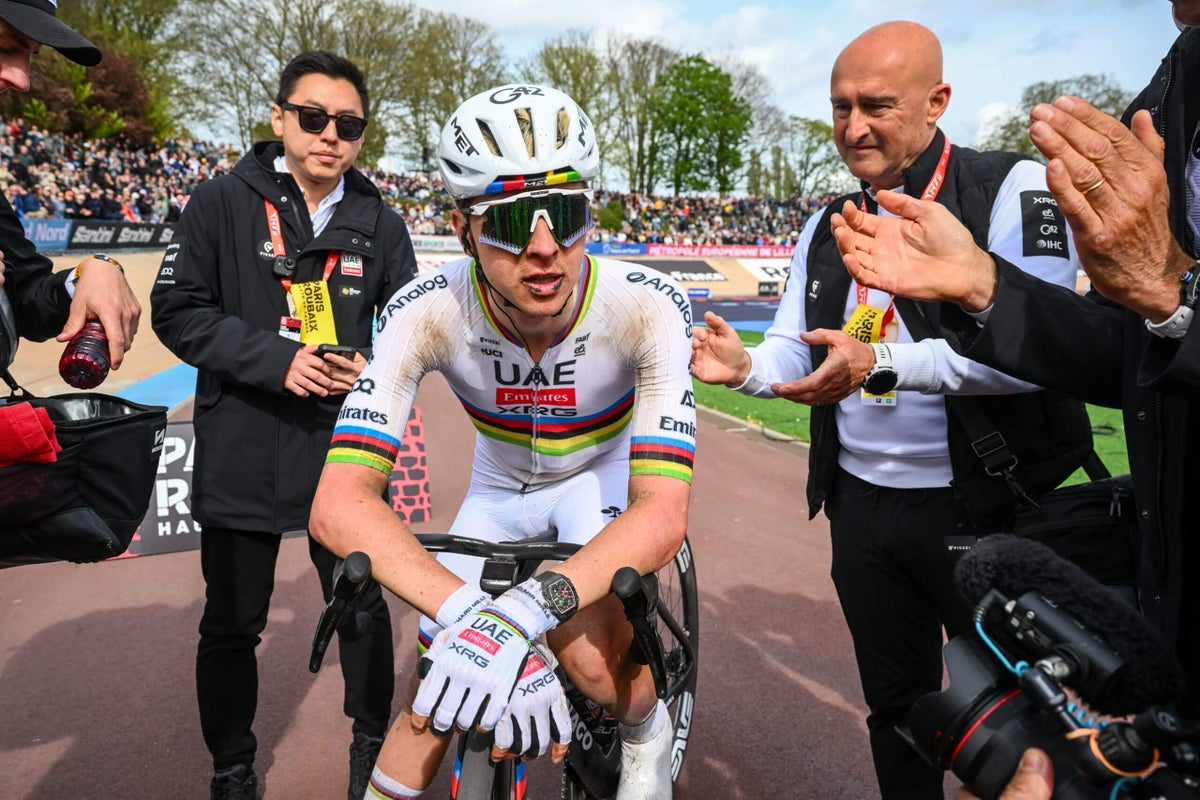
Tadej Pogačar said he would analyse the race “when the dust settles” and for once, he is being literal. His words come slowly, not just from exhaustion, but from the thick layer of grime cornering his lips, too. Even his peroxide hair looks flat and subdued.
This was a brave ride from Pogačar, and it was five metres away from being an astounding ride, one to match last month’s win at Milan-Sanremo.
The facts: he punctured three times, rode a neutral service bike for five kilometres, and despite all that, appeared for long stretches of his second Paris-Roubaix as if he was going to win the only Monument to elude him. Instead, Pogačar was second for the second successive year, a gracious loser behind Wout Van Aert. He was just a sprint away.
It means another year of obsession, of reconnaissance, of winter bulking. As Tom Boonen said in 2004, before he had won any of his four races here: “When I’m standing in the showers in Roubaix, I’m actually starting my preparations for next year.”
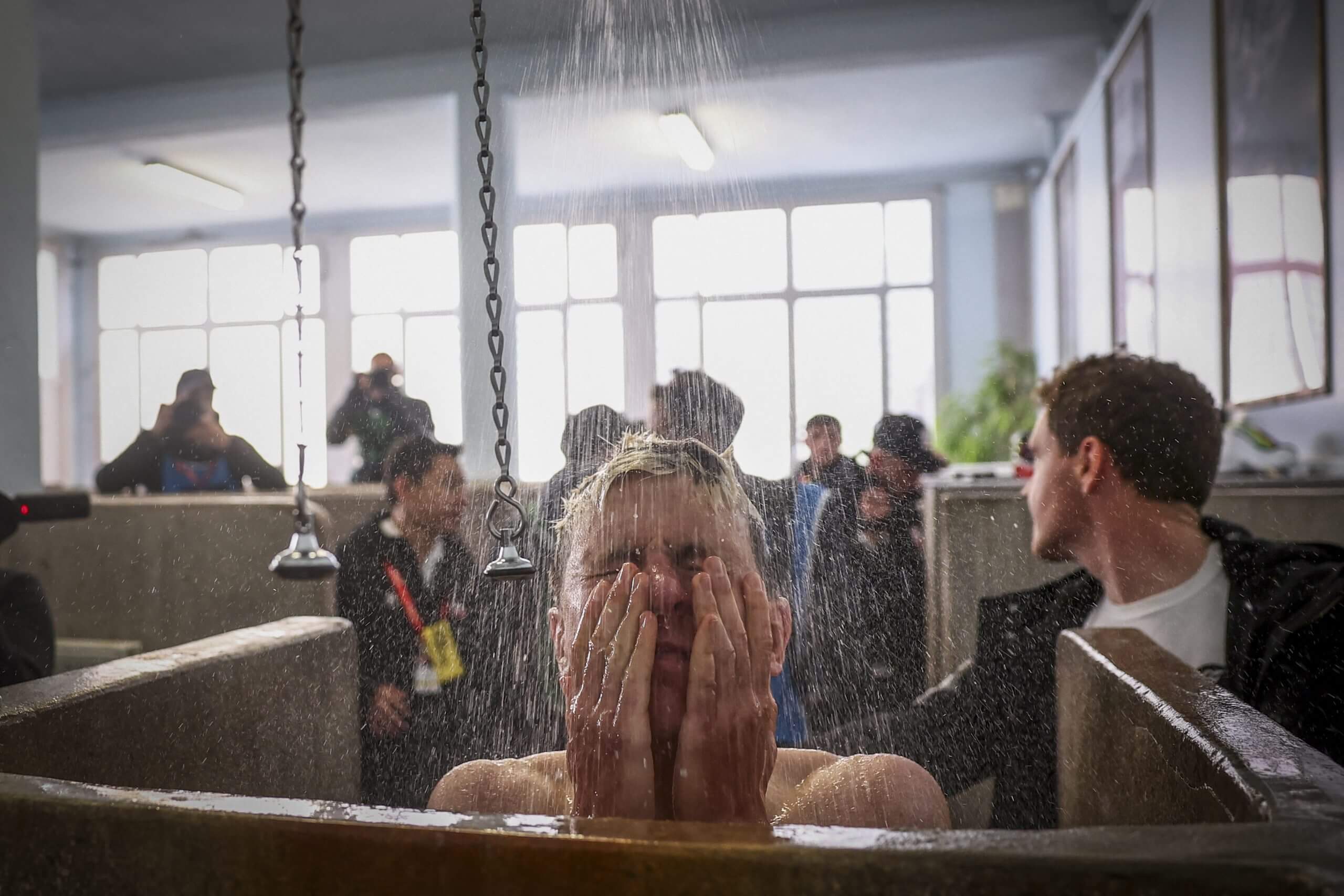
Tadej Pogačar in the famous Roubaix showers after Sunday’s race. (Anne-Christine Poujoulat / AFP via Getty Images)
But these moments recall a speech given by Detroit Lions coach Dan Campbell after the 2023 NFL season, words that already seem destined to rattle around history for decades. “I told our guys, this may have been our only shot,” he said after missing out on the Super Bowl. “Do I think that? No. Do I believe that? No. But I know how hard it is to get here. That’s the reality.”
Pogačar may never be in this position again. He is the best rider of his generation, perhaps of any generation, but Paris-Roubaix is one of the very few races that he has seriously attempted and lost. The other gaps in his palmares — the Vuelta a España and Olympic gold — feel more like a matter of time and interest than inability.
Instead, this is a rare race that he cannot rely on talent alone to win. And make no mistake, over the past two years, he has done the work as well, riding the key cobbled sectors repeatedly over the winter with lieutenant Florian Vermeersch. He went hard enough to crash in one of them, on the Haveluy sector.
“It was so muddy that it wasn’t even cobbles, we were basically riding on the field,” he said pre-race. “I crashed twice, luckily, there was so much mud on the cobbles I wasn’t hurt”.
This is what he is prepared to risk for Roubaix, and that is laudable for a four-time Tour de France winner, but it underscores another reality. Clearly, he possesses the talent, clearly he has done the work, and that means another thing must be needed — the past two years have shown he requires fortune as well. At Paris-Roubaix, the opportunities of tomorrow are never guaranteed.
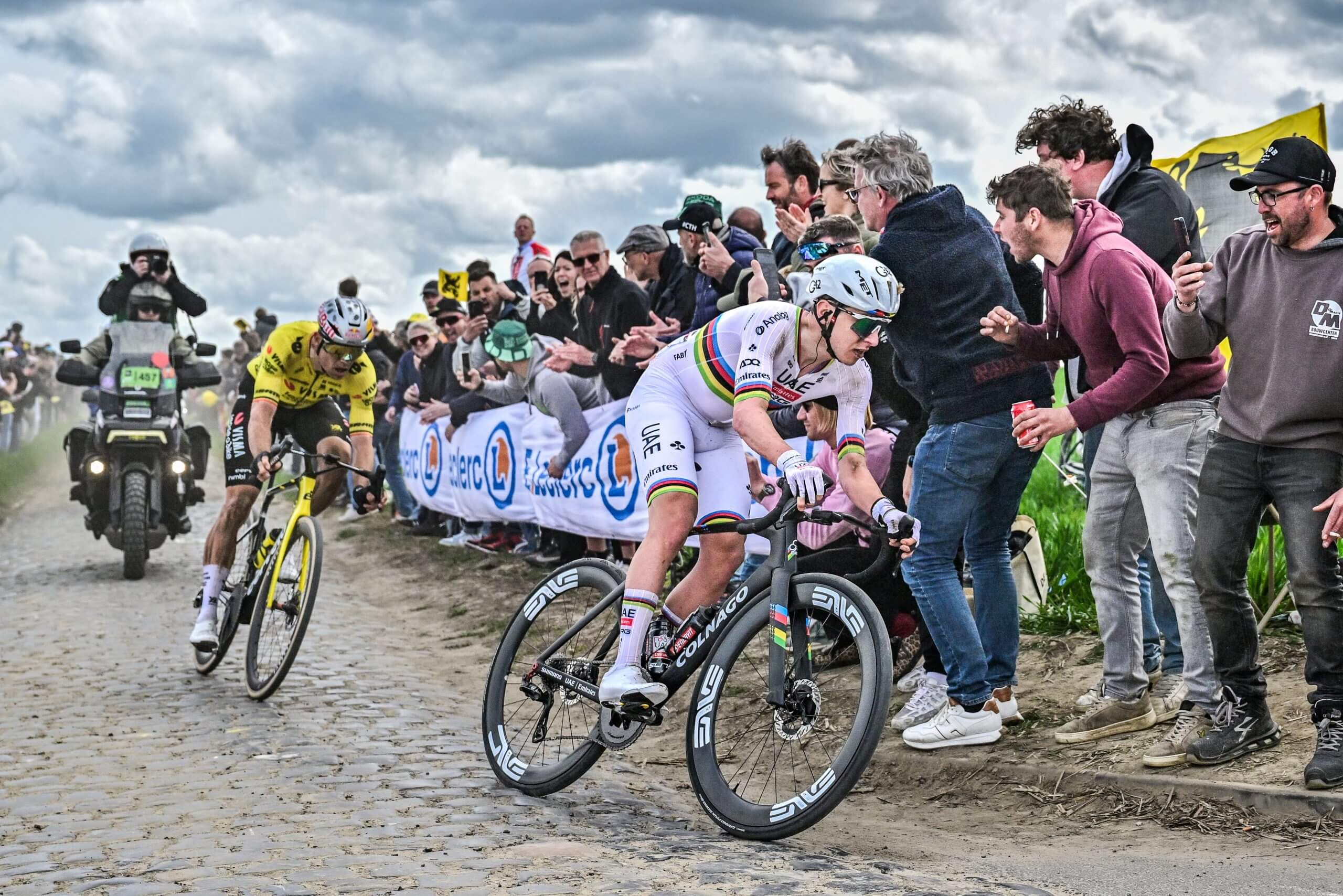
Tadej Pogačar tried several times to drop Wout Van Aert on the cobbled sectors but was unable to do so. (Dirk Waem / Belga / AFP via Getty Images)
Pogačar was not lucky this race — nobody who punctures three times can say that — but he had luck. His biggest rival, Mathieu van der Poel, winner of the past three editions of Paris-Roubaix, was all but taken out of the race after suffering two flat tires on the Arenberg, losing two minutes he would never quite gain back. In closing to just 20 seconds away over the next 100km, there is no doubt that he was one of the strongest riders in the race.
And so Pogačar had his opportunity. He put himself into a two-man leading group without his biggest threat — and still he could not do it.
This is no criticism of Pogačar, who rode his race almost perfectly, especially in getting back to the bunch after his own punctures, while he was unfortunate to lose Vermeersch to his own crash on the Arenberg. He may have opened up his sprint slightly early, but that was not when he lost the race. Van Aert was far superior in the velodrome.
Instead, it was in his inability to shake the Belgian off his back wheel across the final cobbled sectors. Who knows whether he might have found that extra five per cent had he not needed to chase back post-puncture.
“When I tried to counter-attack, (Van Aert) managed to follow me,” said Pogačar post-race. “He was very strong, and after that, a sprint was 99 per cent impossible. When I launched, I felt like my legs were made of spaghetti.”
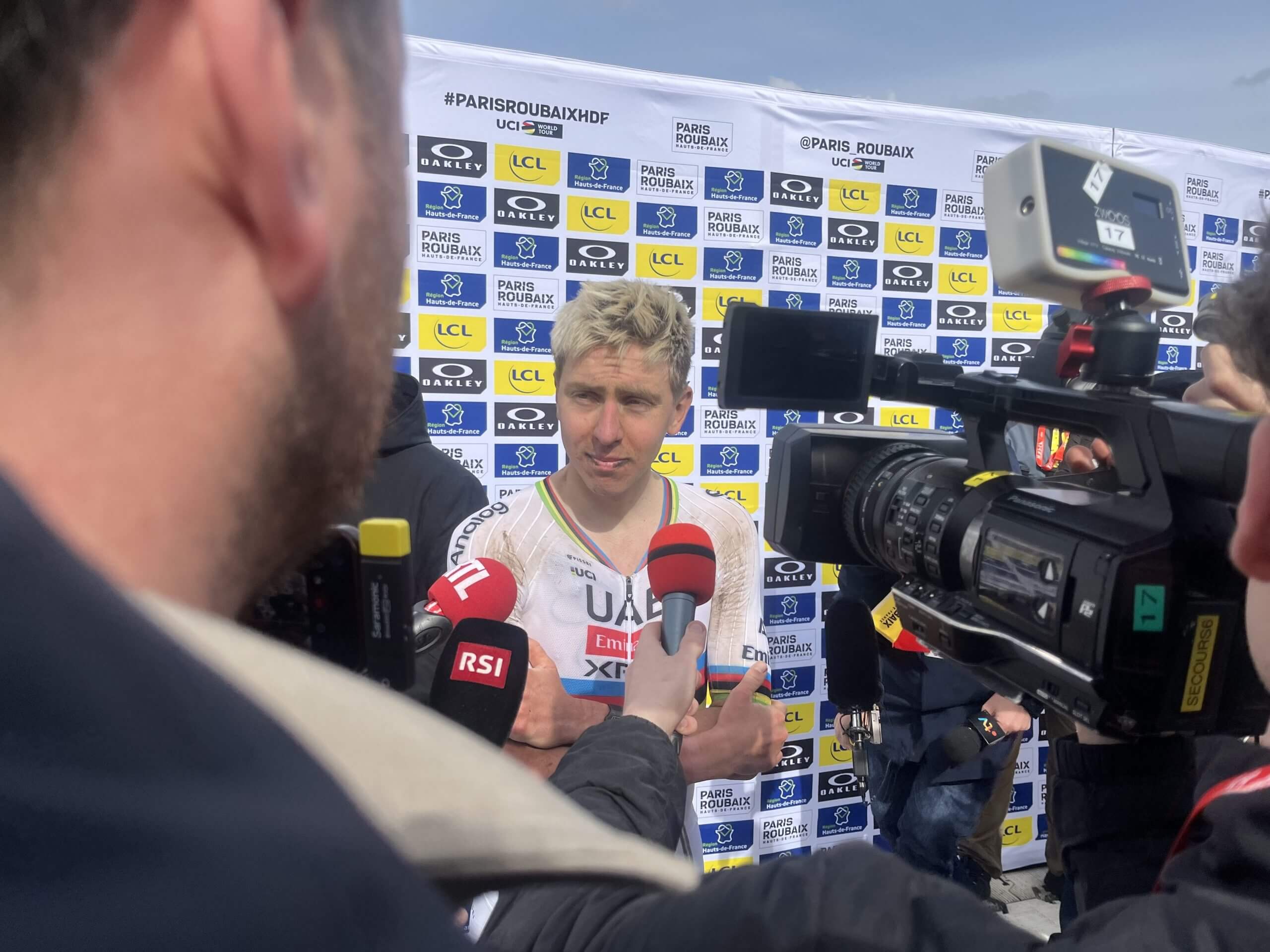
A dust-covered Pogačar speaks to the press after Sunday’s race (Jacob Whitehead/The Athletic)
Racing Paris-Roubaix has a major impact on the scheduling of his season. Preparing properly means he has to sacrifice the high-mountain-climbing shape that he would need to ride the Giro d’Italia, for example, which he would likely skip for a third year in a row if he competes in Roubaix next year.
That race, in many ways, has far more predictable outcomes, its quality levelling itself out over a three-week slog, rather than being settled in the flying mud of six hours in northern France. Pogačar’s ability means he could be in the fight again, but when, and to what extent?
“I’ll be back, maybe not next year, but I still have a few years left in my career and I’m going to try my luck again,” he said.
Pogačar does not need to win Paris-Roubaix to define his career, but the fact is that Van Aert did, and that matters. Pogačar has the opportunity to join Eddy Merckx, Rik Van Looy, and Roger De Vlaeminck as the only men to win all five Monuments, and despite the beckoning of history, you get the sense that Pogačar is riding Paris-Roubaix for himself rather than to meet that expectation, as he should.
An hour after the end of the race, he sat cross-legged on the grass in front of the podium in a group of seven — his parents, Mirko and Marjeta, his girlfriend and fellow professional Urska Zigart, friend and Formula 1 driver Ollie Bearman, plus Bearman’s own girlfriend and brother.
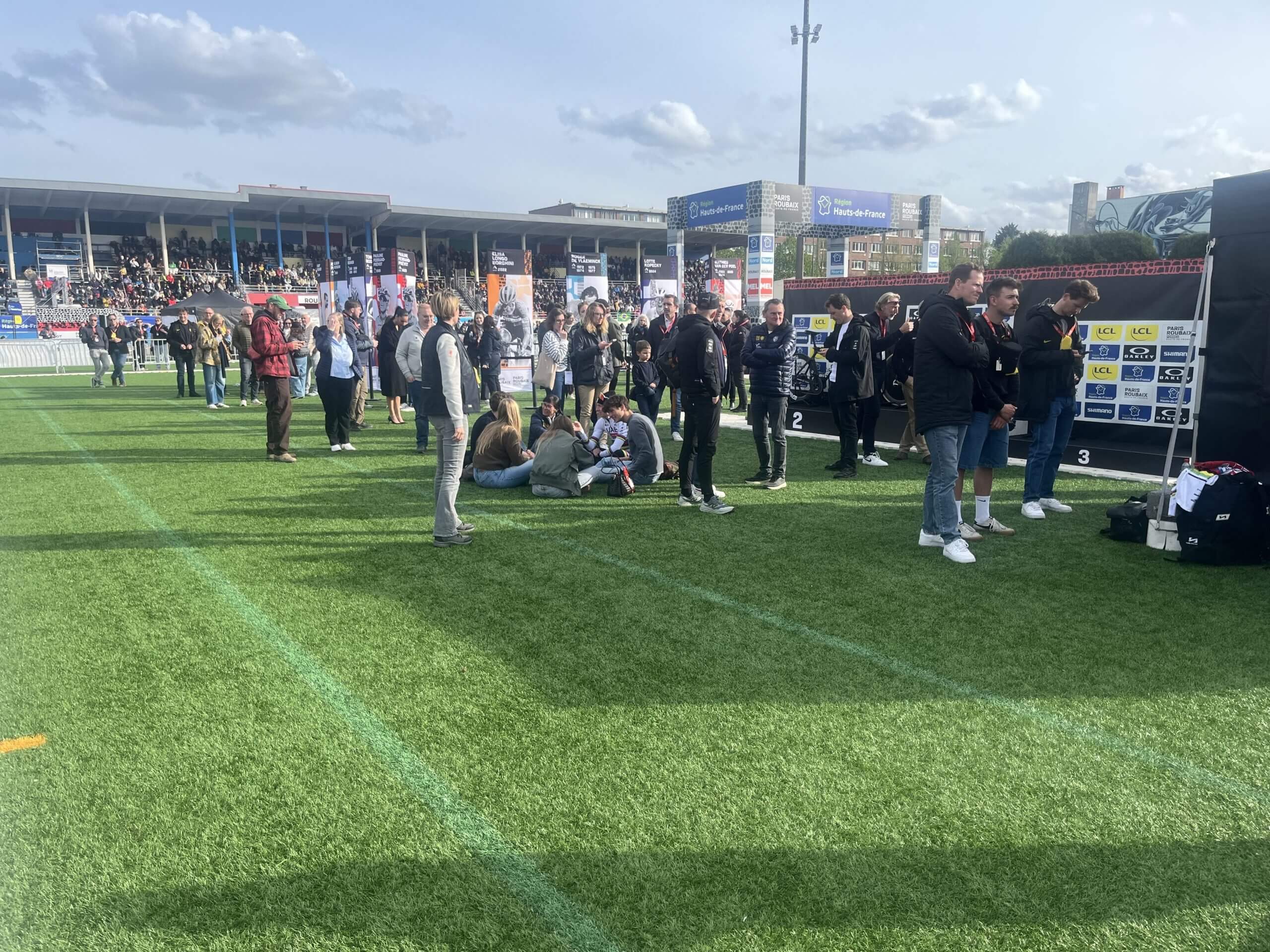
The Pogačar post-race ‘picnic’ in the centre of the velodrome (Jacob Whitehead/The Athletic)
“It’s very important in playing games to learn how to win and how to lose,” Marjeta told The Athletic during the Tour de France last summer. “He learned this also. He wasn’t angry as long as he’d done his best.”
They resemble any group taking a picnic in the spring sunshine, his mother holding court, Bearman asking questions, Pogačar leaning back contentedly on his wrists. For 10 minutes, the greatest rider of his era is mortal. Like all mortal men, he knows being back here tomorrow is not guaranteed, but that will not stop him from enjoying today.