
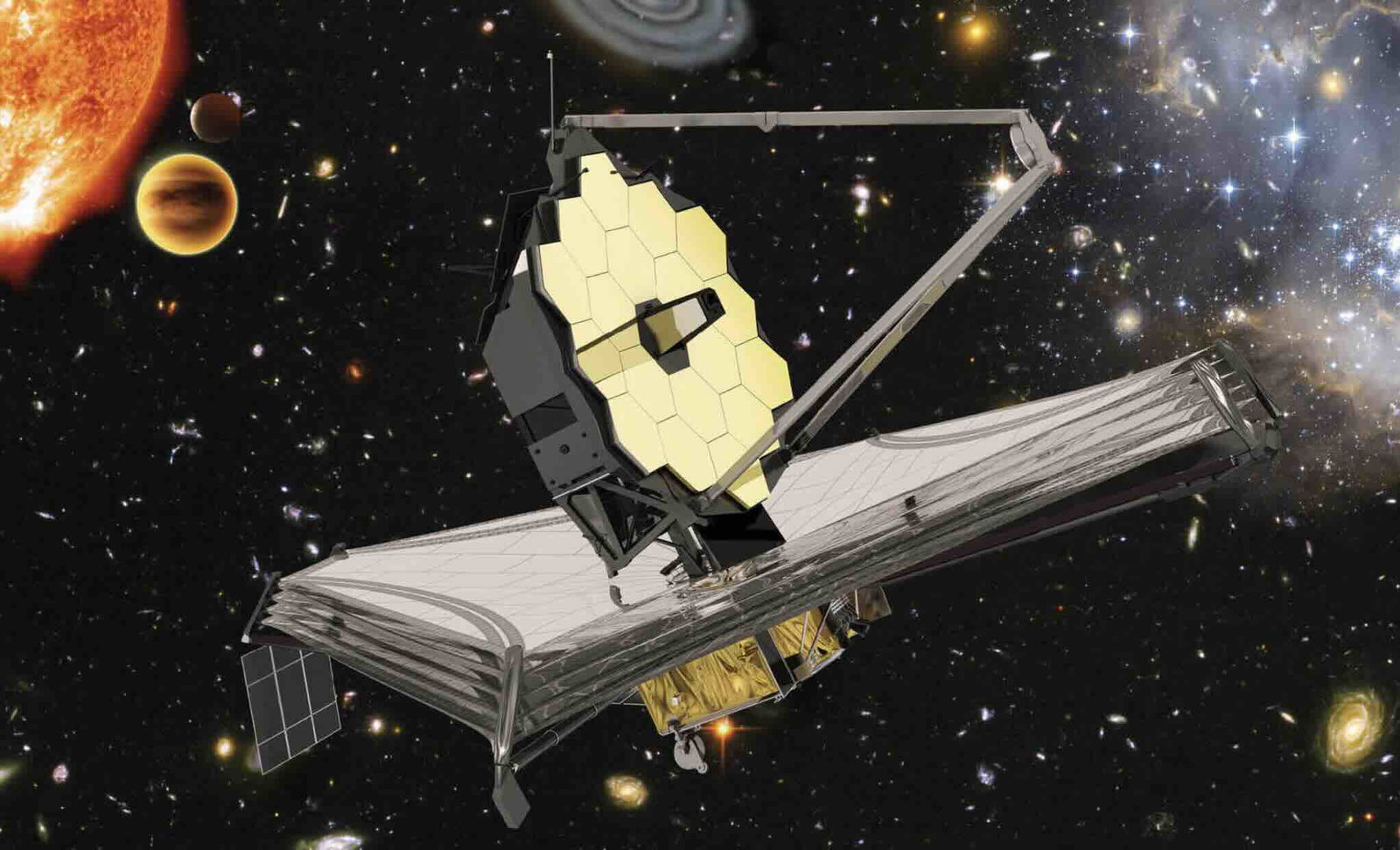
A discovery made possible by NASA’s James Webb Space Telescope may have revealed, for the first time, evidence of a variety of stars that date back to just 400 million years after the Big Bang.
The discovery, if confirmed, could offer the most convincing data yet for what astronomers call Population III stars, potentially moving the study of these primordial stellar features beyond the realm of theory and into real astronomical observation.
The discovery has revealed what is believed to be the best evidence to date for the existence of these stars, which were discovered encircling an ancient celestial companion object during recent Webb observations, as detailed in a pair of studies that appeared on the arXiv preprint server.
Unlike stars we normally observe in the night sky, Population III stars describe a unique class of stellar bodies, whose formation arises almost entirely from hydrogen and helium. Their genesis occurred long before the presence of heavier elements—namely oxygen, iron, and carbon—would begin to populate the universe after being created within the hot bodies of massive stars.
As these ancient stars emptied their elemental fuel stores, they eventually would have exploded as massive supernovae. Those cosmic-scale explosions dispersed the heavy elements forged in their interiors throughout the early cosmos, giving rise to the formation of a large majority of the celestial objects in our universe.
An Odd Signal Emerges
From the heart of GN-z11, one of the universe’s brightest galaxies, an odd signal appeared two years ago, which quickly captured the attention of University of Cambridge researcher Roberto Maiolino.
With the help of the James Webb Space Telescope’s NIRSpec-IFU near-infrared spectroscopy instrument, a nearly-invisible signal in the form of a faint emission line became discernible—an observation that, before Webb, would have been impossible for astronomers. The detection revealed the presence of a companion object astronomers dubbed Hebe, and its distinctive emission line indicated a very specific signature: that of double ionized helium.
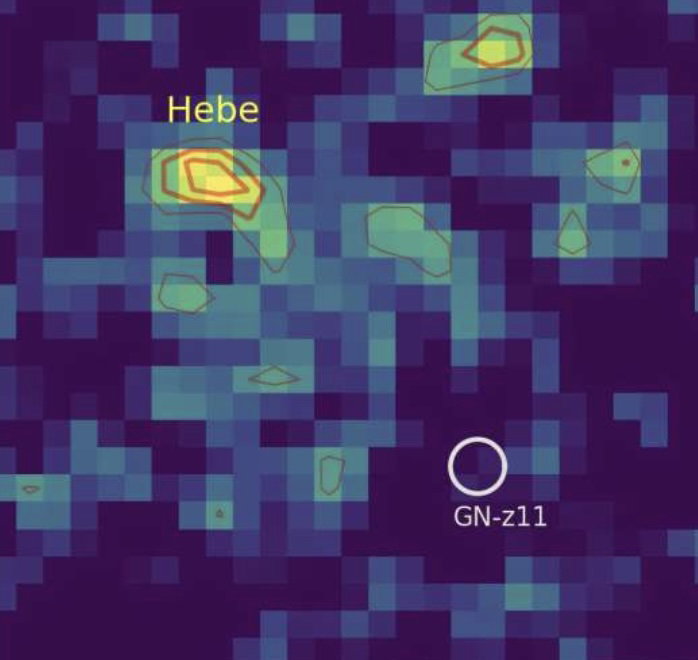 Above: Image indicating the ionized helium associated with the companion object ‘Hebe’ (Image Credit: arXiv (2026). DOI: 10.48550/arxiv.2603.20362)
This is significant, since the double photoionization of helium to occur requires a very large source of radiation energy. The signal was also very pure, evincing no detections of metallic sources, which pointed to an intriguing possibility: that Maiolino and his colleagues had discovered the first direct evidence of ancient Population III stars.
Additional Webb detections would eventually confirm the helium signal the team discovered, which has now been resolved into its two primary components.
Adjacent Research
Meanwhile, Elka Rusta at the University of Florence and colleagues now report an independent similar detection, and from the same cosmic location. Like the research by Maiolino’s team, no evidence of heavier elements present in the emissions was discernible.

With the help of theoretical modeling, Rusta’s team believes that these enigmatic ancient stars possessed a top-heavy mass distribution based on analysis of the helium/hydrogen ratios of the companion object Hebe; this reveals a likelihood that the primordial stars encircling it are anywhere from ten to 100 times the mass of our Sun. Fundamentally, this places them well within the predicted ranges for the universe’s earliest stars.
Going forward, the two teams hope to make additional observations which, with the help of the Webb Telescope and its successors in the coming years, could help to reveal additional evidence for the presence of Population II stars in this ancient region of the cosmos.
For now, though, the dual studies reported by the independent teams are offering astronomers the most compelling evidence yet for their existence, offering an even deeper look into the early days of our universe than many would have ever imagined possible.
The recent study by Roberto Maiolino et al, “The search for Population III: Confirmation of a HeII emitter with no metal lines at z=10.6,” and Elka Rusta and colleagues’ paper, “The Pristine HeII Emitter near GN-z11: Constraining the Mass Distribution of the First Stars,” both appeared on the preprint arXiv server.
Micah Hanks is the Editor-in-Chief and Co-Founder of The Debrief. A longtime reporter on science, defense, and technology with a focus on space and astronomy, he can be reached at micah@thedebrief.org. Follow him on X @MicahHanks, and at micahhanks.com.