
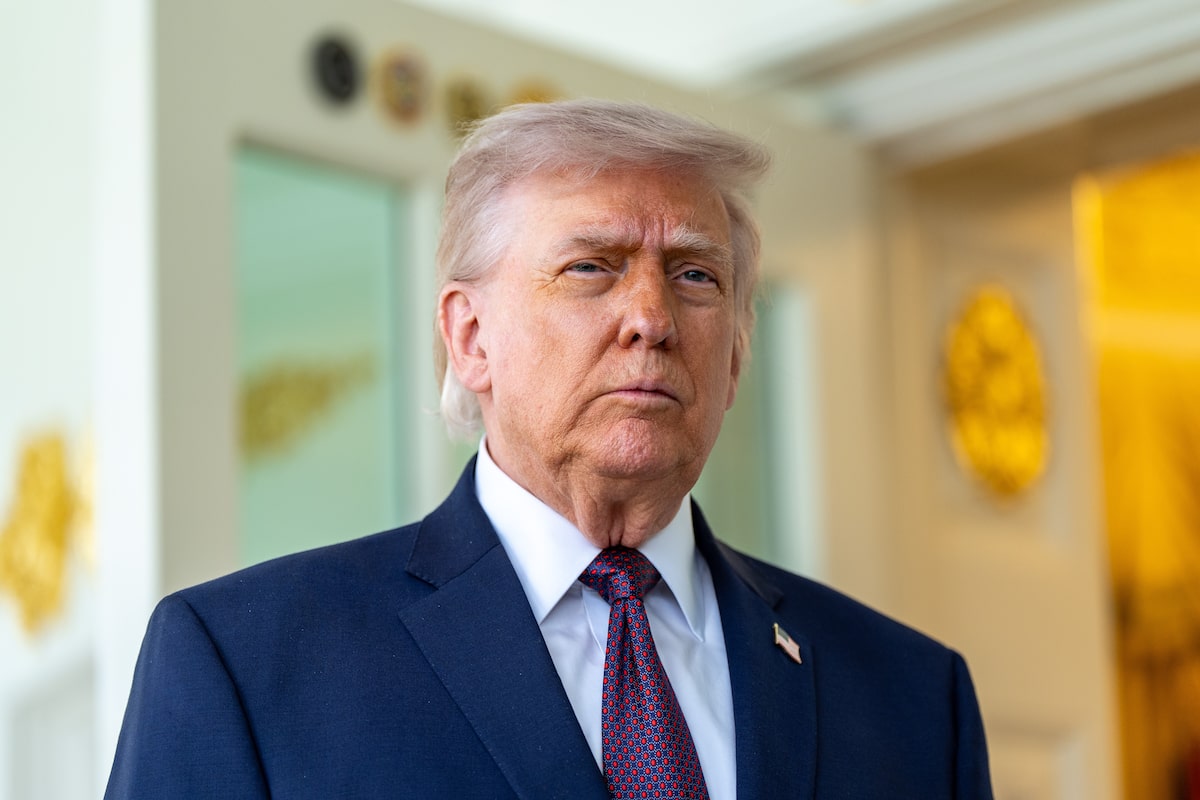
President Donald Trump speaks with reporters outside the Oval Office of the White House on Monday.Alex Brandon/The Associated Press
As best Francis Rooney can recall, the last time a world leader openly sparred with the leader of the Catholic Church, it was Joseph Stalin asking how many military divisions the Pope had at his beck and call.
Nearly a century later, Donald Trump has found new language to taunt the bishop of Rome, calling Pope Leo XIV – the first American to hold that title, and a critic of the U.S. war in Iran – “WEAK on crime” and “terrible for Foreign Policy.”
After posting those remarks on Truth Social, the U.S. President then posted an artificial-intelligence-generated image that depicts him in a beatific pose, light emanating from his hands as he touches the head of a man in a hospital gown.
Mr. Trump, who deleted the image Monday, said he merely saw himself appearing as a doctor. Churchgoers around the world, however, saw a presidential attempt to take on the image of Christ, accusing the White House of blasphemy. Some of his own voters accused him of heresy.
A post on U.S. President Donald Trump’s Truth Social account depicts an AI-generated image of himself apparently as Jesus posted on Sunday.@realDonaldTrump/Reuters
“I think it’s really bad for Trump,” said Mr. Rooney, who served as U.S. ambassador to the Vatican under George W. Bush and has known Leo for many years.
Mr. Trump has “crossed some serious red lines here,” he said. Nearly two-thirds of Americans call themselves Christian and many, even those outside of Catholicism, hold the Pope in high regard. “I think he’s going to find that out,” Mr. Rooney said.
Analysis: Trump opens a new front in his war on everyone: the Vatican
On Monday, the Pope told reporters he had “no fear of the Trump administration,” adding that “speaking out loudly about the message of the Gospel” is “what I believe I am here to do.”
Mr. Trump, too, refused to apologize, once again pointing a finger at the Vatican. “Pope Leo said things that are wrong,” he told reporters.
The U.S. President owes some measure of his political success to Christians. In 2024, some 81 per cent of white evangelicals and six in 10 white Catholics voted for him. In his second term in office, he has blurred lines between church and state. At the memorial service for conservative commentator Charlie Kirk, members of his cabinet delivered church-like homilies. On Easter, a spiritual adviser compared Mr. Trump to “our Lord and Saviour”; days later, Defence Secretary Pete Hegseth likened the rescue of a U.S. airman from Iran to the Christian resurrection story.
Parts of the church remain dedicated to the administration and the military campaigns it has directed.
Paul Van Noy, a pastor at Candlelight Christian Fellowship in Coeur d’Alene, Idaho, called Iranian leadership “thugs” who “need a spanking,” and said the Pope is wrong to decry war in all its forms.
He cited comments from Jesus in the Book of Matthew: ”I have not come to bring peace, but a sword.”
“If we’re saying the gospel is simply the message of ‘Let’s all get along’ – which it isn’t – then I think the Pope is theologically weak,” Mr. Van Noy said.
But he expressed discomfort with Mr. Trump’s willingness to release a messianic image of himself.
“I don’t know what his intention was” in posting the image, Mr. Van Noy said. “But it didn’t make me feel good. I didn’t like it.”
Elsewhere, churchgoers have found themselves losing faith in the President. Caleb Collier, who hosts the podcast Church and State, voted for Mr. Trump in 2024. ”To be honest, I regret that,” Mr. Collier said. He previously served as senior regional manager for the western United States at TPUSA Faith, part of the Turning Point organization that has been a powerful force for Mr. Trump.
A recent convert to Lutheranism, Mr. Collier said he is “not necessarily the biggest fan of the Pope.” But he is also troubled by American attacks on Venezuela and Iran that he calls “just awful.” It is, he said, heartbreaking to see “so many American Christians celebrate the death and destruction that’s occurring out there.”
In that vein, he said, the Pope is giving voice to things that need to be said.
“I’m really tired of so many within the United States on the MAGA side of things not pushing back, not questioning anything that Trump has done or is doing.” The image Mr. Trump posted, he said, is “outright heresy.”
“It blew my mind that he would go that far.”
Scholars, meanwhile, suggested Mr. Trump’s posts indicated deeper issues.
“A messiah complex is a serious mental disorder,” said David Lawton, an emeritus professor at Washington University in St. Louis, Mo., who has studied blasphemy.
The image the President posted “is certainly offensive, and it conforms to the standard definition of blasphemy: an intentionally hurtful form of expression.” He added, “I would think for most viewers of whatever persuasion, not only Catholics, it defaces the image of Christ.”
For Catholics, meanwhile, Mr. Trump’s quarrels with the Pope have prompted reconsideration of old loyalties. Brother André Marie voted for Mr. Trump three times, and said the Pope erred by implying that no war could ever be just. The Catholic Church has maintained a lengthy tradition of a “just war.”
Still, he said, nothing about the attacks on Iran fits the definition of a just war.
“To go into a war literally unprovoked and then to target schools, hospitals, universities, civilian infrastructure – this is simply unethical,” said Brother André, the prior of St. Benedict Center, a traditionalist Catholic monastery in Richmond, N.H.
The Catholic Pope, he said, has a long-standing role in speaking on matters of conscience, one that has placed the church in conflict with American Democrats over abortion. But with American Republicans, “war is the problem,” he said, calling Mr. Trump’s conduct toward the Pope “abhorrent.”
Brother André’s own faith in Mr. Trump has been deeply shaken.
“I’ve realized what he really is, and that is somebody who doesn’t have a remotely Christian ethic when it comes to politics.”