
Discover the cosmos!
Each day a different image or photograph of our fascinating universe is featured, along with a brief explanation written by a professional astronomer.
2026 April 14
Explanation:
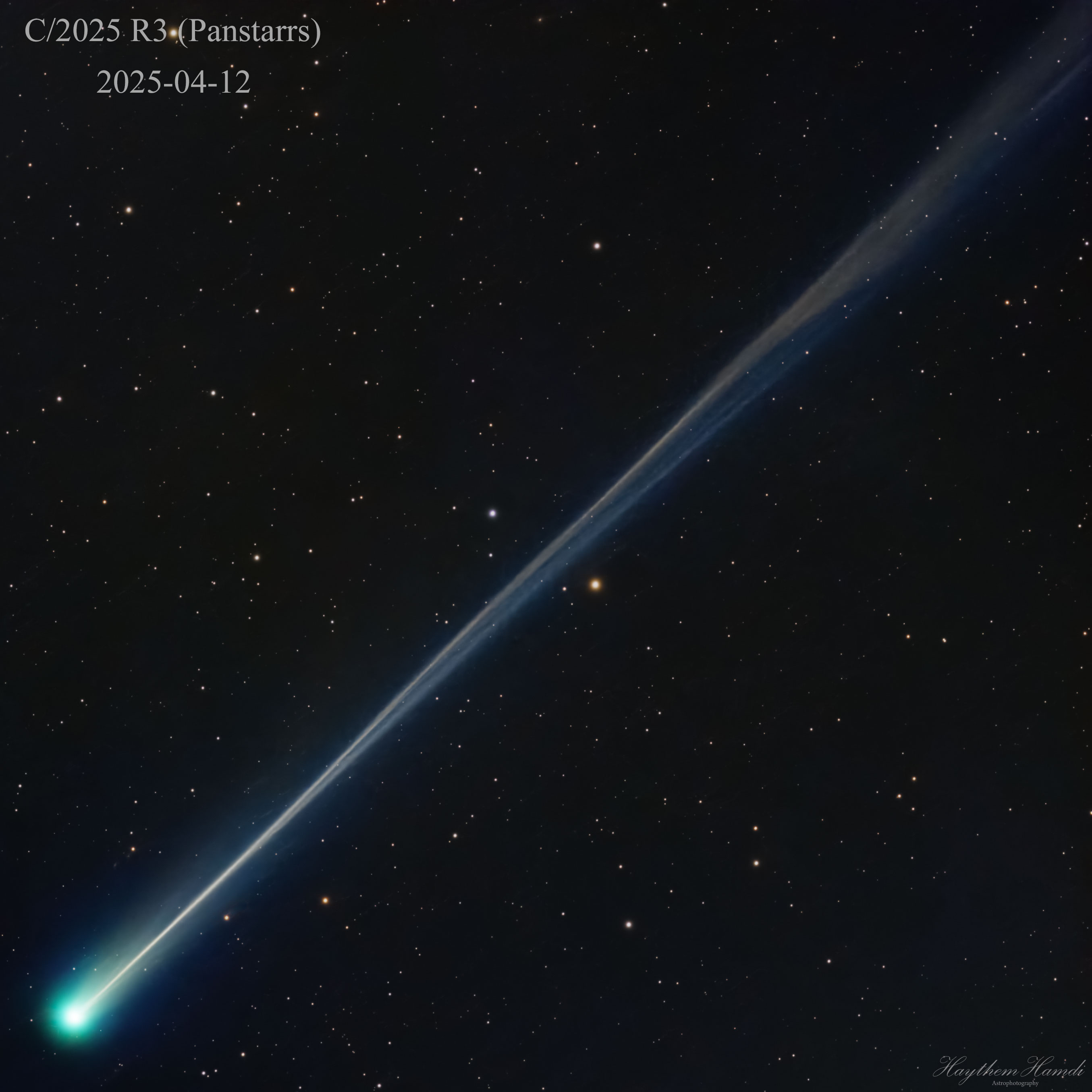
Why does Comet R3 (PanSTARRS) have a wispy tail?
The newest bright member of the inner Solar System,
Comet C/2025 R3 (PanSTARRS) is already extending an
impressive stream of glowing gas.
This tail starts from an unseen
central nucleus of dirty ice that is likely a few kilometers across.
The nucleus is warmed by the Sun and
emits a cloud of neutral gas into a
coma that
glows light green.
Nuclear gas ionized by
energetic sunlight is pushed away from the
Sun by the
solar wind into an ion tail that
glows light blue.
The wispy nature of the
ion tail is caused by the
constantly changing structure of the solar wind.
Pictured from
Rhode Island,
USA two days ago,
Comet R3 (PanSTARRS)
shows off a many-degree ion tail.
Comet R3 (PanSTARRS) is best seen before dawn from
northern skies for another 10 days, after which it
will be best visible from southern skies.